
According to Hyperliquid platform data, the HIP-3 sector’s trading volume over the past 7 days reached approximately $14.39 billion, with open interest around $1.73 billion. Among these, WTI crude oil contracts (CL) are quoted at about $97.87, with a 24-hour increase of approximately 2.13%, open interest around $362 million, and a daily trading volume of about $194 million.
Analysis of HIP-3 Commodity Contract Market Data
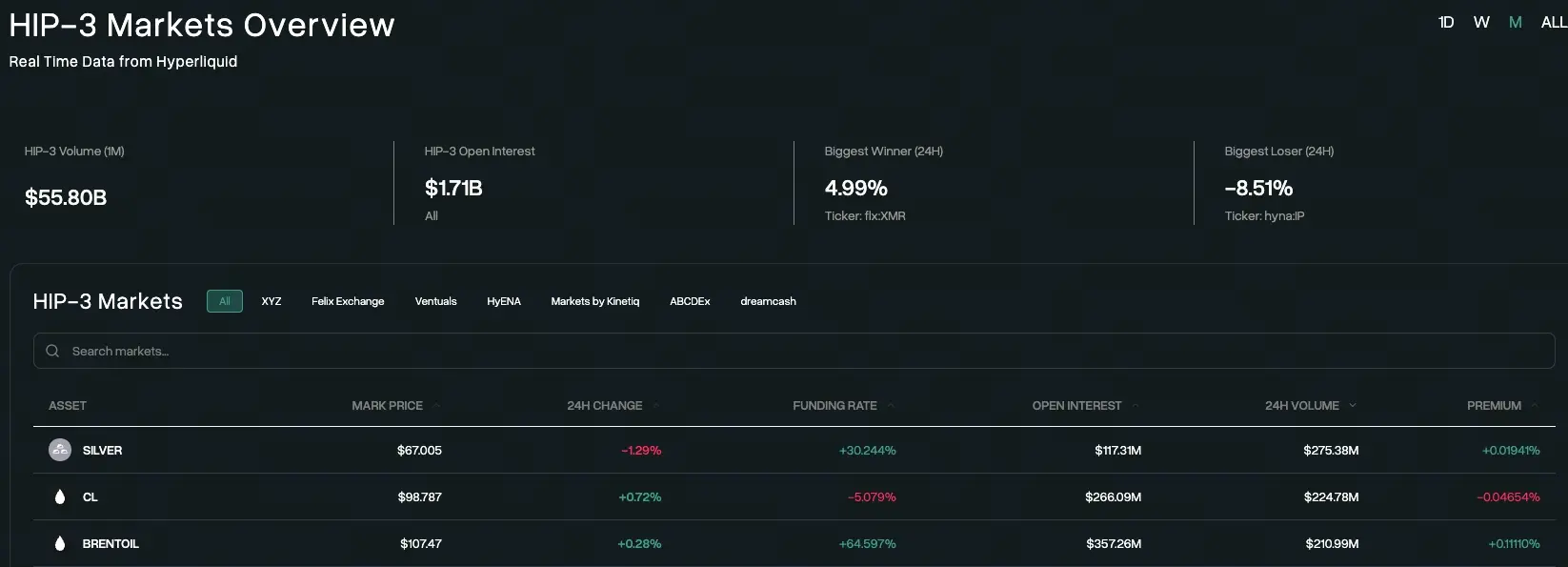
(Source: Hyperliquid)
Hyperliquid’s HIP-3 sector offers perpetual futures trading for commodities and stock index assets, including WTI crude oil, Brent crude oil, silver, and XYZ100 index, with notable activity especially in commodity assets.
Key Contract Overview
WTI Crude Oil (CL): Price at $97.87, 24-hour increase of 2.13%, open interest $362 million, trading volume $194 million, accounting for over 35% of HIP-3 daily trading volume.
Brent Crude Oil: Second in demand within HIP-3, with related open interest reaching $265 million.
Silver and XYZ100 Index: Ranked alongside WTI and Brent in demand, placing in the top four on the platform.
In the past 24 hours, Hyperliquid’s perpetual contracts have totaled $5.4 billion in trading volume, with the HIP-3 sector contributing approximately 21.3% ($1.15 billion), showing higher-than-average activity relative to overall trading scale.
How Hyperliquid is Gaining Global Pricing Influence
Geopolitical events like US-Iran conflicts have directly driven a surge in Hyperliquid’s commodity sector trading volume. Since the platform offers 24/7 trading, macro assets have completed real-time price discovery before the Chicago Mercantile Exchange (CME) opens on Monday, filling liquidity gaps in traditional markets.
Bitwise Chief Investment Officer Matt Hougan pointed out that in the past, major geopolitical events on Sundays meant investors had to wait until after 6 PM Eastern Time to trade; now, they can execute trades instantly via platforms like Hyperliquid. The trend of finance moving onto blockchain is “irreversible.” According to DeFiLlama, as of March 16, Hyperliquid’s monthly trading volume reached $173.42 billion, far surpassing similar platforms. CoinGecko reports that by 2025, decentralized exchanges (DEXs) will see perpetual contract volumes soar to $6.7 trillion, a 346% annual increase, while centralized exchanges (CEXs) open interest has decreased by 20.8%.
Notably, Hyperliquid’s user base is highly concentrated among institutions and whales. Data from Hyperliquid Hub shows total platform trading volume has reached $4.11 trillion, with the top 100 addresses accounting for 81.3%, and the top 200 nearly 98.81%, indicating the platform is mainly driven by institutions, high-frequency traders, and market makers.
Regulatory Strategy: The Role and Challenges of Hyperliquid Policy Center
Recently, CFTC Chair Mike Selig publicly stated that the CFTC is working on a regulatory framework for cryptocurrency perpetual futures, expected to be announced within a month, in collaboration with SEC Chair Paul Atkins to advance the “Project Crypto” initiative, coordinating digital asset regulation reforms.
In response to this regulatory trend, Hyperliquid officially established the Hyperliquid Policy Center in Washington, D.C., in February 2026, appointing veteran crypto lawyer Jake Chervinsky as its first CEO. The foundation also donated 1 million HYPE tokens (about $28 million) to support operations. One of the core missions of the policy center is to develop legal frameworks suitable for decentralized protocols for perpetual contracts.
Hyperliquid co-founder Jeff Yan emphasized that the company aims to build a platform as a neutral, long-term financial infrastructure. However, whether regulatory compliance requirements will impact the on-chain trading pathways that do not require KYC remains a key uncertainty facing the entire Perp DEX sector.
Frequently Asked Questions
What is Hyperliquid HIP-3?
HIP-3 is Hyperliquid’s sector of real-world asset (RWA) perpetual contracts, offering on-chain perpetual futures trading for commodities like WTI crude oil, Brent crude oil, silver, and stock indices, enabling investors to trade traditional financial assets in a decentralized environment.
Why are mainstream media like Bloomberg starting to cite Hyperliquid’s oil contract prices?
Hyperliquid provides 24/7 trading. During weekends when CME and other traditional exchanges are closed, its oil contracts are the only publicly available price sources reflecting market sentiment in real time, making them a direct reference for media outlets like Bloomberg and The Wall Street Journal.
How does CFTC regulation impact Hyperliquid?
The regulatory framework planned by the CFTC for crypto perpetual futures could either boost institutional trust or restrict unlicensed trading. Compliance may attract traditional institutions, but if KYC requirements are enforced, it could undermine the core advantage of Perp DEXs over centralized platforms.
Disclaimer: The information on this page may come from third parties and does not represent the views or opinions of Gate. The content displayed on this page is for reference only and does not constitute any financial, investment, or legal advice. Gate does not guarantee the accuracy or completeness of the information and shall not be liable for any losses arising from the use of this information. Virtual asset investments carry high risks and are subject to significant price volatility. You may lose all of your invested principal. Please fully understand the relevant risks and make prudent decisions based on your own financial situation and risk tolerance. For details, please refer to
Disclaimer.


