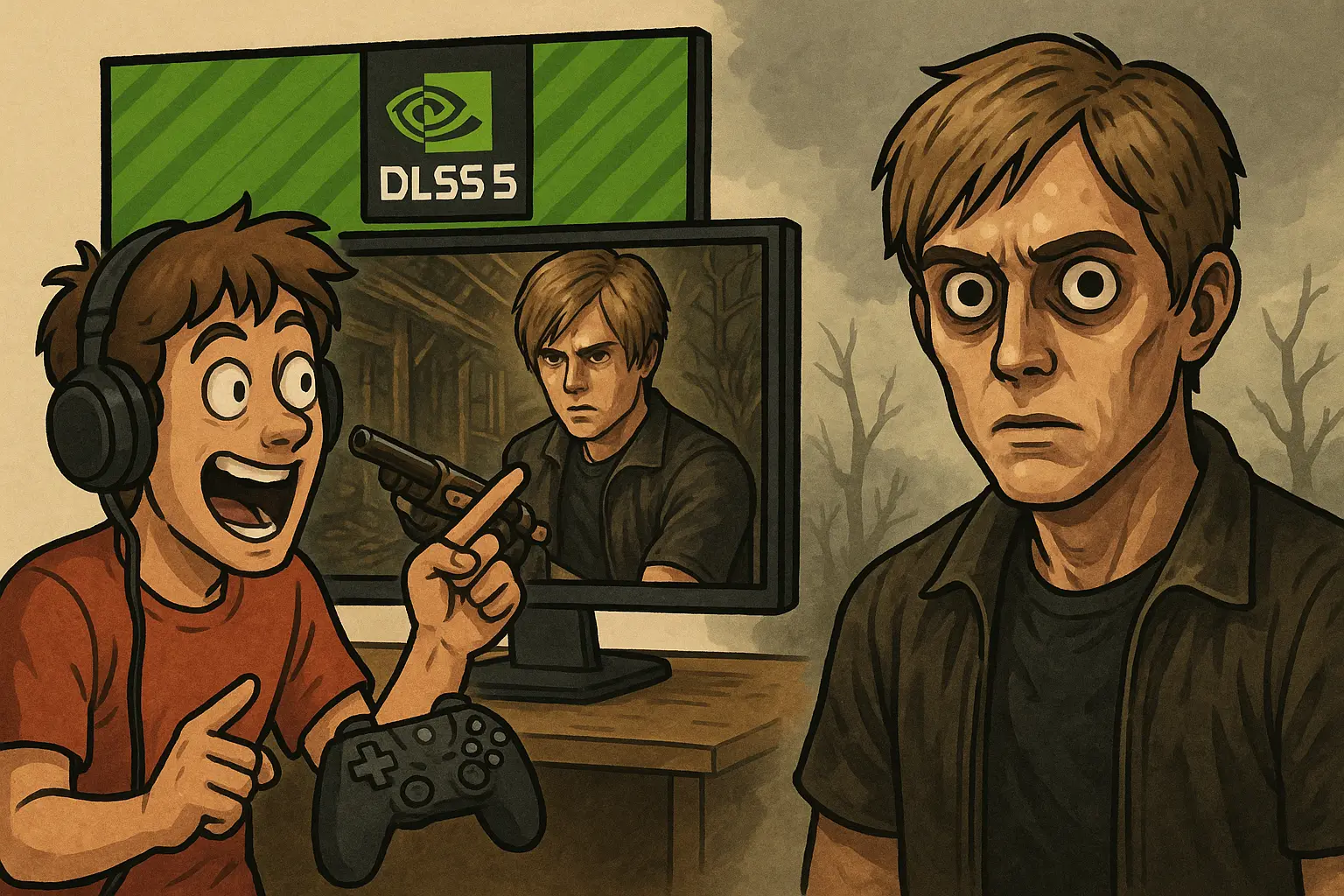
NVIDIA announced DLSS 5 at this week’s GTC 2026 conference. CEO Jensen Huang called it the “GPT moment in graphics,” a breakthrough that reinterprets game visuals through full neural rendering technology, claiming it can achieve “Hollywood-level photorealism.” However, comments on YouTube, Reddit, and gaming forums are filled with criticisms such as “rough AI,” “uncanny valley,” and more.
The Technological Revolution of DLSS 5: From Upscaling to Neural Rendering
Unlike previous generations of DLSS focused on image upscaling (resolution enhancement) or frame generation (frame rate boost), DLSS 5 introduces a complete neural rendering architecture. It works by obtaining the game’s color buffer and motion vectors, then using AI models to reinterpret the entire scene, rather than simply filling in missing pixels.
The results include sub-surface scattering effects on skin, cinematic-quality fabrics, more realistic hair physics, and overall improved lighting and shadows. NVIDIA describes this as “an AI artist re-drawing your game scene in every frame,” rather than traditional image enhancement.
Notably, early demos used dual RTX 5090 graphics cards—one for game rendering, another dedicated to neural network processing. NVIDIA states that single-GPU support will be officially available in Fall 2026. Confirmed supported titles include Assassin’s Creed: Shadow, Starfield, Resident Evil: Village, and The Elder Scrolls IV: Oblivion Remake, with developers able to adjust strength, masking, and color grading to preserve original artistic intent.
Player Reactions: Meme Virality and the Uncanny Valley Boundary
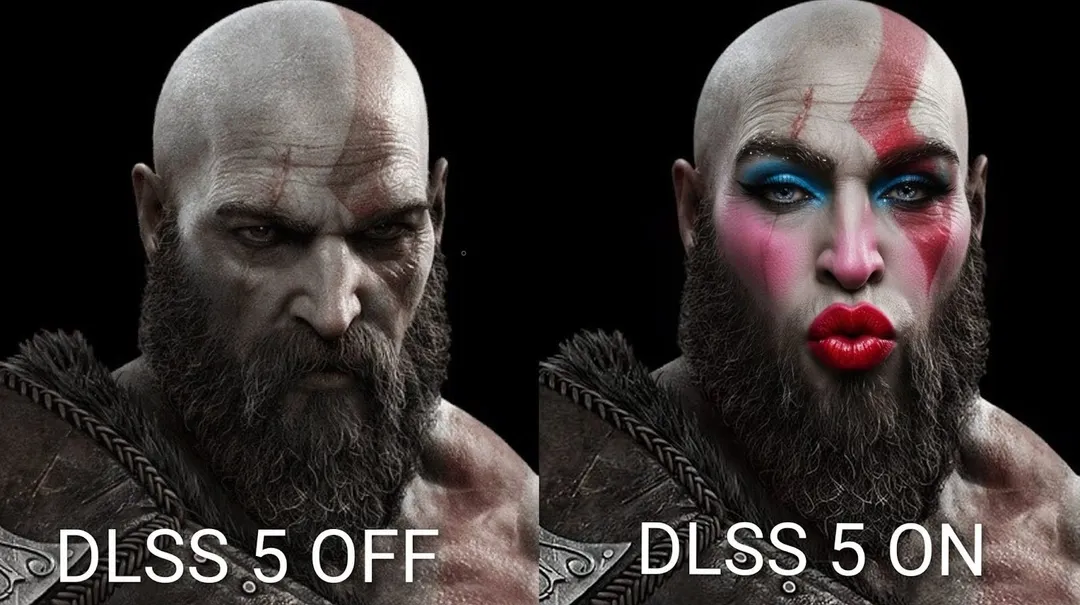 (Source: Santa Monica Studio, Jetpack Interactive)
Tech media and developers generally praised the early DLSS 5 demos—Todd Howard, director of Starfield, said the technology “brings games to life,” and tech reviews highlighted character facial details and environment fidelity as “stunning.”
However, the broader gaming community’s reactions are quite different:
Criticism Focus: Grace Ashcroft from Resident Evil: Village became a focal point, with comparison screenshots described by players as “plastic-like,” “over-processed,” and “strangely exaggerated.”
Meme Wave: The “DLSS 5 off vs. on” meme format went viral—Kratos with full makeup, Patrick Star turning into a surreal nightmare, and even Jensen Huang himself “transformed” in memes.
Core Sentiment: For years, players have been accustomed to DLSS as an “invisible” upgrade—improving performance without altering visual appearance. DLSS 5 breaks this understanding.
Core Controversy: NVIDIA’s Defense and the Fundamental Question of “Who Creates the Visuals”
During the GTC 2026 Q&A, Jensen Huang responded positively to criticism, stating critics are “completely wrong,” emphasizing that DLSS 5 combines “geometry, textures, and all elements in the game” with generative AI, rather than replacing original visuals with AI. NVIDIA’s stance is that developers retain artistic control over the final image, with AI as a tool, not a decision-maker.
However, critics’ deeper concern isn’t performance but a more fundamental issue: when AI processes character faces, it relies on its understanding of photorealism rather than the original artist’s intent. This isn’t just technological iteration—it signifies a shift in visual production authority—from human artists to AI interpretation.
This transition from “performance tool” to “visual taste arbiter” is the true root of meme humor and player dissatisfaction.
Frequently Asked Questions
Q: Will DLSS 5 truly change the original artistic style of games?
A: It depends on implementation. NVIDIA provides tools for developers to adjust the strength of neural rendering, theoretically allowing control over AI intervention. However, comparison screenshots show that in some cases, character faces do differ visibly from the original, especially in skin tone and smoothness. The final artistic fidelity heavily depends on how developers tune these parameters.
Q: What hardware is required to use DLSS 5?
A: The early demo used dual RTX 5090 cards—one for gaming, one for neural processing. NVIDIA plans to release a single-GPU support version in Fall 2026, meaning current DLSS 5 is not yet generally available and requires high-end hardware for full experience.
Q: What are the core differences between DLSS 5 and earlier versions like DLSS 4 or 3?
A: DLSS 1-3 mainly rely on super-resolution upscaling—taking low-res input and enlarging it, with AI filling in missing details. DLSS 4 added multi-frame generation. DLSS 5 introduces “full neural rendering”—no longer just upscaling or frame interpolation, but fundamentally reinterpreting the entire visual language of the scene, more akin to generative AI art than traditional image quality enhancement.
Disclaimer: The information on this page may come from third parties and does not represent the views or opinions of Gate. The content displayed on this page is for reference only and does not constitute any financial, investment, or legal advice. Gate does not guarantee the accuracy or completeness of the information and shall not be liable for any losses arising from the use of this information. Virtual asset investments carry high risks and are subject to significant price volatility. You may lose all of your invested principal. Please fully understand the relevant risks and make prudent decisions based on your own financial situation and risk tolerance. For details, please refer to
Disclaimer.


