What is SafePal?
SafePal is a multi-chain cryptocurrency wallet ecosystem offering both a mobile app and hardware wallet solutions. Its native utility token, SFP, is built on the BEP-20 standard of BNB Chain. SFP serves as the payment and discount token within the ecosystem, enables staking for rewards, and powers community governance through proposal creation and voting. The BEP-20 standard is a widely used token protocol on BNB Chain, ensuring seamless compatibility with decentralized applications (DApps) and tools.
Current Price, Market Cap, and Supply of SafePal (SFP)
As of 2026-01-06, SFP’s latest price is approximately $0.360000. The circulating supply stands at 500,000,000 tokens, with total and maximum supply capped at 500,000,000—indicating a fixed upper limit. The circulating market capitalization is about $180,000,000, while fully diluted market cap (theoretical value if all tokens were in circulation) is also around $180,000,000. Short-term price changes include a 1-hour change of -0.22%, a 24-hour change of 0.75%, a 7-day increase of 14.16%, and a 30-day rise of 7.18%. 24-hour trading volume is approximately $16,165.98 (data as of 2026-01-06).
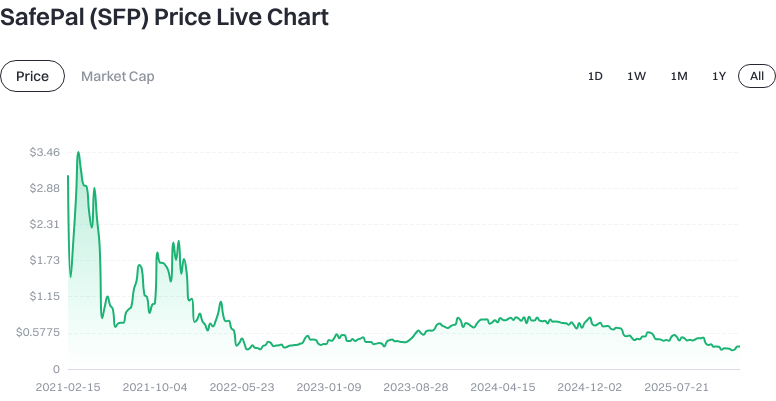
Click to view SFP Latest Price Trends
Market capitalization is calculated by multiplying price by circulating supply and reflects the overall asset scale in the market. Circulating supply refers to the number of tokens currently available for trading.
Who Created SafePal (SFP), and When?
SFP was launched on 2021-02-07 to serve incentives and governance needs within the SafePal wallet ecosystem. The project aims to provide secure and user-friendly crypto asset management tools across mobile apps and hardware wallets, supporting multiple blockchains, tokens, and NFT assets. SFP functions as the ecosystem’s unified value token for fee settlement, discounts, staking rewards, and community governance.
How Does SafePal (SFP) Work?
SFP is issued as a BEP-20 token on BNB Chain. Within the SafePal ecosystem, users can use SFP to pay for products and services at discounted rates. Staking involves locking tokens in designated programs to earn rewards; for example, users can stake SFP in SafePal Earn to receive returns. In terms of governance, holders can submit proposals and vote on matters such as treasury management or new features, influencing the ecosystem’s direction. As a standardized token, SFP is compatible with wallets, applications, and cross-chain tools that support BNB Chain.
What Can You Do With SafePal (SFP)?
Key use cases for SFP include:
- Payments & Discounts: Use SFP to settle fees for wallet products and services, enjoying exclusive discounts.
- Staking Rewards: Participate in staking programs to earn returns or incentive points.
- Governance Voting: Vote on new chain integrations, feature launches, treasury usage, and more.
- Ecosystem Activities & Collectibles: Receive coupons or special collectibles in official or partnered events as a holder.
These utilities tightly integrate SFP with wallet products, forming a closed loop of “usage–incentive–governance”.
Wallets and Extensions in the SafePal (SFP) Ecosystem
The SafePal ecosystem comprises a mobile app wallet, hardware wallet, and extension tools. The mobile app handles daily transfers, on-chain interactions, and asset management; the hardware wallet securely stores private keys offline, minimizing risks from online attacks; extension tools facilitate connectivity with decentralized applications (DApps). Blockchain support includes major networks such as BNB Chain, with compatibility for various tokens and NFT assets—allowing users to manage assets and transactions across different chains from one interface.
Main Risks and Regulatory Considerations for SafePal (SFP)
Price Volatility: Crypto asset prices are highly influenced by market sentiment and liquidity—expect significant short-term fluctuations.
Technical & Smart Contract Risks: Interactions involving cross-chain transfers, smart contracts, or third-party DApps may expose users to vulnerabilities or unauthorized access.
Private Key & Mnemonic Safety: Mnemonic phrases are the only means to recover wallets—never screenshot or sync them online; always write down offline and store securely. Hardware wallets reduce attack vectors but require careful physical protection.
Staking & Liquidity Risk: Staking may involve lock-up periods or variable returns—review program rules and withdrawal terms carefully.
Regulation & Compliance: Crypto regulations vary by region and may affect deposits, trading, or tax reporting; always comply with local laws.
Exchange Usage Risk: Enable two-factor authentication for account security; beware of phishing links and fake apps.
How to Buy and Safely Store SafePal (SFP) on Gate
Step 1: Register at gate.com and complete email or phone verification plus identity checks to improve account security and transaction limits.
Step 2: Deposit or purchase USDT. Use fiat channels to buy USDT or transfer from another wallet to your Gate account—ensure network selection and deposit address match.
Step 3: Search for the “SFP/USDT” trading pair on the trading page; choose limit or market orders, confirm quantity and price, then submit your order.
Step 4: Withdraw SFP to your personal wallet for self-management. As a BEP-20 token on BNB Chain, select BNB Chain as the withdrawal network and make sure the destination address supports it—incorrect network selection can result in asset loss.
Step 5: Secure storage and setup. For mobile app wallets, properly back up mnemonic phrases offline; for hardware wallets, set a secure PIN code. Enable two-factor authentication for both your Gate account and wallet apps to guard against phishing and account theft.
Step 6: Future usage. If participating in staking or governance, use official channels and audited contracts; check lock-up periods, yield changes, and withdrawal rules.
Comparison: SafePal (SFP) vs TrustWallet
Positioning & Hardware Support: SafePal offers both hardware wallets and mobile apps with an emphasis on offline private key security; TrustWallet focuses on mobile app experience with external hardware options.
Token Utility: SFP is used for fees, discounts, staking rewards, and governance within its ecosystem; TWT mainly serves community incentives, governance, and partner benefits. Both are governance and incentive tokens but SFP emphasizes integration with hardware devices and service fee settlement.
Blockchain & Standards: Both adopt standard token protocols in BNB Chain for DApp compatibility; actual cross-chain support depends on each wallet’s integration scope.
User Base & Use Case: Users prioritizing offline security and hardware storage may prefer SafePal; those seeking lightweight mobile solutions may lean toward TrustWallet. The two are complementary—users can combine them based on needs.
Summary of SafePal (SFP)
SFP is a utility token designed for the SafePal wallet ecosystem, connecting users to products and services through fee payments, discounts, staking rewards, and governance voting. Its current market cap and supply structure show a clear maximum supply with standardized issuance. SFP is used for ecosystem payments, staking participation, governance involvement, and event benefits. Beginners buying SFP on Gate should pay close attention to account setup, withdrawal network compatibility, offline backup of mnemonic phrases, and two-factor authentication; review lock-up terms before staking. Overall, using SFP as a “utility and governance token” within the wallet ecosystem can be beneficial—provided risks are understood and compliance is maintained.
FAQ
What are the practical uses of SFP tokens?
SFP is the governance token of the SafePal ecosystem—holders can vote on major platform decisions. It also serves as payment for advanced wallet features, enables participation in liquidity mining for returns, and can be traded on exchanges like Gate. In short, SFP represents both voting rights and utility.
How do I participate in SafePal ecosystem governance with SFP?
SFP holders can vote on proposals via the official SafePal governance platform—voting power is proportional to holdings. After purchasing SFP on Gate, transfer it to a supported wallet address to participate in decisions such as feature updates or fund allocation—empowering community involvement in project development.
What is SFP’s supply? Is there unlimited issuance?
SFP has a fixed maximum supply of 100 million tokens—no risk of unlimited inflation. The project employs a burn mechanism to periodically remove circulating SFP from the market, preserving scarcity. This deflationary model may support long-term value but depends on actual burn execution.
Do I need to worry about theft when holding SFP?
The security of your SFP holdings depends entirely on your storage method. Storing in an official SafePal wallet provides hardware-level protection; centralized exchanges like Gate require two-factor authentication and withdrawal whitelists; self-custody wallets demand diligent private key management. For larger amounts, prioritize storage in SafePal or hardware wallets.
Is SFP tradable on major exchanges?
SFP is listed on Gate, Binance, Coinbase, and other leading exchanges with ample liquidity and diverse trading pairs (such as SFP/USDT and SFP/ETH). Gate offers 24-hour trading and convenient fiat deposit/withdrawal channels—making it beginner-friendly for SFP trading.
- Circulating Supply: Number of coins currently available in the market—used to calculate circulating market cap.
- Fully Diluted Market Cap: Total market capitalization if all coins were in circulation—indicates long-term value potential.
- Market Cap Share: Percentage of this coin’s market cap relative to total crypto market cap—measures its market position.
- 24-Hour Trading Volume: Total value traded over the past 24 hours—reflects liquidity and activity levels.
- Price Change (%): Percentage change in coin price over specific time frames—used to gauge short-term and long-term trends.
SafePal (SFP) Reference & Further Reading