With the rapid advancement of large models and AI agents, data has become a decisive factor in determining model performance. However, current AI training still relies heavily on traditional data labeling platforms. These platforms often depend on low-cost crowdsourced labor, which leads to unstable data quality, unverifiable sources, and increasingly misaligned incentive structures.
Against this backdrop, Perle (PRL) introduces a new approach. By combining blockchain technology with token-based incentives, it brings expert-level human feedback into the process and records data production on-chain, enabling traceability and verifiable quality. Perle is working to build AI data infrastructure for the Web3 era, serving as a bridge between human expertise and machine intelligence.
What Is Perle (PRL)?
As a Web3 AI data training protocol, Perle is designed to provide high-quality, verifiable data for AI models. Its core idea is to convert human expertise and judgment into on-chain data assets, improving both the performance and reliability of AI systems.
Unlike traditional data labeling platforms, Perle prioritizes not just data volume, but also quality and verifiability. By involving professional contributors such as developers, researchers, and domain experts, it supports more complex and higher-value tasks, including reasoning annotation, code review, and RLHF data generation.
To date, Perle has raised $17.5 million in funding, led by Framework Ventures and CoinFund, with participation from HashKey Capital, NGC Ventures, and Foresight Ventures.

Problems Perle Aims to Solve and Key Participants
The current AI data market faces three major challenges: quality, trust, and incentive alignment. Traditional crowdsourcing models struggle to ensure consistency in labeling, while the lack of transparency makes auditing and traceability difficult for enterprises. At the same time, contributors are often underpaid relative to the value of their work, resulting in a shortage of high-quality data supply, especially in specialized fields such as healthcare, finance, and engineering.
To address these issues, Perle establishes a multi-stakeholder collaboration system. AI companies and model developers act as data demanders, defining training needs. Experts and developers produce the data, reviewers ensure quality control, and the protocol itself records contributions and distributes rewards through on-chain mechanisms. This structure gradually shifts data production toward a more professional and market-driven model.
Key Features of Perle
At its core, Perle is built around a quality-first philosophy. By involving experts, it expands data production from simple labeling to complex cognitive tasks, improving both depth and accuracy. All contributions are recorded on-chain, ensuring traceability, a feature largely absent in traditional platforms.
Its incentive model also differs significantly. Instead of paying per task, rewards are distributed based on data quality. This helps reduce low-quality output while improving the overall reliability of datasets. In addition, its support for RLHF aligns closely with the real needs of modern large model training.
Perle’s Core Architecture and Operating Mechanism
Structurally, Perle can be understood as a multi-layered data production network. The expert layer provides high-quality annotations and feedback, the data layer handles multimodal information, and the verification layer ensures authenticity and integrity through on-chain mechanisms. At the top sits the incentive system, centered around the PRL token, which distributes economic rewards.
In practice, users first complete identity and skill verification before participating in tasks. Once a task is completed, the data goes through a review process and is then recorded on-chain. Based on data quality and level of contribution, participants receive PRL rewards. This creates a closed-loop system for data production.
PRL Token Design and Use Cases
PRL serves as the core medium of the Perle ecosystem. Its function extends beyond incentives to include value transfer. On the supply side, PRL rewards data contributors and reviewers. On the demand side, AI companies use PRL to access high-quality data services, creating real utility.
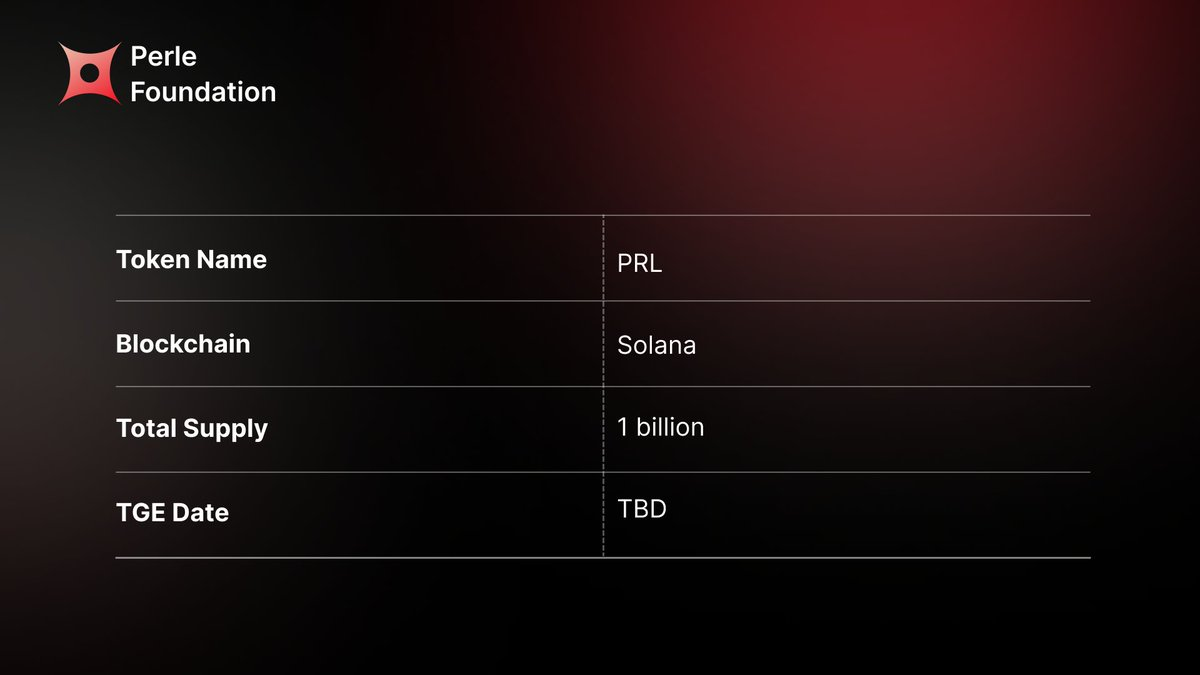
In addition, PRL may be integrated with a reputation system, allowing high-quality contributors to gain access to more tasks and higher earnings. As the ecosystem evolves, PRL could also play a role in governance, such as participating in parameter adjustments or resource allocation decisions. Overall, its design aims to directly map data value to economic value.
Perle vs Scale AI: Web2 vs Web3 Data Labeling Models
Traditional platforms, such as Scale AI, operate under a centralized model and rely on large-scale crowdsourced labor. While this approach offers advantages in scalability, it often comes at the cost of data quality and transparency.
In contrast, Perle emphasizes trust and auditability through a decentralized network of experts and on-chain verification. In terms of incentives, traditional platforms typically offer fixed compensation, whereas Perle introduces token rewards and reputation systems that more closely align contributor earnings with data value.
Fundamentally, the difference lies in their structure: the former is a platform-controlled production system, while the latter aims to build an open data marketplace.
Perle’s Competitive Advantages
Perle’s primary advantage lies in data quality. By incorporating expert contributors, it can support more complex AI training tasks, which is particularly valuable in high-risk domains. Its on-chain verification mechanism further enhances data trustworthiness, providing enterprises with auditable data sources.
At the same time, its token-based incentive system increases market transparency, reduces intermediary costs, and opens participation to a global pool of contributors. In theory, this model has strong network effects, and once supply and demand reinforce each other, the platform’s value can grow continuously.
Limitations and Risks of Perle
Despite its promise, Perle faces several challenges. High-quality data depends on expert contributors, who are inherently scarce, potentially limiting scalability. Additionally, expert-generated data is more expensive than traditional crowdsourced data, which may discourage adoption by some companies.
The Web3 model also introduces higher barriers to entry, and traditional AI companies may face migration costs. Finally, whether the token economy can maintain a long-term balance between incentives and demand remains uncertain and will require time to validate.
Conclusion
Perle (PRL) represents a new paradigm in AI data production. By using Web3 technology to transform human expertise into verifiable data assets, it improves both data quality and transparency while introducing new mechanisms for value distribution.
Although still in its early stages, as demand for high-quality AI data continues to grow, protocols like Perle have the potential to become a key part of future AI infrastructure, driving the shift from scale-driven to quality-driven data markets.
FAQs
What is the core function of the PRL token?
It is used to incentivize data contributions, pay for data services, and support the overall ecosystem.
What is the key difference between Perle and traditional data labeling platforms?
Perle emphasizes expert participation and on-chain verification, while traditional platforms rely on crowdsourcing and centralized management.
What use cases is Perle best suited for?
It is particularly well-suited for complex AI training tasks that require high-quality data.
What is Perle's long-term value driver?
Its ability to match growing AI data demand with a reliable supply of high-quality data.







