Users are drawn to Flow because its architecture stands apart from most traditional public blockchains. Flow doesn’t require every node to perform identical tasks; rather, it distributes transaction processing across specialized node types. Flow also leverages the Cadence language and a resource-based model to manage assets, allowing NFTs, in-game items, and digital collectibles to be stored and transferred with enhanced security.
Key topics include transaction submission, node specialization, account resource management, smart contract execution, and final confirmation—components that together define Flow’s operational workflow.
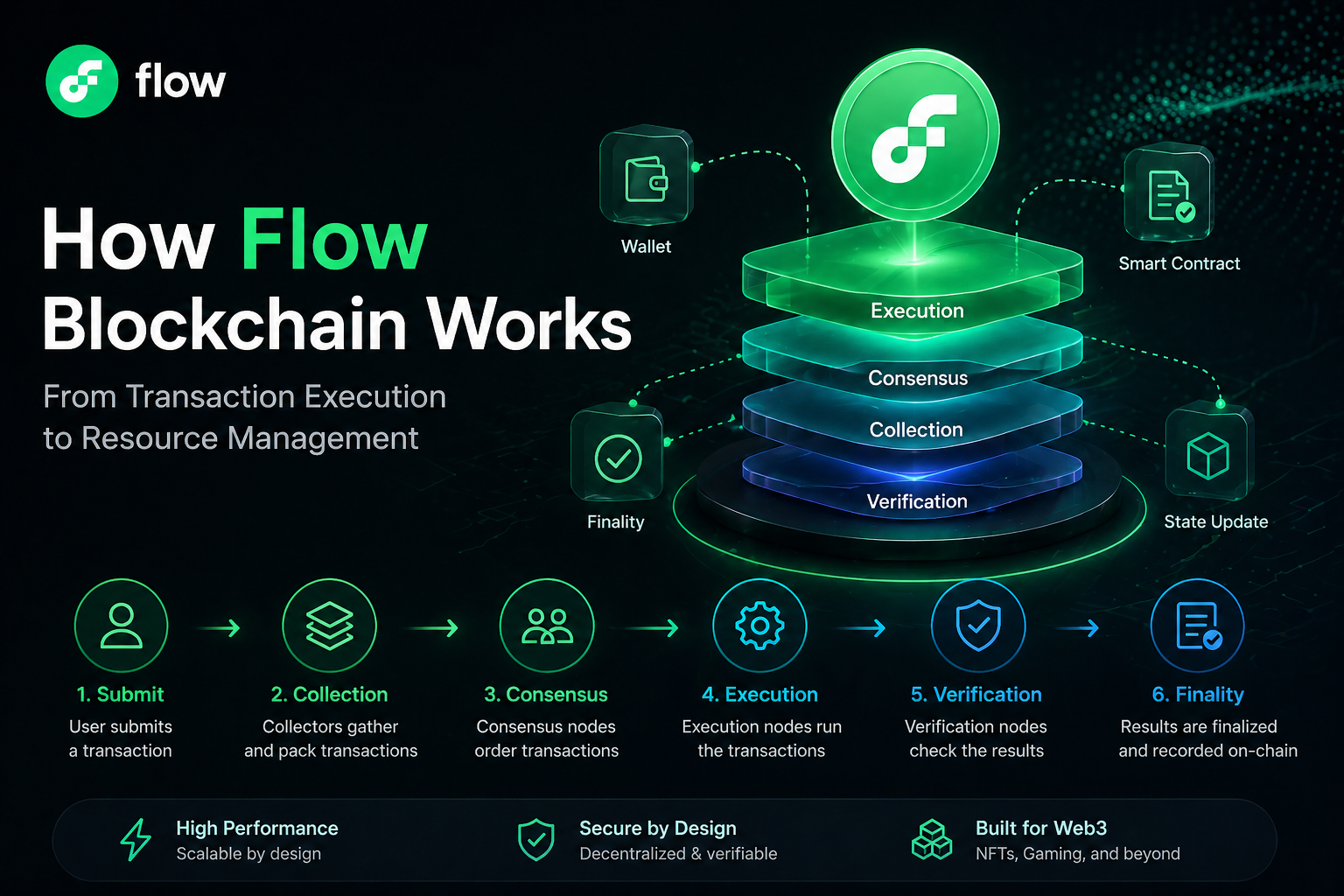
Flow’s Operational Process at a Glance
Flow operates as a transaction processing system with clearly defined roles, breaking down the path from transaction submission to confirmation into distinct stages.
In the Flow network, users initiate transactions via wallets or applications. These transactions are then processed by collection nodes. Consensus nodes establish transaction order and form blocks, execution nodes carry out computational logic, and verification nodes audit execution results. The transaction’s final state is then confirmed and committed to the blockchain. Official Flow documentation underscores that each node has a dedicated role, rather than all nodes redundantly performing the same task.
| Process Stage |
Primary Participant |
System Activity |
| Transaction Submission |
User & Wallet |
Transaction sent to the Flow network |
| Transaction Collection |
Collection Node |
Transactions batched and organized |
| Ordering & Confirmation |
Consensus Node |
Transaction order set, blocks formed |
| Computation Execution |
Execution Node |
Transaction logic executed, states updated |
| Result Verification |
Verification Node |
Execution results validated |
| State Recording |
Entire Network |
Transaction results written on-chain |
This division of labor reduces strain on individual nodes, enabling the network to handle more sophisticated application interactions. For NFTs, gaming, and digital asset use cases, this structure supports high-frequency user engagement.
How Flow Executes Transactions
Transaction execution on Flow follows a multi-step pipeline: after a user submits a transaction, the network sequentially verifies, orders, executes, and updates state.
From the user’s perspective, transactions originate from wallet signatures or in-app interactions—for example, purchasing an NFT, transferring assets, or invoking a smart contract. Each submission generates a transaction ID for lifecycle tracking. According to Flow’s developer documentation, transactions are submitted via the Access Node API and progress through their lifecycle to finalization.
From the system side, transactions aren’t immediately finalized. The network first validates the transaction’s format and signature, then processes it through collection and ordering stages, followed by execution nodes running the smart contract logic. Upon completion, the system generates state changes—such as account balance updates, NFT ownership transfers, or contract event logs.
Importantly, transaction execution is a sequential, multi-step process. Each stage fulfills a specific function, ensuring correct handling and preventing erroneous states from being committed on-chain.
This enables transparent transaction tracking for users and a predictable execution environment for developers.
Node Specialization in Flow’s Transaction Processing
Node specialization is central to Flow’s architecture, dividing transaction processing among collection, consensus, execution, and verification nodes.
Collection nodes receive and organize transaction data, increasing network throughput. Consensus nodes set transaction order and group them into blocks. Execution nodes perform computations—running smart contracts and updating state—while verification nodes validate execution results to ensure correctness. Flow’s official documentation details that consensus nodes order transactions and submit execution results for verification, with execution nodes responsible for processing transactions and recording state changes.
This approach contrasts with many legacy blockchains, where nodes often replicate the same work for consensus. By specializing node roles, Flow allows each node type to focus on its area of responsibility.
This design boosts throughput and efficiency but demands strong coordination between node types. Successful transaction processing depends on seamless collaboration across collection, consensus, execution, and verification stages.
This mechanism enables Flow to increase throughput without sharding, preserving both on-chain execution and verification.
Account and Resource Management on Flow
Flow’s account model is defined by resource-oriented asset management, preventing arbitrary duplication or accidental destruction of assets.
Accounts in Flow can store not only addresses and balances but also resource objects—special data structures representing NFTs, tokens, or other digital assets. Resources cannot be copied or lost without explicit actions, making them ideal for unique on-chain assets.
Resources are stored at designated paths within accounts, with access controlled by permissions. Developers must define resource creation, transfer, borrowing, and destruction explicitly in Cadence contracts. These strict rules reduce risks of asset anomalies due to code errors.
This model benefits both users and developers: users enjoy clear ownership of NFTs and digital assets, while developers are required to implement robust asset handling logic.
As a result, Flow’s resource model is not just a feature of Cadence—it forms the backbone of its digital asset security.
How Smart Contracts Operate on Flow
Flow smart contracts are written in Cadence and focus on resources, accounts, and transaction scripts.
Cadence is a resource-oriented smart contract language optimized for NFTs, digital assets, and complex logic. When a transaction is initiated, it triggers contract code that updates account states according to predefined rules. For NFT transfers, the contract verifies resource existence, user permissions, and the recipient’s ability to store the resource.
Structurally, Flow contracts define resources, interfaces, storage paths, and transaction logic—specifying asset properties, access mechanisms, storage locations, and user-driven operations.
Smart contract execution impacts both computation and asset states. Transferring an NFT, for example, actually moves a resource between account storage areas—not just a database entry.
This makes Flow’s smart contracts particularly well-suited for applications that require clear ownership and secure asset transfers, such as NFTs.
Confirmation and Recording of Transaction Results
Flow confirms transaction results through execution, validation, and on-chain state updates.
After execution nodes process a transaction, the system outputs results—including state changes, events, and proofs. Verification nodes audit these results, and only transactions that pass validation are committed as final.
Flow’s documentation highlights transaction lifecycle and finality: after submission, a transaction transitions through multiple states before reaching irreversible confirmation. Rapid finality is achieved through both soft and hard confirmation stages.
For users, confirmation means the network has accepted the transaction, and asset changes or contract events are viewable. For developers, confirmation triggers follow-up logic—UI updates, reward distribution, or subsequent processes.
This ensures that Flow prioritizes not just transaction submission, but also correct execution and reliable recording. The finality mechanism underpins secure asset transfers and application state management.
Summary
Flow’s operation centers on transaction submission, node specialization, smart contract execution, resource management, and result confirmation. Its multi-role architecture boosts processing efficiency, while the Cadence resource model strengthens digital asset security. For NFTs, games, and digital asset applications, Flow’s design enables complex interactions, robust asset ownership, and high-frequency on-chain activity.
FAQ
How does Flow process transactions?
Flow transactions are submitted by users and move through collection, ordering, execution, verification, and recording stages. Specialized nodes handle each stage, ensuring orderly and efficient processing.
Why does Flow specialize node roles?
Specialization increases network efficiency. Collection, consensus, execution, and verification nodes each have distinct responsibilities, preventing redundant computation.
What distinguishes the Flow account model?
Flow accounts store resource objects, typically representing NFTs and digital assets. Resources cannot be freely copied or lost, making them ideal for unique on-chain asset management.
How do Cadence smart contracts work?
Cadence contracts govern on-chain operations through resource definitions, account storage, and transaction logic. After a transaction is initiated, the contract enforces rules for asset transfers and state updates.
How are Flow transaction results confirmed?
Execution generates results that verification nodes audit. Once validated, the transaction state is recorded on-chain, enabling users and applications to act on the final outcome.