Gate Layer Accelerates Web3 Infrastructure with High Performance and Low Costs

Beginner
Quick Reads
Last Updated 2026-03-28 11:36:14
Reading Time: 1m
Gate Layer processes up to 5,700 transactions per second with a 1-second block time. It features low transaction fees and supports cross-chain asset integration.

Web3 Infrastructure Enters a New Era

With Web3 technology moving into mainstream adoption, network performance and transaction costs have become critical factors driving industry growth. To address these market needs, Gate has introduced Gate Layer, a new foundational solution. By deploying Layer 2 scaling technology and upgrading the GT token economic model, Gate Layer delivers a stable, secure, and cost-efficient Web3 infrastructure, making it easier for developers and users to participate in decentralized ecosystems.

Technical Core

Gate Layer is built on the OP Stack architecture, using Gate Chain as its settlement layer. It offers full EVM compatibility, allowing Ethereum ecosystem developers to seamlessly migrate their existing DApps. This approach shortens development cycles and lowers deployment barriers. Gate Layer offers the following key features:

  • Comprehensive EVM tool support: Compatible with major development environments like MetaMask, Remix, and Hardhat;
  • Dual-layer security architecture: Integrates Gate Chain’s consensus mechanism and GT staking to reinforce network stability and defense;
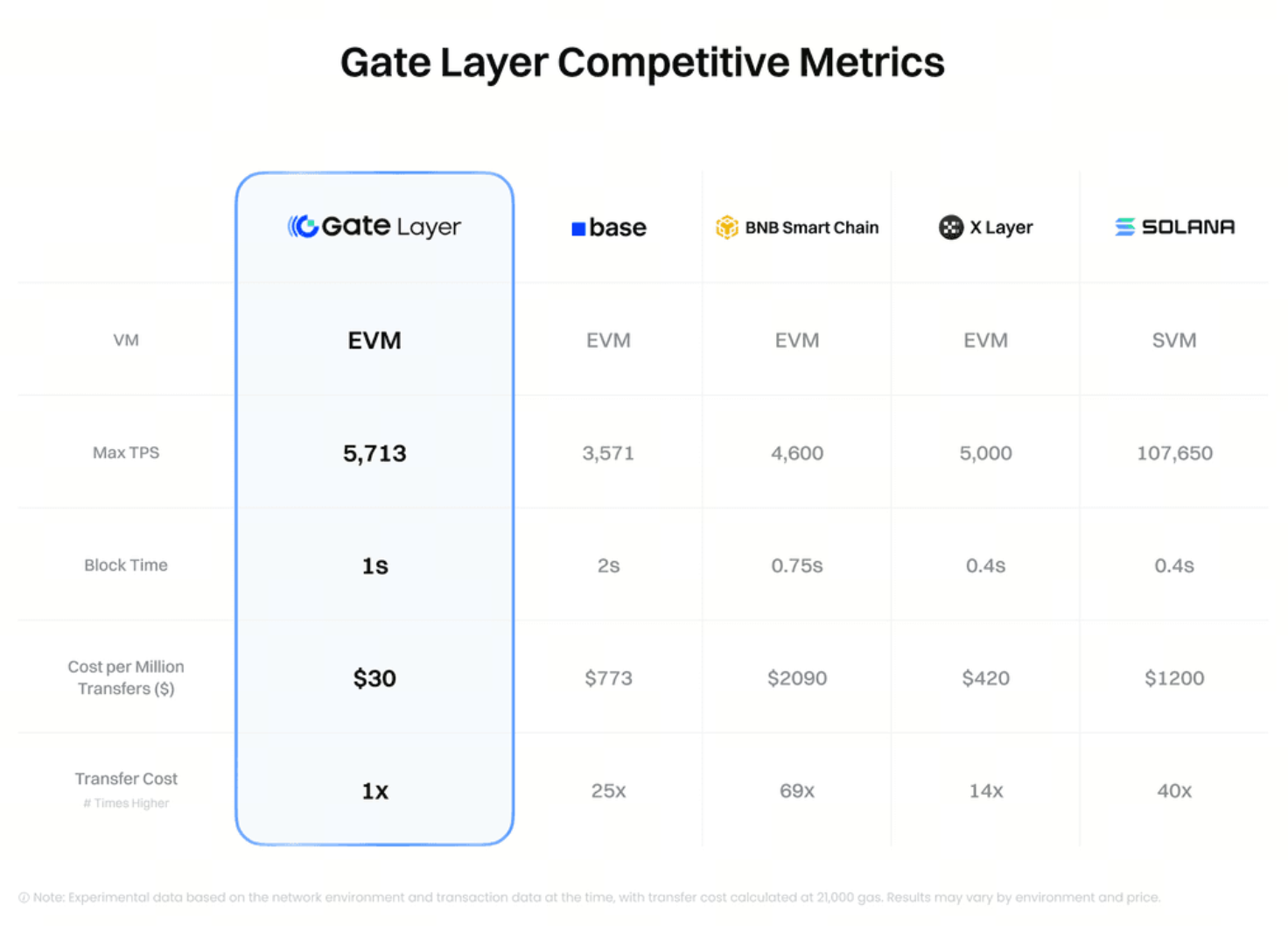
  • High-speed processing: Supports up to 5,700 transactions per second with one-second block times;
  • Ultra-low transaction fees: Gas costs are much lower than leading Layer 2 solutions;
  • Cross-chain asset integration: Supports the LayerZero protocol for seamless interoperability across Ethereum, BNB Smart Chain (BSC), Polygon, and other chains.

Cost Efficiency

Processing one million transactions on Gate Layer costs about $30, compared to $700 on Base, $2,000 on BSC, and $1,000 on Solana. This dramatic cost difference makes Gate Layer a highly cost-effective option, easing financial pressure for developers and enabling more viable deployments for DeFi, GameFi, RWA, and other use cases.
Ecosystem Development

Gate Layer is not just a technical upgrade — it also serves as an incubation platform for the Web3 ecosystem. Gate will continue to roll out diverse applications to expand and interconnect the ecosystem:

  • Perp DEX: A decentralized perpetual contract trading platform offering high liquidity and low slippage;
  • Gate Fun: A no-code token issuance tool enabling creators and projects to launch new tokens effortlessly;
  • Meme Go: A cross-chain meme coin aggregator platform for tracking market trends and liquid assets.

These releases position Gate Layer as both a public blockchain and a central hub for Web3 innovation and user engagement.

Ecosystem Core Drivers

With the launch of Gate Layer, GT (GateToken) has been fully upgraded, evolving from an exchange token to the central energy source of the entire ecosystem. Key highlights include:

  1. Gas token role: All on-chain actions—including smart contracts, NFTs, and cross-chain transactions—are paid in GT;
  2. Dual deflationary mechanism:
  • Regular burn: Over 60% of total supply has been burned as of Q2 2025;
  • EIP-1559 model: Each transaction’s base fee is burned automatically, increasing GT’s scarcity and long-term value.

This model enhances the token’s utility and establishes its status as the ecosystem’s foundation.

Gate Chain Technical Upgrades

To fully support Gate Layer’s operations, Gate Chain has been upgraded to consensus version v1.20, introducing several technical improvements:

  • Supports EIP-4844 blob transactions for significantly improved data transmission efficiency;
  • Upgraded to EVM Cancun version to stay synchronized with Ethereum’s technological advancements;
  • Enhanced protocol compatibility: Supports standards including EIP-2565 and EIP-2929;
  • Optimized RPC interface performance for a smoother, more stable developer experience.

Conclusion

The launch of Gate Layer marks Gate’s entry into a new era of Web3 infrastructure. With high-speed transactions, competitive costs, and deep integration with GT tokenomics, Gate is building a sustainable, scalable, developer-focused open ecosystem. Gate Layer will serve as the technical foundation for on-chain applications and become a driving force for mass Web3 adoption. This will bring decentralized technology to the mainstream.

Author: Allen
Disclaimer
* The information is not intended to be and does not constitute financial advice or any other recommendation of any sort offered or endorsed by Gate.
* This article may not be reproduced, transmitted or copied without referencing Gate. Contravention is an infringement of Copyright Act and may be subject to legal action.

Related Articles

AI-Native Settlement Layers: How United Stables Is Building the Next Financial Rail
Beginner

AI-Native Settlement Layers: How United Stables Is Building the Next Financial Rail

Stablecoins were originally designed as dollar substitutes within exchanges, primarily used for asset pricing and trade settlement. As on-chain financial ecosystems have matured, their role has expanded beyond simple payments to include collateral assets, cross-chain liquidity mediums, and unified settlement units. In particular, as AI systems and automated agents begin to participate directly in economic activity, demand has risen sharply for programmable value units capable of instant settlement. This shift is pushing stablecoins toward the role of foundational financial infrastructure.
2026-03-25 03:16:17
DePIN Identity Network and Real World Applications: How Humanity Protocol Brings on-chain Identity Into the Physical World
Beginner

DePIN Identity Network and Real World Applications: How Humanity Protocol Brings on-chain Identity Into the Physical World

Most Web3 identity systems remain confined to on-chain environments and struggle to achieve meaningful adoption in real world settings. Through a DePIN architecture and physical verification hardware, Humanity Protocol aims to bring decentralized identity into access control systems, hospitality, public services, and offline events, allowing on-chain identity to function not just as a digital credential, but as foundational infrastructure for real world access.
2026-03-25 07:40:53
Gold Price Forecast for the Next Five Years: 2026–2030 Trend Outlook and Investment Implications, Could It Reach $6,000?
Beginner

Gold Price Forecast for the Next Five Years: 2026–2030 Trend Outlook and Investment Implications, Could It Reach $6,000?

Analyze current gold price trends alongside authoritative five-year forecasts, integrating an evaluation of market risks and opportunities. This gives investors insight into the potential trajectory of gold prices and the main drivers expected to shape the market over the next five years.
2026-03-25 18:13:30
Aster vs Hyperliquid: Which Perp DEX Will Prevail?
Beginner

Aster vs Hyperliquid: Which Perp DEX Will Prevail?

Aster and Hyperliquid are the two representative protocols of the "purpose-built L1 path" within the current decentralized perpetual exchange (Perp DEX) sector. As a pioneer in the field, Hyperliquid has built a deep liquidity moat through its highly mature order book architecture and strong community consensus. Conversely, Aster, as a rising challenger, seeks to leapfrog the competition in high-performance trading through more aggressive multi-chain aggregation logic, private transaction modules, and an underlying execution environment optimized for 2026 market demands.
2026-03-24 11:58:33
Aerodrome Tokenomics: How ve(3,3) Powers Base's Most Profitable DEX
Beginner

Aerodrome Tokenomics: How ve(3,3) Powers Base's Most Profitable DEX

AERO is the native token of Aerodrome Finance, a core decentralized exchange and liquidity protocol in the Base ecosystem. It is primarily used for liquidity incentives and ecosystem operations. veAERO is a governance NFT that users receive by locking AERO, representing both voting power and the right to share protocol revenue. Through a dual track structure of AERO as a utility token and veAERO as a governance credential, Aerodrome separates liquidity usage value from long term governance power, allowing participants to act as liquidity providers, governance decision makers, and revenue sharers within the same system.
2026-03-25 06:40:31
The ve(3,3) Flywheel Explained: How AERO Tokenomics Powers Aerodrome’s DeFi Economy
Beginner

The ve(3,3) Flywheel Explained: How AERO Tokenomics Powers Aerodrome’s DeFi Economy

In the competition for DeFi liquidity, high-inflation mining alone is no longer enough to build lasting advantages. Aerodrome applies the ve(3,3) economic model to redesign token emissions, voting mechanisms, and revenue distribution, creating a liquidity flywheel centered on governance and cash flow. This article examines AERO tokenomics, the veAERO locking mechanism, and protocol revenue models to explain how Aerodrome builds a sustainable DeFi economic system.
2026-03-25 06:41:58





