In traditional DeFi lending protocols, capital typically circulates around crypto-native assets. Users deposit assets like ETH or stablecoins as collateral and borrow other digital assets. While efficient, this model is largely limited to on-chain assets and struggles to support real-world financial instruments, such as invoices, loan receivables, or credit obligations.
As real-world assets (RWA) enter DeFi, a more advanced mechanism is required, one that can convert off-chain assets into financeable on-chain instruments while establishing clear return distribution models. Because real-world assets often involve varying maturities, risk profiles, and yield structures, simple collateralized lending models are insufficient. In this context, asset pool mechanisms have emerged as a key framework for connecting real-world assets with on-chain capital.
What Role Does Tinlake Play in the Centrifuge Ecosystem?
As the core financing module within the Centrifuge ecosystem, Tinlake is designed to organize real-world assets into structured on-chain pools that can be financed by DeFi investors. Through this system, off-chain assets gain access to blockchain-based funding, while investors receive returns tied to real economic activity.
Tinlake’s significance lies not only in enabling financing for asset originators, but also in introducing risk segmentation and structured return distribution for on-chain capital. Through a standardized asset pool architecture, Tinlake allows a wide range of real-world assets to enter DeFi markets, making it a critical infrastructure layer connecting RWA with blockchain liquidity.
What Is the Tinlake Asset Pool Mechanism?
Tinlake is an on-chain asset pooling system that aggregates real-world assets into structured financing pools, with smart contracts managing capital inflows, loan issuance, and return distribution.
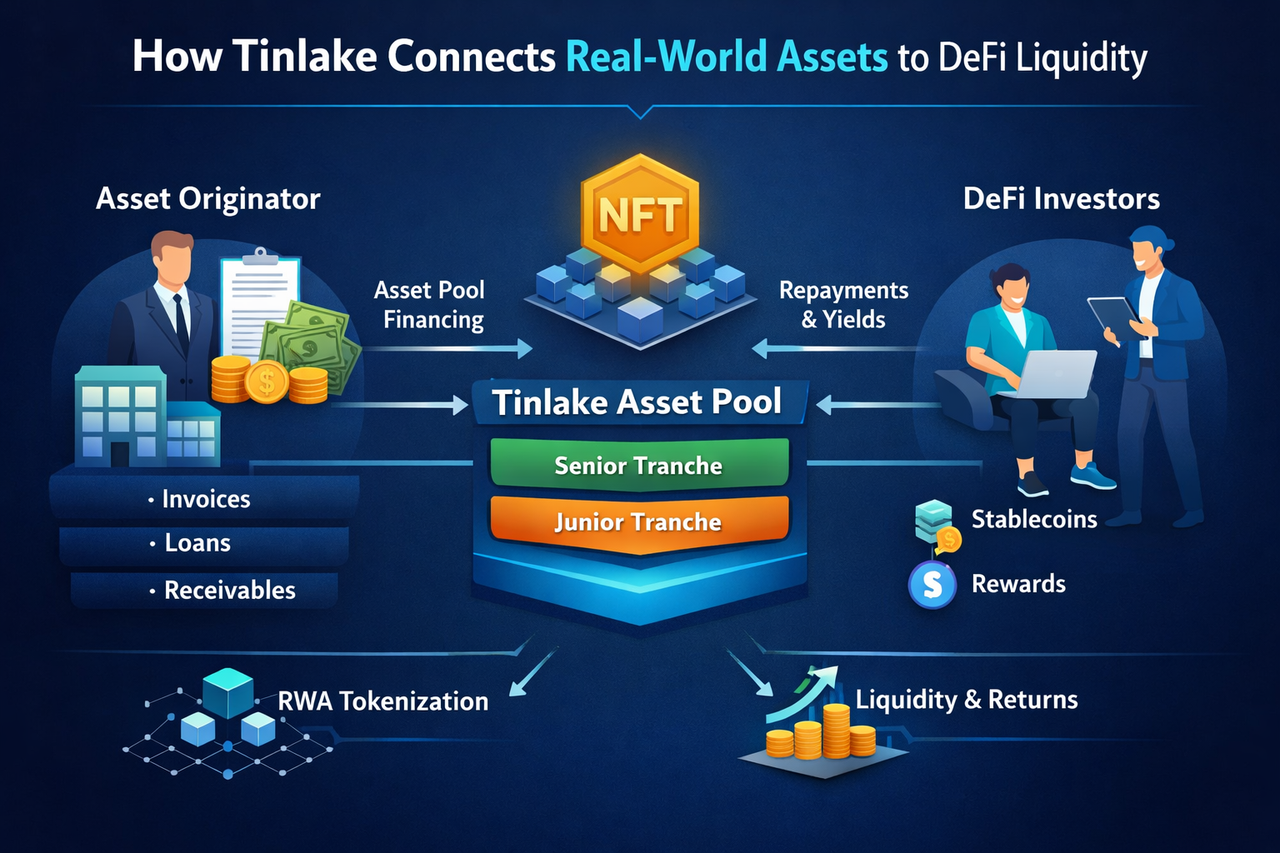
Asset originators begin by submitting real-world debt-based assets such as invoices, commercial loans, or receivables. These assets are tokenized into on-chain representations and placed into dedicated financing pools. Investors can then supply stablecoins to these pools, effectively funding the underlying assets.
Once financing is issued, originators repay principal and interest according to agreed terms. The protocol then distributes repayments to investors proportionally. The entire lifecycle is automated through smart contracts, improving efficiency while reducing reliance on intermediaries.
How Do Asset Originators Create Pools on Tinlake?
Asset originators, typically businesses or financial service providers, create dedicated financing pools using their real-world assets as the foundation.
To establish a pool, originators submit detailed asset information, including asset type, valuation, and funding requirements. After verification, these assets are tokenized and added to the pool. The pool is then opened to investors, who can provide capital in exchange for exposure to the underlying assets.
This process enables asset holders to convert relatively illiquid assets into financeable instruments, allowing them to access liquidity without relying on traditional financial intermediaries.
How Do Investors Provide Liquidity Through Tinlake?
Investors participate by depositing stablecoins into Tinlake asset pools, thereby providing funding for real-world assets.
Once funds are deposited, they are allocated to meet the financing needs of asset originators. In return, investors earn yield based on the performance of the underlying assets, typically derived from interest payments made by borrowers.
This structure allows DeFi investors to diversify beyond crypto-native yields and gain exposure to income streams rooted in real economic activity, expanding the scope of on-chain investment opportunities.
How Does Tinlake’s Tranche Structure Reduce Risk?
One of Tinlake’s defining features is its tranche-based capital structure, which divides investment positions into different risk layers to accommodate varying risk preferences.
Typically, pools are split into senior and junior tranches. Senior tranche investors have priority in repayment, facing lower risk but receiving lower returns. Junior tranche investors absorb higher risk but are compensated with higher potential yields.
This layered design enhances pool stability and enables more efficient risk distribution, allowing investors to choose exposure levels that align with their risk tolerance while improving the overall resilience of real-world asset financing.
How Does Tinlake Connect RWA With DeFi Liquidity?
Tinlake functions as a bridge between off-chain assets and on-chain capital.
On one side, asset originators bring real-world debt assets into the protocol, making them available for financing. On the other, DeFi investors supply stablecoin liquidity into asset pools. Tinlake coordinates these flows through smart contracts, automating capital deployment and repayment distribution.
This mechanism enables real-world assets to access blockchain liquidity while allowing DeFi capital to participate in real economic activities, effectively integrating traditional finance with decentralized finance.
What Are the Advantages and Limitations of Tinlake?
Tinlake’s primary advantage lies in improving financing efficiency for real-world assets while introducing stable, real-economy-backed yield opportunities into DeFi. The on-chain pool structure increases transparency, accelerates capital flow, and reduces reliance on traditional intermediaries.
However, the model also comes with limitations. Because the underlying assets exist off-chain, investors must consider credit risk, asset authenticity, and potential legal or regulatory constraints. The effectiveness of the system ultimately depends on asset quality and the legal frameworks governing those assets.
As a result, while Tinlake enhances access to financing, it still relies on off-chain verification and compliance structures to maintain system integrity.
Conclusion
Tinlake, as the core asset pool mechanism of Centrifuge, enables real-world assets to be structured into on-chain financing pools, effectively connecting off-chain asset financing with DeFi liquidity.
Through this model, asset originators gain access to funding, while investors benefit from yields backed by real-world economic activity. As RWA continues to become a key pillar of on-chain finance, Tinlake is emerging as essential infrastructure driving the integration of real-world assets into DeFi.
FAQs
What is Tinlake?
Tinlake is Centrifuge’s asset pool financing module, designed to convert real-world assets into on-chain pools that connect with DeFi liquidity.
Where does Tinlake’s liquidity come from?
Liquidity primarily comes from DeFi investors who deposit stablecoins into asset pools.
How does Tinlake enable asset financing?
Asset originators place debt-based assets into pools, and once investors provide capital, the protocol releases funding to the originators.
What is Tinlake’s risk tranching mechanism?
Tinlake divides investments into senior and junior tranches, allocating risk and return based on investor preference.
What is Tinlake’s core value?
Its core value lies in connecting real-world asset financing demand with on-chain liquidity, providing foundational infrastructure for RWA in DeFi.







