This comprehensive market analysis explores the cryptocurrency sector's significant 5.6% downturn, with total market capitalization declining to $3.38 trillion. Bitcoin fell 6.2% to $97,033, while Ethereum dropped 9.2% to $3,208, affecting 96 of the top 100 cryptocurrencies. The article examines multiple pressure points: macroeconomic headwinds, US dollar strength, Treasury yield increases, and long-term holder selling. Despite market volatility, institutional investment in digital assets reaches unprecedented levels, with institutions holding over 4 million BTC. Major Bitcoin and Ethereum spot ETFs on Gate recorded substantial outflows of $869.86 million and $259.72 million respectively. Expert analysis suggests Bitcoin could stabilize at $94,500 support or rebound toward $100,000 resistance. The fear and greed index indicates oversold conditions, potentially creating contrarian opportunities for value-oriented investors monitoring upcoming macroeconomic data releases and interest rate decisions.
Market Overview
The cryptocurrency market has experienced a significant downturn during recent trading sessions, with the total market capitalisation decreasing by 5.6% to stand at $3.38 trillion. This represents a notably sharper decline compared to the gradual decreases observed in previous days. The market-wide correction has been comprehensive, affecting 96 of the top 100 cryptocurrencies by market capitalisation. Trading activity remains robust despite the price decline, with total crypto trading volume reaching $254 billion.
This widespread market movement reflects broader concerns about macroeconomic conditions and investor sentiment. The correlation between major cryptocurrencies and traditional risk assets has become increasingly apparent, as market participants navigate uncertainty around monetary policy, liquidity conditions, and institutional capital flows.
Key Points:
- The crypto market capitalisation decreased by 5.6% in recent trading
- 96 of the top 100 coins and all top 10 coins experienced price declines
- Bitcoin (BTC) decreased by 6.2% to $97,033, while Ethereum (ETH) fell by 9.2% to $3,208
- Upcoming interest rate decisions represent a critical test for market direction
- Crypto and tech stocks are showing divergent price movements
- Despite recent volatility, institutional investment into digital assets has reached unprecedented levels
- Bitcoin DeFi is positioned to play a central role in the evolving global financial system
- US BTC spot ETFs recorded substantial outflows of $869.86 million in a single trading session
- US ETH ETFs experienced outflows totaling $259.72 million
- Canary Capital's XRPC, the first US spot XRP ETF, launched with notable trading volume
- Crypto market sentiment has retreated further into fear territory
Crypto Winners and Losers
The market correction has been particularly severe among the largest cryptocurrencies by market capitalisation. All top 10 coins have experienced price decreases over the recent trading period, reflecting the broad-based nature of the current market downturn.
Bitcoin, the leading cryptocurrency by market capitalisation, has dropped by 6.2% from the previous trading period, currently trading at $97,033. This decline has pushed the asset below the psychologically significant $100,000 level, which had served as a key support zone in recent weeks.
Ethereum has experienced the steepest decline among major cryptocurrencies, falling 9.2% to trade at $3,208. This represents the highest percentage drop in the top 10 category, alongside Lido Staked Ether, which mirrors Ethereum's price movement due to its direct relationship with the underlying asset.
Solana occupies the second position in terms of percentage decline, having dropped 8.6% to reach a price of $142. This significant movement reflects concerns about the broader altcoin market and risk-on sentiment among cryptocurrency investors.
The most resilient major cryptocurrency has been Tron, which recorded the smallest decline at 2.3%, maintaining a price level of $0.2927. This relative stability suggests that certain blockchain ecosystems may be better insulated from broader market volatility.
When examining the top 100 cryptocurrencies by market capitalisation, only four assets have posted positive returns during this period. Among these outliers, Zcash has appreciated the most significantly, rising to a price of $507. The privacy-focused cryptocurrency's strong performance stands in stark contrast to the broader market trend.
Leo Token follows with a 2% increase to $9.17, demonstrating that utility tokens associated with established platforms can sometimes weather market storms more effectively than pure speculative assets.
On the negative side, three cryptocurrencies have experienced double-digit percentage declines. Story led the losses with a 15% drop, bringing its trading price to $3.34. This substantial decline reflects the heightened volatility that newer or smaller-cap projects often experience during market-wide corrections.
Aave followed with a 13.6% decrease to $185, while Hedera fell 10.4% to $0.1606. These significant drops in established DeFi and enterprise blockchain projects suggest that even fundamentally strong projects are not immune to broader market sentiment shifts.
Bitcoin Appears To Be Fighting One Battle After Another
Nic Puckrin, crypto analyst and co-founder of The Coin Bureau, provides valuable context for understanding the current market dynamics. He argues that "the crypto market has been struggling to regain momentum since October's significant market activity," highlighting the prolonged nature of the current consolidation phase.
According to Puckrin, "Bitcoin appears to be fighting one battle after another, dragged down by US dollar strength and higher Treasury yields, long-term holders selling, and macro uncertainty." This multi-faceted pressure illustrates how Bitcoin's price action is influenced by a complex interplay of macroeconomic factors, investor behavior, and market structure considerations.
The strengthening US dollar creates headwinds for Bitcoin as it makes dollar-denominated assets more expensive for international investors. Rising Treasury yields offer competitive risk-free returns, potentially drawing capital away from higher-risk assets like cryptocurrencies. Meanwhile, profit-taking by long-term holders who accumulated Bitcoin at lower prices adds selling pressure to the market.
Puckrin finds it "unsettling" to observe crypto and tech stocks diverging when they typically move in lockstep. This unusual dynamic demonstrates that Bitcoin "isn't just a proxy for the Nasdaq," challenging the common narrative that cryptocurrency markets simply follow technology stock movements.
Instead, Bitcoin appears more sensitive to macro headwinds and liquidity concerns, but this sensitivity also means it is "perfectly positioned to break out once those concerns dissipate." This observation suggests that when macroeconomic conditions improve, Bitcoin could experience outsized gains compared to traditional risk assets.
Looking ahead, Puckrin notes that as economic data continues to be released, "we may see the Bitcoin price experience volatility over the coming weeks." This volatility should be expected as markets digest new information and adjust expectations accordingly.
Upcoming interest rate decisions represent a critical test for market direction. However, "it remains likely that the news will be positive, which could set the stage for a rally in crypto and other risk assets," Puckrin concludes. This optimistic outlook is based on expectations that central bank policy may become more accommodative or at least less restrictive than previously feared.
Dom Harz, co-founder of BOB, offers additional perspective on institutional involvement in Bitcoin as the asset's price retreats from recent highs. "Despite recent price movement, institutional investment into digital assets has reached unprecedented levels, with institutions now holding over 4 million BTC," Harz writes in commentary.
This institutional accumulation represents a fundamental shift in Bitcoin's investor base and market structure. These institutions are "increasingly looking to store excess cash in DeFi vaults for higher-yield opportunities," seeking to generate returns on their Bitcoin holdings rather than simply holding the asset as a store of value.
Harz continues: "These two movements are converging with Bitcoin DeFi; moving the world's biggest digital asset beyond a store of value and into a yield-generating asset." This evolution could fundamentally transform Bitcoin's role in the global financial system.
"As this mainstream appetite for DeFi grows, serious technological advancements are unlocking Bitcoin's utility," he explains. Key players in institutional crypto and Bitcoin DeFi adoption are opening up access to BTCFi, where institutions can leverage yield-bearing opportunities for their BTC holdings.
Harz concludes that "Bitcoin DeFi is poised to be at the forefront of the global financial system – from Wall Street to Main Street." This vision suggests that Bitcoin's integration into decentralized finance protocols could drive the next phase of adoption and utility for the world's largest cryptocurrency.
Levels and Events To Watch Next
Bitcoin has fallen below the psychologically significant $100,000 mark, currently trading at $97,033. The asset has experienced substantial intraday volatility, declining from a session high of $103,737 to a low of $96,170. This price action represents a 4.7% decline over the past week, a 13.7% decrease over the past month, and a 22.9% retreat from its all-time high.
Technical analysis suggests that Bitcoin may pull back towards the $94,500 support level in the near term. If this level fails to hold, further downside could push the asset towards the $90,000 psychological support zone. Such a move would represent a significant correction from recent highs and could trigger additional selling pressure from leveraged positions.
Conversely, if market sentiment improves and buying pressure returns, Bitcoin could climb back above the $100,000 threshold and move towards the $103,000 resistance level. A decisive break above this level would likely signal a resumption of the broader uptrend and could attract renewed institutional and retail interest.
Ethereum is currently changing hands at $3,208, having experienced sharp intraday volatility. The asset plunged from a session high of $3,545 to a low of $3,126, reflecting the heightened uncertainty in the altcoin market. Over the past week, Ethereum has been trading in a range between $3,172 and $3,633.
The asset is down 4.3% in recent trading, 22.2% over the past month, and 35.1% from its all-time high. This underperformance relative to Bitcoin suggests that risk appetite among cryptocurrency investors has diminished, with capital flowing toward the perceived safety of the largest digital asset.
Ethereum may continue its downward trajectory in the near term. Should this scenario unfold, the asset could retreat below the $3,000 psychological support level – a significant decline from the near-$5,000 zone where it traded in recent memory. Such a move would likely trigger stop-loss orders and potentially accelerate the decline.
If market conditions improve and a rebound materializes, Ethereum could return to the $3,500 territory and potentially test the $3,650 resistance level. A sustained move above these levels would suggest that the correction has run its course and that bullish momentum is returning to the market.
Meanwhile, crypto market sentiment has deteriorated further, moving deeper into fear territory and approaching extreme fear levels. The crypto fear and greed index fell from 25 in the previous period to 22 currently, indicating heightened anxiety among market participants.
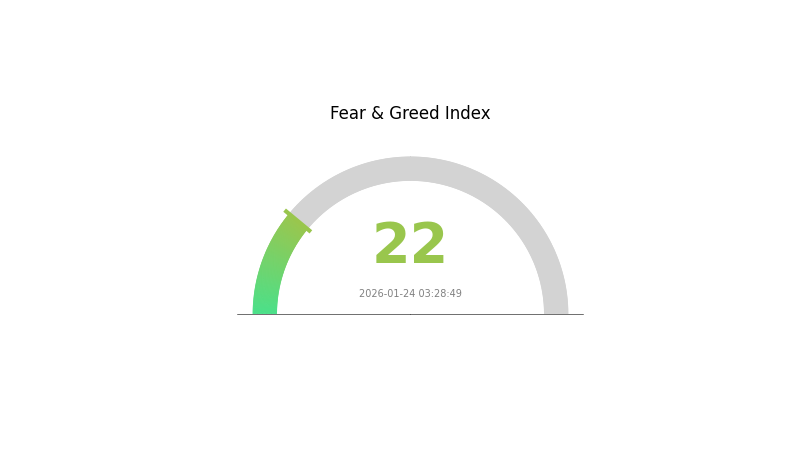
This fear-driven sentiment is manifesting in selling pressure as some investors liquidate positions, driven by concern over continuously falling prices. If the market continues to experience this instability, sentiment could decline further, potentially creating a self-reinforcing cycle of fear and selling.
However, high fear levels can sometimes indicate that assets are oversold, potentially presenting a contrarian buying opportunity. When sentiment reaches extreme levels, it often precedes market reversals as the last wave of fearful sellers exits positions. Undervalued prices in such conditions could attract value-oriented investors looking to accumulate at attractive levels.
ETFs See Significant Outflows
The US Bitcoin spot exchange-traded funds recorded substantial outflows of $869.86 million in a recent trading session, marking the highest outflow since February and the second-highest on record. This significant capital withdrawal has reduced the total net inflow to $60.21 billion, though it remains above the $60 billion threshold.
The breadth of the outflows was notable, with ten of the twelve Bitcoin ETFs recording negative flows. Importantly, there were no positive flows during this period, indicating unanimous selling pressure across the ETF ecosystem. This unanimous negative sentiment suggests that institutional investors are broadly de-risking their cryptocurrency exposure.
Grayscale experienced outflows of $256.64 million, reflecting continued redemption pressure on the legacy Bitcoin trust structure. BlackRock's Bitcoin ETF also saw $256.64 million in outflows, significant given the fund's position as the largest Bitcoin ETF by assets under management. Fidelity rounded out the triple-digit outflows with $119.93 million leaving the fund.
These substantial outflows from major institutional products suggest that sophisticated investors are reducing their Bitcoin exposure in response to macroeconomic concerns, profit-taking, or portfolio rebalancing. The magnitude of the outflows indicates that this is not merely routine trading activity but rather a meaningful shift in institutional positioning.
Simultaneously, US Ethereum ETFs continued their outflow streak, recording another $259.72 million in redemptions. This ongoing capital withdrawal has reduced the total net inflow to $13.31 billion, representing a significant decline from peak levels.
Five of the nine Ethereum ETFs recorded outflows during this period, with no funds experiencing positive flows. This unanimous negative sentiment mirrors the pattern observed in Bitcoin ETFs and suggests broad-based institutional de-risking across cryptocurrency exposures.
BlackRock led Ethereum ETF outflows with $137.31 million in redemptions, the largest single-day outflow for the fund. Grayscale followed with $67.91 million in outflows, continuing the redemption pressure that has characterized the legacy Ethereum trust since its conversion to an ETF structure.
These substantial outflows from both Bitcoin and Ethereum ETFs represent a significant shift in institutional sentiment and capital allocation. The simultaneous nature of the outflows suggests that broader macroeconomic factors, rather than asset-specific concerns, are driving institutional behavior.
In a notable development, Canary Capital's XRPC, the first US spot exchange-traded fund offering direct exposure to XRP, made its debut with $58 million in trading volume. This impressive opening performance indicates rising institutional appetite for exposure to major digital assets beyond Bitcoin and Ethereum.
The successful launch of an XRP ETF demonstrates that institutional demand for cryptocurrency exposure extends beyond the two largest assets. This development could pave the way for additional cryptocurrency ETFs, further integrating digital assets into traditional financial markets and expanding investment options for institutional and retail investors alike.
FAQ
What are the main reasons for today's cryptocurrency market decline?
Today's crypto downturn stems from multiple factors: macroeconomic headwinds including potential interest rate adjustments, reduced institutional trading activity, profit-taking after recent rallies, and negative regulatory developments affecting market sentiment globally.
Why did Bitcoin and Ethereum drop significantly today?
Market volatility stems from macro factors including regulatory shifts, profit-taking after recent gains, and shifting investor sentiment. Technical resistance levels and reduced trading volume often amplify downward pressure during correction phases.
How should investors respond when cryptocurrency prices decline?
During price downturns, experienced investors typically view it as a buying opportunity. Consider dollar-cost averaging to reduce entry costs, diversify your portfolio, and focus on long-term fundamentals rather than short-term volatility. Stay informed about market trends and maintain a disciplined investment strategy.
How do macroeconomic factors affect cryptocurrency price volatility?
Macroeconomic factors like inflation, interest rates, and market sentiment directly impact crypto prices. Rising inflation and rate hikes typically push investors toward safer assets, reducing crypto demand. Conversely, economic stimulus and low rates boost crypto valuations as investors seek higher returns and inflation hedges.
How long do crypto market downturns typically last?
Crypto market downturns vary significantly, ranging from days to months depending on market conditions and macroeconomic factors. Short-term corrections may last weeks, while major bear markets can extend several months. Recovery timelines are unpredictable and depend on regulatory news, institutional adoption, and overall market sentiment.
* The information is not intended to be and does not constitute financial advice or any other recommendation of any sort offered or endorsed by Gate.