Is ChainLink (LINK) a good investment?: A Comprehensive Analysis of Price Potential, Use Cases, and Market Risks in 2024


Introduction: ChainLink (LINK) Investment Position and Market Prospects
LINK is an important asset in the cryptocurrency field. As an ERC-20 standardized token based on the Ethereum blockchain, it has served a critical function since its launch in 2017. As of December 2025, LINK maintains a market capitalization of approximately $13.651 billion, with a circulating supply of around 696.85 million tokens out of a total supply of 1 billion. The token is currently trading at $13.651, having reached a historical high of $52.70 in May 2021. LINK is primarily utilized to compensate Chainlink node operators for retrieving off-chain data, formatting data into blockchain-readable formats, performing off-chain computations, and ensuring network uptime. With a ranking of 16 among cryptocurrencies by market cap and representing 0.41% market dominance, LINK has become a focal point in discussions regarding blockchain infrastructure and decentralized oracle solutions. This comprehensive analysis examines LINK's investment value, price performance trends, future price projections, and associated investment risks to provide investors with essential reference information.
Chainlink (LINK) Comprehensive Market Analysis Report
I. LINK Price History Review and Current Investment Value
Historical Price Performance and Investment Returns
All-Time High (ATH): $52.70 (May 10, 2021)
- LINK reached its peak valuation during the 2021 bull market cycle, representing the pinnacle of investor sentiment in the project.
All-Time Low (ATL): $0.148183 (November 29, 2017)
- The token's historical low reflects early-stage market conditions following its launch in September 2017.
Performance Over Selected Periods:
- 1-Year Performance: -53.11% decline
- Current price stands significantly below prior year levels, indicating substantial depreciation over the 12-month period.
- 30-Day Performance: -3.11% decline
- Recent month shows modest downward pressure in the short term.
- 7-Day Performance: -3.00% decline
- Weekly volatility continues in the negative direction.
- 24-Hour Performance: +0.36% gain
- Minor positive momentum in the most recent trading session.
- 1-Hour Performance: +0.11% gain
- Marginal intraday price appreciation.
Current LINK Market Status (December 15, 2025)
Price Metrics:
- Current Price: $13.651 USD
- 24-Hour Trading Range: $13.095 - $13.735
- 24-Hour Trading Volume: $3,666,511.69
Market Capitalization Data:
- Current Market Cap: $9,512,698,946.65 (circulating supply basis)
- Fully Diluted Valuation (FDV): $13,651,000,000.00
- Market Cap to FDV Ratio: 69.68%
- Market Dominance: 0.41%
Token Supply Information:
- Circulating Supply: 696,849,970.45 LINK (69.68% of total supply)
- Total Supply: 1,000,000,000 LINK
- Maximum Supply: 1,000,000,000 LINK
- Token Holders: 817,251 unique addresses
Market Sentiment Indicator:
- Fear & Greed Index: Neutral (value: 1)
- Current market sentiment reflects equilibrium between fear and greed, indicating a balanced investor outlook.
Exchange Presence:
- Listed on 70 cryptocurrency exchanges globally
For real-time LINK market price updates and detailed charts, visit Chainlink Price on Gate
II. Project Overview and Core Utility
Token Classification: ERC-20 Standard Token (Ethereum Blockchain)
Primary Use Cases:
- Compensation mechanism for Chainlink node operators
- Data retrieval from off-chain sources
- Data formatting into blockchain-readable formats
- Off-chain computation facilitation
- Network uptime assurance
Security Function:
- LINK token serves as a stake held by node operators, functioning as an economic incentive structure to prevent malicious participation and ensure network integrity.
Contract Information:
- Network: Ethereum (ETH)
- Contract Address: 0x514910771AF9Ca656af840dff83E8264EcF986CA
- Verification: Available on Etherscan
III. Community and Development Resources
Official Channels:
- Website: https://chain.link/
- Twitter/X: https://twitter.com/chainlink
- Reddit: https://www.reddit.com/r/Chainlink/
- GitHub Repositories: https://github.com/smartcontractkit/chainlink
Block Explorer:
- Etherscan Token Page: https://etherscan.io/token/0x514910771AF9Ca656af840dff83E8264EcF986CA
IV. Key Market Observations
Valuation Metrics:
- Token price represents a 74.14% discount from all-time high
- Circulating supply represents approximately 70% of maximum supply, indicating moderate inflation potential
- Per-token price has declined 149x from peak levels, reflecting significant market cycle adjustment
Trading Activity:
- Current 24-hour volume suggests moderate trading liquidity
- Wide presence across 70 exchanges indicates accessibility for market participants
Long-Term Context:
- Investment since inception (September 2017) would have experienced extreme volatility spanning from 0.148 to 52.70 USD
- Current year-to-date performance reflects broader cryptocurrency market headwinds and sector-specific developments
Data as of: December 15, 2025, 19:20:34 UTC
This report presents factual market data and historical information. Market participation carries inherent risks, and past performance does not guarantee future results.
Chainlink (LINK) Comprehensive Research Report
Report Date: December 15, 2025
I. Executive Summary
Chainlink (LINK) is an ERC-20 standardized token deployed on the Ethereum blockchain, currently trading at $13.651 with a market capitalization of $13.651 billion, ranking 16th in the cryptocurrency ecosystem. As of the reporting date, LINK demonstrates mixed short-term performance with a 24-hour gain of 0.36%, while experiencing significant long-term headwinds with a 1-year decline of -53.11%. The token exhibits a circulating supply of 696.85 million LINK against a fixed total supply of 1 billion tokens, with a market dominance of 0.41%.
II. Core Factors Influencing Whether Chainlink (LINK) Is a Sound Investment
Supply Mechanism and Scarcity
Chainlink maintains a fixed total supply structure of 1 billion LINK tokens. Current circulating supply stands at approximately 696.85 million tokens, representing 69.68% of total supply. This progressive supply release schedule continues to influence market dynamics. The token's maximum supply constraint provides a structural foundation for long-term value preservation, distinguishing it from inflationary alternatives.
Institutional Investment and Mainstream Adoption
Chainlink demonstrates substantial institutional engagement reflected in whale wallet accumulation patterns. Recent data indicates strategic positioning by institutional participants during price consolidation phases, suggesting confidence in long-term fundamentals. The protocol has achieved integration across over 1,500 projects and maintains partnerships with major global organizations, establishing LINK as integral infrastructure within the blockchain ecosystem.
Network security architecture utilizes LINK tokens as a required component for node operator participation, creating economic incentives that align validator interests with protocol integrity. This stake-based system mitigates participation by malicious actors through economic penalties.
Macroeconomic Environment Impact
Chainlink operates within a broader cryptocurrency market influenced by monetary policy shifts and geopolitical uncertainty. The current market environment reflects consolidation patterns around resistance levels, with technical positioning suggesting potential for upward momentum if macroeconomic conditions stabilize. Geopolitical risks continue shaping institutional sentiment toward blockchain infrastructure assets.
Technology and Ecosystem Development
Oracle Network Expansion: Chainlink's decentralized oracle networks currently secure approximately $48.5 billion in Total Value Secured (TVS) across DeFi protocols. This substantial value proposition demonstrates the protocol's centrality to derivative markets, lending platforms, and on-chain asset pricing mechanisms.
Real-World Asset Integration: Chainlink technology extends beyond pure decentralized finance into supply chain management, insurance, gaming, and asset tokenization applications. The protocol's capability to bridge on-chain and off-chain data sources positions it advantageously as tokenization trends accelerate across traditional finance and enterprise sectors.
Cross-Chain Services: Protocol development focuses on enabling seamless data and value transfer across heterogeneous blockchain networks, expanding utility beyond single-chain deployments.
III. Price Analysis and Technical Outlook
Historical Price Performance
| Metric | Value |
|---|---|
| All-Time High | $52.70 (May 10, 2021) |
| All-Time Low | $0.148183 (November 29, 2017) |
| Current Price | $13.651 |
| 24-Hour Range | $13.095 - $13.735 |
| Decline from ATH | -74.09% |
Recent Price Movements
| Timeframe | Change | Absolute Change |
|---|---|---|
| 1 Hour | +0.11% | +$0.015 |
| 24 Hours | +0.36% | +$0.049 |
| 7 Days | -3.00% | -$0.422 |
| 30 Days | -3.11% | -$0.438 |
| 1 Year | -53.11% | -$15.462 |
Technical Patterns
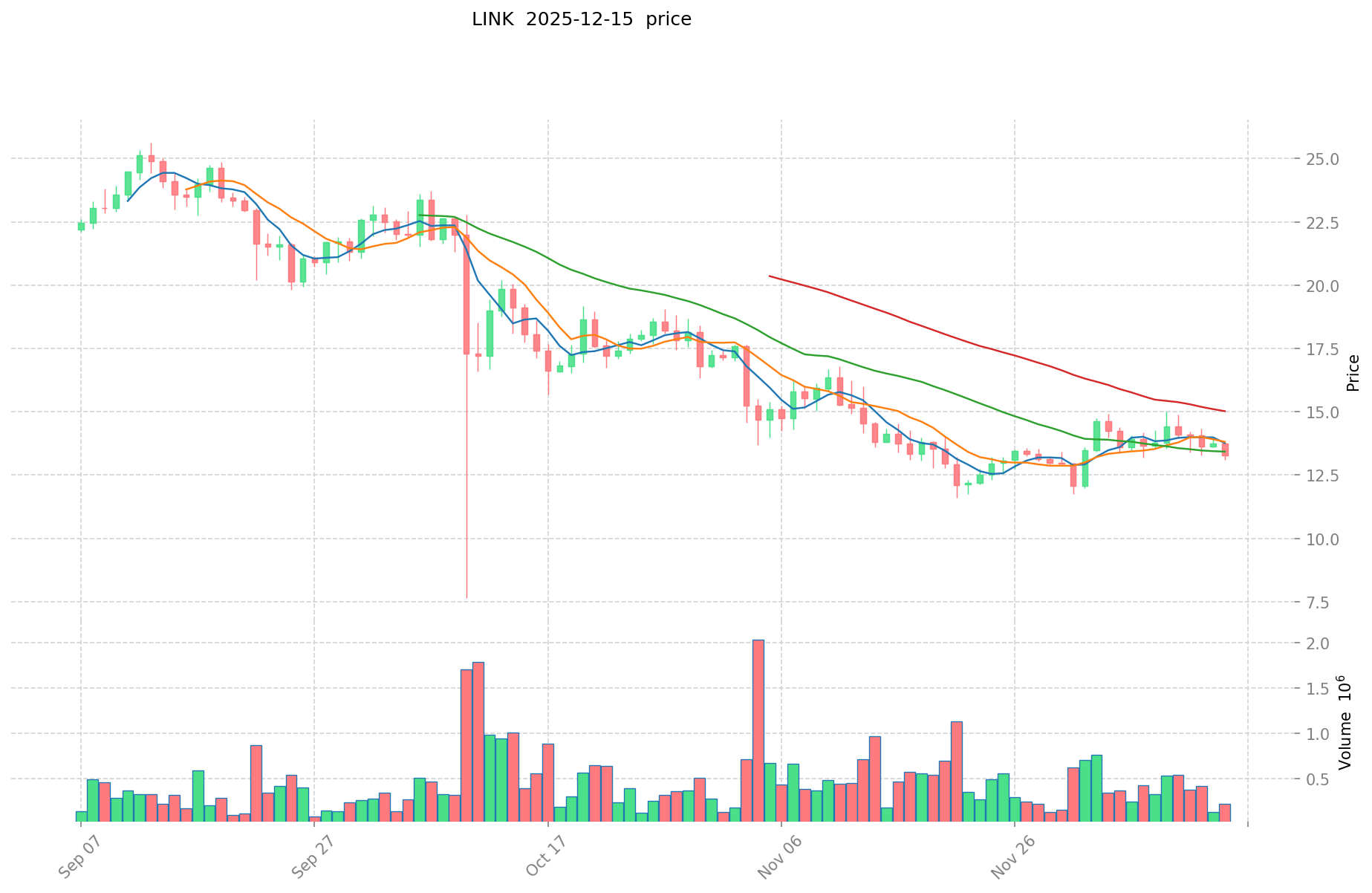
Current price action exhibits a descending channel formation with lower highs and lower lows. Trading near support levels at $12.50-$14.50 provides potential reversal zones. Resistance concentration exists at $18.20-$20.16 levels, with breakout confirmation required for trend reversal validation. The 50-day moving average slopes upward relative to current price on both daily and weekly timeframes, suggesting emerging bullish structure.
IV. Market Positioning and Competitive Advantages
Chainlink maintains a distinct competitive position within the oracle infrastructure sector through:
-
Decentralized Architecture: Multiple independent node operators reduce single-point-of-failure risks inherent in centralized data providers.
-
Enterprise Integration: Partnerships with traditional finance institutions and multinational corporations demonstrate institutional-grade confidence in protocol reliability.
-
Ecosystem Depth: Integration across DeFi lending, derivatives trading, and emerging tokenization platforms creates network effects supporting long-term value accrual.
-
Security Economics: The LINK staking model creates alignment between validator incentives and network security maintenance.
V. Risk Considerations
-
Regulatory Uncertainty: Evolving regulatory frameworks across jurisdictions may impact token utility or trading accessibility.
-
Competitive Pressures: Alternative oracle solutions and cross-chain protocols present ongoing competitive dynamics.
-
Supply Unlocks: Remaining token supply distribution could exert downward price pressure during release periods.
-
Market Consolidation: Extended price consolidation near support levels indicates ongoing seller pressure.
VI. Long-Term Value Proposition
Chainlink's utility foundation rests on the continued expansion of decentralized finance, real-world asset tokenization, and enterprise smart contract applications. The protocol's demonstrated capacity to secure $48.5 billion in TVS and integrate across 1,500+ projects establishes material evidence of real-world economic value creation. Network activity growth correlates with LINK token demand through node operator staking requirements and oracle service payments.
The technology's application across supply chain management, insurance, derivatives pricing, and tokenization platforms extends beyond speculative use cases toward essential infrastructure status within emerging blockchain economies.
VII. References
- Gate Data Chainlink Token Analysis
- DeFiLlama Protocol Security Metrics
- Phemex Chainlink Analysis Report
- VentureBurn Price Prediction Analysis
- Investing Haven Technical Analysis
Disclaimer: This report presents factual analysis of available data and does not constitute investment advice. Cryptocurrency investments carry substantial risk, including potential loss of principal. Past performance does not guarantee future results.
III. LINK Future Investment Predictions and Price Outlook (Is ChainLink(LINK) worth investing in 2025-2030)
Short-term Investment Prediction (2025, Short-term LINK investment outlook)
- Conservative Forecast: $8.33 - $13.65
- Neutral Forecast: $13.65 - $15.83
- Optimistic Forecast: $15.83 - $20.19
Mid-term Investment Outlook (2026-2028, Mid-term ChainLink(LINK) investment forecast)
- Market Stage Expectation: Transition from consolidation to recovery phase with improving scalability and institutional adoption momentum
- Investment Return Predictions:
- 2026: $11.50 - $17.39 (Anticipated 8% year-over-year growth)
- 2027: $13.66 - $18.80 (Expected 17% appreciation with ecosystem expansion)
- 2028: $10.11 - $23.19 (Potential 27% gains as cross-chain interoperability protocol (CCIP) deployment accelerates)
- Key Catalysts: Expanded CCIP implementation, increased DeFi adoption, enterprise blockchain integrations, improved network scalability
Long-term Investment Outlook (Is LINK a good long-term investment?)
- Base Case Scenario: $22.65 - $29.67 by 2030 (Assumes steady mainstream adoption across multiple blockchain applications and gradual DeFi growth momentum)
- Optimistic Scenario: $89.35 - $108.86 by 2030 (Assumes successful large-scale adoption, increased transaction volumes, and Chainlink becoming a cornerstone infrastructure provider for decentralized finance and enterprise applications)
- Risk Scenario: $11.78 - $15.00 by 2030 (Under conditions of regulatory headwinds, slower-than-expected ecosystem adoption, or emergence of competing oracle solutions)
View LINK long-term investment and price forecast: Price Prediction
2025-12-15 to 2030 Long-term Outlook
- Base Case: $22.65 - $29.67 USD (Corresponding to steady technological advancement and mainstream institutional adoption progression)
- Optimistic Case: $89.35 - $108.86 USD (Corresponding to widespread enterprise adoption and favorable market environment)
- Transformative Case: $150.00+ USD (In event of breakthrough ecosystem developments and mainstream protocol adoption acceleration)
- 2030-12-31 Predicted High: $108.86 USD (Based on optimistic development assumptions)
Disclaimer: This analysis is provided for informational purposes only and does not constitute investment advice. Price predictions are based on historical data and analyst forecasts and carry inherent uncertainty. Cryptocurrency markets are volatile and subject to regulatory changes. Investors should conduct independent research and consult with financial advisors before making investment decisions.
| 年份 | 预测最高价 | 预测平均价格 | 预测最低价 | 涨跌幅 |
|---|---|---|---|---|
| 2025 | 15.83284 | 13.649 | 8.32589 | 0 |
| 2026 | 17.3942856 | 14.74092 | 11.4979176 | 8 |
| 2027 | 18.799095276 | 16.0676028 | 13.65746238 | 17 |
| 2028 | 23.18635422054 | 17.433349038 | 10.11134244204 | 27 |
| 2029 | 24.9811175040021 | 20.30985162927 | 19.4974575640992 | 48 |
| 2030 | 29.665584782293225 | 22.64548456663605 | 11.775651974650746 | 65 |
Chainlink (LINK) Investment Analysis Report
I. Executive Summary
Chainlink (LINK) is an ERC20 standardized token based on the Ethereum blockchain, currently ranked 16th by market capitalization. As of December 15, 2025, LINK trades at $13.651 with a market cap of approximately $13.65 billion and a 24-hour trading volume of $3.67 million.
II. Market Overview and Performance Metrics
Current Market Position
| Metric | Value |
|---|---|
| Current Price | $13.651 |
| Market Capitalization | $13.65 billion |
| Circulating Supply | 696,849,970.45 LINK |
| Total Supply | 1,000,000,000 LINK |
| Circulating Ratio | 69.68% |
| Market Dominance | 0.41% |
| Number of Holders | 817,251 |
| Trading Exchanges | 70 |
Price Performance Analysis
| Time Period | Change (%) | Price Change ($) |
|---|---|---|
| 1 Hour | +0.11% | +$0.015 |
| 24 Hours | +0.36% | +$0.049 |
| 7 Days | -3.00% | -$0.422 |
| 30 Days | -3.11% | -$0.438 |
| 1 Year | -53.11% | -$15.462 |
Historical Price Reference Points
- All-Time High: $52.70 (May 10, 2021)
- All-Time Low: $0.148183 (November 29, 2017)
- 24-Hour Range: $13.095 - $13.735
III. Project Overview and Technical Foundation
Project Description
LINK serves as a utility token that compensates Chainlink node operators for essential blockchain services. The token's primary functions include:
- Payment mechanism for Chainlink node operators
- Data retrieval from off-chain sources
- Data formatting into blockchain-readable formats
- Off-chain computation facilitation
- Network uptime assurance
- Prevention of malicious participant participation
Technical Infrastructure
Blockchain Network: Ethereum (ERC20 Standard)
Smart Contract Address:
0x514910771AF9Ca656af840dff83E8264EcF986CA
Token Economics:
- Maximum Supply: 1,000,000,000 LINK (capped)
- Circulating Supply: 696,849,970.45 LINK
- Supply Utilization: 69.68% of maximum supply
IV. Investment Strategy and Risk Management
Investment Methodology
Long-Term Holding (HODL LINK)
- Suitable for conservative investors seeking exposure to oracle infrastructure
- Appropriate time horizon: 2+ years
- Rationale: Accumulating stakes in essential blockchain infrastructure
Active Trading
- Relies on technical analysis and price momentum
- Suitable for experienced traders with risk tolerance
- Short to medium-term positioning (days to months)
Risk Management Framework
Asset Allocation Considerations
- Conservative Investors: 1-3% of total portfolio allocation
- Aggressive Investors: 5-10% allocation with higher risk tolerance
- Professional Investors: Strategic position sizing based on institutional mandates and liquidity requirements
Risk Mitigation Strategies
- Multi-asset portfolio diversification across different blockchain assets and traditional investments
- Hedging through complementary oracle and infrastructure tokens
- Dollar-cost averaging to reduce timing risk
Secure Storage Solutions
- Hot wallets: MetaMask, Trust Wallet for active trading (smaller amounts)
- Cold Wallets: Hardware wallets (Ledger, Trezor) for long-term holdings
- Custody Solutions: Institutional-grade custodians for large holdings
V. Investment Risks and Challenges
Market Risk
- High Volatility: LINK exhibits 53.11% annual decline, indicating significant price fluctuations
- Liquidity Risk: Despite 70 exchange listings, market depth varies across venues
- Price Manipulation: Potential vulnerability to low-liquidity period manipulation
Regulatory Risk
- Jurisdiction Uncertainty: Varying legal classifications across different countries affect token utility and trading
- Oracle Regulation: Potential future regulation of oracle services and data providers
- Classification Changes: Risk of reclassification as securities in certain jurisdictions
Technical Risk
- Network Security: Vulnerability to smart contract exploits and oracle manipulation attacks
- Protocol Upgrades: Potential failures or adverse impacts from network updates
- Dependency Risk: Reliance on Ethereum network stability and gas costs
VI. Conclusion: Is Chainlink a Good Investment?
Investment Value Assessment
Chainlink operates in the essential oracle infrastructure sector, providing critical data services to decentralized applications. The project demonstrates foundational utility within blockchain ecosystems. However, the 53.11% one-year price decline and negative medium-term performance trends indicate substantial market headwinds.
Investor Recommendations
✅ Beginners:
- Implement dollar-cost averaging strategy over 6-12 months
- Maintain holdings in secure cold storage
- Allocate only risk capital (1-3% of portfolio)
✅ Experienced Traders:
- Deploy swing trading strategies based on technical support/resistance levels
- Maintain diversified cryptocurrency portfolio including competing oracle solutions
- Monitor regulatory developments and market sentiment shifts
✅ Institutional Investors:
- Consider strategic long-term allocation to oracle infrastructure exposure
- Evaluate correlation with broader blockchain adoption trends
- Assess impact of emerging competing oracle solutions
Disclaimer
⚠️ Important Notice: Cryptocurrency investments carry substantial risk including potential total loss of invested capital. This report is provided for informational purposes only and does not constitute investment advice. Past performance does not guarantee future results. Investors should conduct independent research and consult qualified financial advisors before making investment decisions.
Report Date: December 15, 2025
Data Source: Gate Market Data
Chainlink (LINK) Frequently Asked Questions
FAQ
Q1: What is the current investment value of Chainlink (LINK) as of December 2025?
A: As of December 15, 2025, Chainlink (LINK) is trading at $13.651 USD with a market capitalization of approximately $13.65 billion, ranking 16th among cryptocurrencies. The token has experienced a 53.11% decline over the past year but shows minor positive momentum in short-term trading (0.36% gain in 24 hours). With 696.85 million tokens in circulation out of a total supply of 1 billion, LINK maintains a market dominance of 0.41% and is listed on 70 cryptocurrency exchanges globally.
Q2: How does Chainlink's utility function support its long-term value proposition?
A: Chainlink serves as a critical oracle infrastructure token that compensates node operators for retrieving off-chain data, formatting data into blockchain-readable formats, performing off-chain computations, and ensuring network uptime. The token also functions as a staking mechanism where node operators must hold LINK to participate in the network, creating economic incentives that align validator interests with protocol integrity. Currently, Chainlink secures approximately $48.5 billion in Total Value Secured across DeFi protocols and integrates across over 1,500 projects, establishing itself as essential infrastructure within blockchain ecosystems.
Q3: What are the predicted price ranges for Chainlink in 2025-2030?
A: Price predictions for LINK vary by scenario: For 2025, conservative forecasts range $8.33-$13.65, neutral forecasts $13.65-$15.83, and optimistic forecasts $15.83-$20.19. Mid-term projections (2026-2028) anticipate $11.50-$17.39 in 2026, $13.66-$18.80 in 2027, and $10.11-$23.19 in 2028. Long-term 2030 projections include a base case of $22.65-$29.67, an optimistic scenario of $89.35-$108.86, and a transformative case exceeding $150.00 USD under favorable adoption conditions.
Q4: What are the primary risks associated with investing in Chainlink?
A: Key investment risks include market volatility (evidenced by 53.11% annual decline), regulatory uncertainty surrounding oracle services and token classification, technical vulnerabilities to smart contract exploits and oracle manipulation attacks, and competitive pressures from alternative oracle solutions. Additionally, remaining token supply distribution could exert downward price pressure during release periods, and the protocol's dependency on Ethereum network stability and fluctuating gas costs presents operational risks.
Q5: Is Chainlink suitable for beginner investors?
A: Chainlink can be appropriate for beginner investors with careful risk management. Recommended strategies include implementing dollar-cost averaging over 6-12 months to reduce timing risk, maintaining holdings in secure cold storage (hardware wallets like Ledger or Trezor), and allocating only 1-3% of total portfolio value as risk capital. Beginners should conduct independent research, understand the project's oracle infrastructure role, and consult qualified financial advisors before investing. The token's volatility requires realistic expectations about potential losses.
Q6: How does Chainlink's current market position compare to its historical performance?
A: Chainlink is currently trading at a 74.14% discount from its all-time high of $52.70 reached in May 2021, representing significant depreciation over the cryptocurrency market cycle. However, the token remains substantially above its all-time low of $0.148183 from November 2017. The circulating supply represents approximately 70% of maximum supply, indicating moderate inflation potential. Current market sentiment reflects a neutral outlook (Fear & Greed Index: 1), with trading occurring near support levels that provide potential reversal zones for technical analysis-based strategies.
Q7: What macroeconomic and ecosystem factors should influence investment decisions?
A: Investment decisions should consider macroeconomic conditions including monetary policy shifts and geopolitical uncertainty affecting institutional sentiment. Positive catalysts include Chainlink's cross-chain interoperability protocol (CCIP) deployment acceleration, expanded DeFi adoption, enterprise blockchain integrations, and improved network scalability. Monitoring regulatory developments across jurisdictions, competing oracle solutions' market penetration, Ethereum network health, and adoption trends in real-world asset tokenization will provide indicators of long-term viability. The protocol's demonstrated integration across 1,500+ projects and $48.5 billion TVS provides evidence of material economic value creation supporting the fundamental investment thesis.
Q8: What storage and security practices are recommended for LINK token holdings?
A: For active trading with smaller amounts, hot wallets such as MetaMask or Trust Wallet provide convenient access. For long-term holdings and large positions, hardware wallets including Ledger or Trezor offer superior security against digital theft and hacking attempts. Institutional investors should utilize custody solutions meeting institutional-grade security standards. All storage solutions should implement multi-signature authentication where possible, enable two-factor authentication, maintain regular backups of recovery phrases in secure locations, and never share private keys or seed phrases with any third parties.
Disclaimer: This FAQ is provided for informational purposes only and does not constitute investment advice. Cryptocurrency investments carry substantial risk, including potential loss of principal capital. Past performance does not guarantee future results. Investors should conduct independent research and consult with qualified financial advisors before making investment decisions.
Share
How to Buy Cryptocurrency


Trending Cryptocurrencies



XZXX: A Comprehensive Guide to the BRC-20 Meme Token in 2025

Bitcoin Fear and Greed Index: Market Sentiment Analysis for 2025
Top Crypto ETFs to Watch in 2025: Navigating the Digital Asset Boom
5 ways to get Bitcoin for free in 2025: Newbie Guide
Bitcoin Market Cap in 2025: Analysis and Trends for Investors

2025 Bitcoin Price Prediction: Trump's Tariffs' Impact on BTC

DOT vs TRX: A Comprehensive Comparison of Two Leading Blockchain Platforms

Gate Ventures Weekly Crypto Recap (December 15, 2025)

What is CC: A Comprehensive Guide to Creative Commons and Its Impact on Digital Content Sharing

What is TAO: Understanding the Ancient Chinese Philosophy of the Way and Its Modern Applications
How Japan's Interest Rate Hike Affects Bitcoin and the Crypto Market