The spot ETF optimism drove Bitcoin near $37,000, but there could have been more signs behind that rally. Gauging to Exchange Inflow – Spent Output Value Band metric, CryptoQuant analyst found an interesting shift in market dynamics.
The latest leg up comes as inflows from whales decrease while retail investor receipts rise.
Bitcoin Surge Faces Retail Threat?
The influx of Bitcoin into exchanges from large whale addresses has been on a decline when compared to previous years. Contrastingly, there is a rise in the amount received from individual retail investors, according to CryptoQuant’s latest analysis by ‘IT Tech.’
Exchange Inflow – Spent Output Value Bands’ chart displays the distribution of all spent outputs that have flowed into exchange wallets based on their value. Each colored band represents the ratio of the total value of spent outputs that flowed into exchanges within the specified range, thereby helping in gauging capital flow into exchanges from both whale and retail holders.
The latest data shows that the whales persist with their resilient strategy amid the recent price rallywhile retail players capitalize on gains.
Meanwhile, the spot volumes are currently at historic lows. The derivative volumes, on the other hand, have reached record highs relative to spot trading. The current spot-to-derivatives volume ratio stands at 0.06, indicating that spot volumes constitute a mere 6%, while derivatives represent 94% of market volumes.
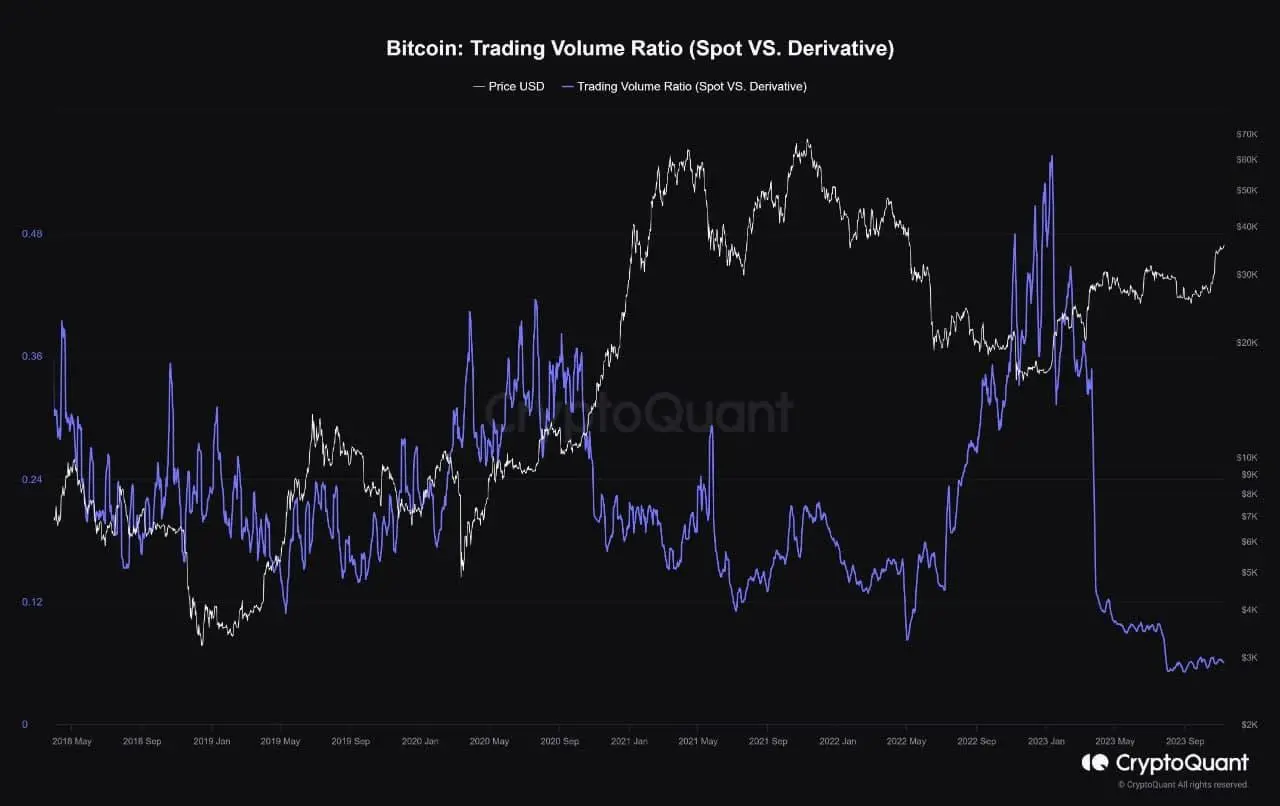 Bitcoin Trading Volume. Source: CryptoQuant## Tightness Within Bitcoin Supply
The trend was also confirmed by another blockchain intelligence platform, Glassnode, which observed a “powerful divergence” that has continued to form between the Bitcoin Long-Term Holder (LTH) supply and the Short-Term Holder (STH supply).
In its latest analysis, the firm said that while LTH supply is just shy of an all-time high, STH supply stands at effectively all-time lows, demonstrating a “growing tightness within the BTC supply” as existing holders become increasingly unwilling to part with their holdings.
“LTHs historically wait for the market to break to new price ATH before ramping up their distribution. This process can be seen by the large-scale decline in their supply during the 2021 bull run, which is matched by an uptick in STH Supply, as well as Exchange inflow volumes.”
Besides, the Sell-Side Risk Ratio uates investor spending behaviors by measuring the absolute value of profit or loss relative to the asset’s size (Realized Cap). High values indicate significant profit or loss, while low values suggest coins spent are near break-even.
Focusing on Short-Term Holders post the $35k rally, a spike in the ratio suggested a ‘re-awakening’ of young coins, thereby hinting at near-term profit-taking. Long-term holders continued to show a slight increase in the ratio, reminiscent of the 2016 and late 2020 periods of tight overall BTC supply.
Tuyên bố miễn trừ trách nhiệm: Thông tin trên trang này có thể đến từ bên thứ ba và không đại diện cho quan điểm hoặc ý kiến của Gate. Nội dung hiển thị trên trang này chỉ mang tính chất tham khảo và không cấu thành bất kỳ lời khuyên tài chính, đầu tư hoặc pháp lý nào. Gate không đảm bảo tính chính xác hoặc đầy đủ của thông tin và sẽ không chịu trách nhiệm cho bất kỳ tổn thất nào phát sinh từ việc sử dụng thông tin này. Đầu tư vào tài sản ảo tiềm ẩn rủi ro cao và chịu biến động giá đáng kể. Bạn có thể mất toàn bộ vốn đầu tư. Vui lòng hiểu rõ các rủi ro liên quan và đưa ra quyết định thận trọng dựa trên tình hình tài chính và khả năng chấp nhận rủi ro của riêng bạn. Để biết thêm chi tiết, vui lòng tham khảo
Tuyên bố miễn trừ trách nhiệm.


