WhitepaperByTheRoadside

vip
Age 0.1 Year
Peak Tier 0
I read whitepapers, but I trust on-chain execution more. I like to identify a project's points of self-consistency and also highlight sentences that make excessive promises.
Range-bound market, don't be greedy, take profits in stages.
View Original
LedgerBull
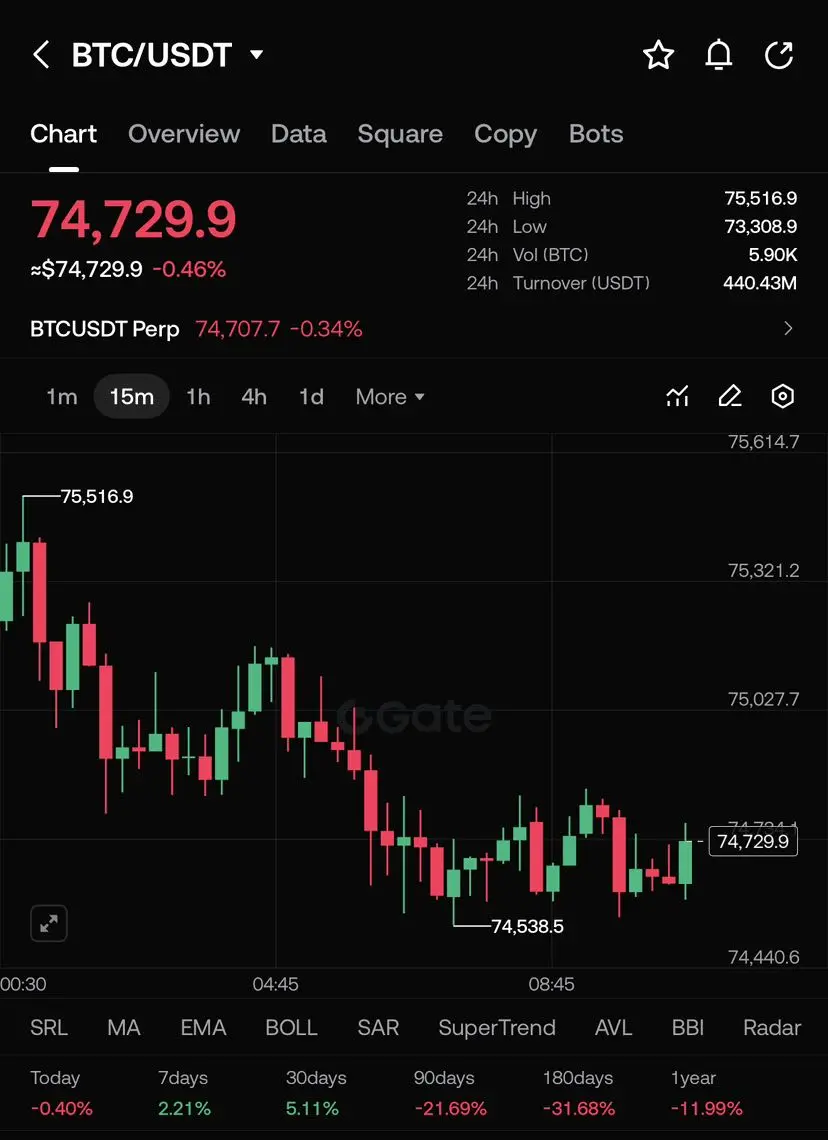
$BTC showing short-term consolidation after rejection from local highs.
Buyers attempting to regain control, but structure remains range-bound on lower timeframes.
EP
74400 - 74750
TP
TP1 75050
TP2 75400
TP3 75800
SL
73950
Price tapped liquidity near 74.5k and bounced, showing demand stepping in. However, weak follow-through suggests chop before expansion. Break above local resistance could trigger upside continuation, while losing support may shift momentum bearish.
Let’s go $BTC ‌
repost-content-media
  • Reward
  • Comment
  • Repost
  • Share
Recently, there's been a lot of talk about the narrative of parallelization/sharding, which is indeed lively, but what I care more about are the three old issues: where to place assets, how to exit if something goes wrong, and whether in the worst case I can admit defeat and walk away. Seeing large transfers on-chain, or hot and cold wallets moving on exchanges, being called "smart money" is honestly something I envy a bit—the information advantage and courage... But after calming down and thinking about it, it's better to first clarify your own exit strategy than to follow the interpretation:
View Original
  • Reward
  • Comment
  • Repost
  • Share
Recently, the debate over the "optional royalties" in the secondary market has exploded again. To be honest, everyone wants liquidity, but creators also need to make a living. No matter how good the white paper sounds, ultimately it depends on how it's implemented on the chain: you write royalties as a "community consensus," but if there's no binding in the contract and the market just turns off the switch, I really can't believe in this self-consistency.
What's more awkward is that now there's also the wave of AI Agents/auto-trading hype, with a bunch of bots sweeping floors and automatically
View Original
  • Reward
  • Comment
  • Repost
  • Share
Lately, I haven't been paying much attention to the K-line while watching the market, mostly thinking about how interest rates mess with people's psychology. To put it simply, when interest rates are high, that small amount of "willingness to take risks" in people's hands gets drained, and positions naturally lighten; once the market feels it's about to loosen, risk appetite springs like a released spring, and this tends to amplify in the crypto space.
In the group, there's again talk about stablecoin regulation, reserve audits, and rumors of "de-pegging," which makes the mood noisy when emo
View Original
  • Reward
  • Comment
  • Repost
  • Share
Recently, I keep hearing people talk about block builders, bundles, as if it's some kind of mysticism.
Honestly, how much do retail investors need to know?
I think you shouldn't push yourself to become a researcher: remember one thing—
the transactions you send out may not be included in the block in the order you see;
someone might "bundle" and jump the queue or insert themselves, so for large or sensitive operations,
don't be greedy for that tiny fee savings;
try to use the default protections of reliable wallets and avoid changing parameters unnecessarily.
If you want to under
View Original
  • Reward
  • Comment
  • Repost
  • Share
The more data of this kind, the better: how much it costs, how long it takes to confirm, where the pilot is, is more useful than just shouting slogans.
View Original
BraveBullsAreNotAfra
A crypto news show focused on institutional adoption and regulation says Japanese banks have completed a live pilot showing cross-border payments using XRP were around 60% cheaper than traditional SWIFT transfers, settling in under four seconds.The test, presented at “XRP Tokyo 2026,” involved real XRP chain remittance corridors between Japan and Southeast Asia, suggesting that at least some Japanese institutions are actively trialing XRP as a payments rail rather than treating it as a speculative asset.
  • Reward
  • Comment
  • Repost
  • Share
Today I tidied up the table and found an old alarm clock, the battery had leaked long ago and it was still sitting there, reluctant to throw away, so I kept it. Every time I see it, I get annoyed. Cutting losses really feels like a breakup; dragging it out and not dealing with it makes you start convincing yourself "just a little longer," ultimately wasting not only time but also your mindset and interest.
Recently, the debate over re-pledging and shared security has flared up again. To put it simply, the returns stack like nesting dolls; no matter how good the outer packaging looks, if the lo
View Original
  • Reward
  • Comment
  • Repost
  • Share
  • Pin