An onchain analyst argues that Bitcoin developers are more actively addressing quantum computing risks than headlines suggest, with discussions accelerating in 2025 and highlighted by the first Quantum Bitcoin Summit in San Francisco.
Data Shows a Shift in Focus
Onchain analyst Willy Woo has entered the debate regarding bitcoin’s readiness for the looming quantum threat, claiming that significantly more work is happening behind the scenes than headlines suggest. While admitting that the initial response from bitcoin developers was slow, Woo insists the pace has accelerated, particularly during the second half of 2025.
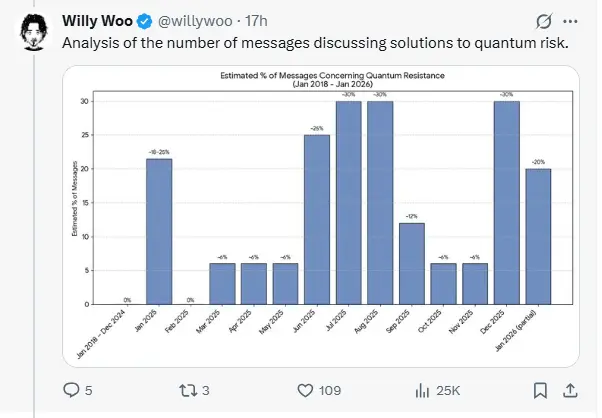
“ Bitcoin dev response to quantum risks started in Jan. 2025 and accelerated midyear; we also saw the first Quantum Bitcoin Summit in July in SF,” Woo noted.
In a post on X, Woo shared archives from the bitcoin developers mailing list to support his argument. The data reveals that the share of messages discussing quantum resistance has consistently remained above 10% since June 2025, with October and November being the only exceptions.
This defense comes amid growing alarm regarding the vulnerability of bitcoin addresses to quantum computing. Some analysts suggest these fears are already weighing on the market, contributing to bitcoin’s inability to break above the $100,000 mark for several weeks. Crypto advocate Nic Carter suggested that bitcoin’s recent price stagnation reflects a market waking up to long-term quantum risks. While developers may view the threat as distant, Carter argues institutional investors now see it as a legitimate “headwind.”
Read more: Is Quantum Computing Casting a Shadow Over Bitcoin’s Price?
This sentiment is gaining traction in traditional finance. Christopher Wood, a strategist at Jefferies, recently removed bitcoin from a recommended pension portfolio, citing the “existential technological threat” of quantum computing. On the other hand, Sergio Ermotti, the CEO of the financial services giant UBS, stated that bitcoin must overcome the quantum threat to maintain its long-term credibility as a store of value.
To counter the narrative of inaction, Woo’s analysis highlighted an “explosion” of technical discussions in 2025, following a period of near-total silence between 2018 and 2024.
The primary focus of these discussions—often exceeding 100 messages per thread—revolves around the vulnerability of ECDSA/Schnorr signatures to Shor’s algorithm. Key points of the current developer consensus include implementing voluntary transitions rather than forced protocol changes. There is an agreement to prioritize the maturity of the National Institute of Standards and Technology (NIST) post-quantum cryptography standards before integration.
Woo characterized the current atmosphere not as one of panic, but as “proactive engineering for a distant-but-real threat.”
FAQ ❓
- What is the quantum threat to bitcoin? Quantum computing could break Bitcoin’s cryptographic signatures, risking address security.
- How are developers responding? Bitcoin devs accelerated work in 2025, with discussions topping 10% of mailing list activity.
- Why is the market concerned? Analysts say quantum fears are weighing on Bitcoin’s price, stalling it below $100,000.
- What solutions are being explored? Developers favor voluntary transitions and NIST post‑quantum standards before protocol integration.
Disclaimer: The information on this page may come from third parties and does not represent the views or opinions of Gate. The content displayed on this page is for reference only and does not constitute any financial, investment, or legal advice. Gate does not guarantee the accuracy or completeness of the information and shall not be liable for any losses arising from the use of this information. Virtual asset investments carry high risks and are subject to significant price volatility. You may lose all of your invested principal. Please fully understand the relevant risks and make prudent decisions based on your own financial situation and risk tolerance. For details, please refer to
Disclaimer.
Related Articles
Capital flows into Bitcoin ETFs: After the US-Iran conflict, has BTC replaced gold as a safe-haven asset?
Bitcoin spot ETFs continue to attract capital inflows after the US-Iran conflict. Bloomberg analysts pointed out that since the incident, Bitcoin has risen by 12%, while gold has fallen, raising questions about gold's safe-haven status. Analysts emphasized that short-term price fluctuations should not be overinterpreted, as they may reflect changes in market sentiment and profit-taking.
ChainNewsAbmedia4m ago
Hyperliquid BTC Long TOP1 position has only $729 remaining and will be liquidated
PANews March 6 News, according to on-chain analyst @ai\_9684xtpa monitoring, Hyperliquid BTC long TOP1 position has only $729 remaining before liquidation. Address 0x1bf…9547e currently holds 731.73 BTC with 40x leverage long position, opening price $71,441, liquidation price $70,200, now with an unrealized loss of $375,000. Since March, this address has also been actively trading BTC contracts with both long and short positions, accumulating a profit of $644,000.
GateNews7m ago
Data: In the past 24 hours, the entire network has been liquidated by $252 million, with long positions liquidated by $170 million and short positions liquidated by $81.7741 million.
ChainCatcher message, according to Coinglass data, in the past 24 hours, the entire network experienced liquidations of $252 million, with long positions liquidated at $170 million and short positions at $81.77 million. Among them, Bitcoin long positions liquidated at $69.2463 million, Bitcoin short positions at $27.4732 million, Ethereum long positions at $36.4551 million, and Ethereum short positions at $22.6325 million.
GateNews18m ago
CleanSpark sells 97% of its Bitcoin production in February to fund its AI transformation
Bitcoin mining company CleanSpark produced 568 Bitcoins in February, sold 553, achieving a sales ratio of 97%, setting a new record. The revenue was approximately $36.65 million. The sale will fund its expansion into AI and high-performance computing data centers. The company still holds 13,363 Bitcoins and operates a hash rate of 50 EH/s.
GateNews18m ago
Solv Protocol Confirms $2.7 Million Exploit in Bitcoin Yield Vault, Commits to User Compensation
Solv Protocol, a Bitcoin-focused decentralized finance platform, has reported a limited exploit affecting one of its Bitcoin Reserve Offering (BRO) vaults, resulting in the loss of approximately 38 SolvBTC valued at $2.7 million and impacting fewer than 10 users.
CryptopulseElite23m ago
PsiQuantum's million-qubit facility begins construction, scientists say this scale is sufficient to crack Bitcoin encryption
Quantum computing company PsiQuantum has launched the construction of a million-qubit quantum computing facility in Chicago, with 500 tons of steel already assembled. The goal is to commercialize quantum computing and support next-generation AI supercomputers. Scientists warn that quantum computing could threaten Bitcoin's cryptographic security.
GateNews32m ago


