


UK Cryptocurrency Regulation Coming Soon! DeFi and Exchanges Face New Rules, Opinions Due by February
The UK Financial Conduct Authority (FCA) has recently launched three major consultations, marking a substantive phase in the UK’s cryptocurrency regulatory framework. These proposals cover exchange operations, staking services, lending platforms, and decentralized finance (DeFi). The consultation deadline is February 12, 2026. Simultaneously, the UK Treasury announced that legislation will be introduced before October 2027 to incorporate cryptocurrency companies into the existing financial legal system.
The UK FCA’s Three Major Consultation Frameworks Fully Cover the Crypto Industry
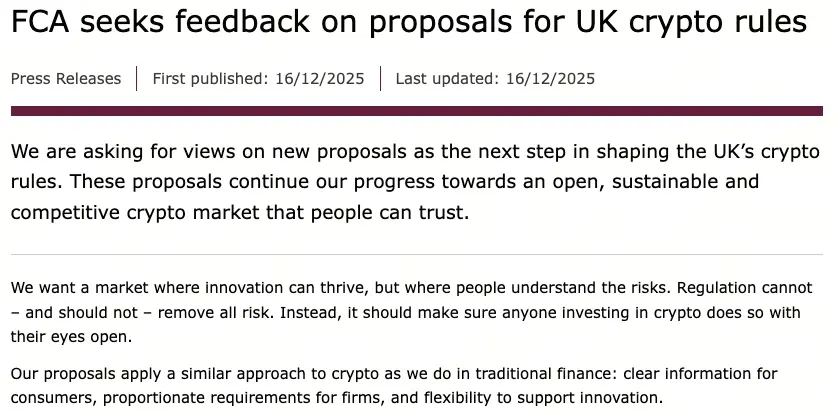
(Source: FCA)
The three consultation documents initiated by the UK Financial Conduct Authority form the core framework of the country’s cryptocurrency regulation. The first consultation focuses on cryptocurrency trading platforms and intermediaries, requiring exchanges to face clearer admission standards, information disclosure standards, and trading integrity standards. The UK regulator explicitly states that measures to combat insider trading and market manipulation will bring the cryptocurrency market closer to traditional finance.
This regulatory approach represents a significant shift in UK policy. Previously, UK regulation of cryptocurrencies mainly focused on financial promotion and anti-money laundering compliance. The new framework will establish comprehensive “market structure” rules. David Geale, Director of Payments and Digital Finance at the FCA, said: “Our goal is to establish a mechanism that protects consumers, supports innovation, and fosters trust.” He emphasized that industry feedback will help shape the final rules.
The second consultation focuses on cryptocurrency staking and lending services. The UK regulator is seeking opinions from all parties to understand how firms should disclose risks when offering yield-generating products that lock customer assets. These rules will have a profound impact on the currently booming staking economy, where many UK crypto platforms offer annual yields of up to 10% to 20%, but risk disclosures are often insufficient. Cryptocurrency lending is also within the scope of the consultation, with measures proposed to protect the rights of borrowers and lenders.
Core Elements of the UK Regulatory Framework
Exchange Compliance Requirements: Clear admission standards, information disclosure, and trading integrity regulations, prohibiting insider trading and market manipulation
Staking Service Regulation: Mandatory risk disclosures to protect customers’ locked assets
Lending Platform Regulations: Establish mutual protection mechanisms for borrowers and lenders
DeFi Regulation Exploration: Assess whether peer-to-peer transactions should be subject to traditional financial service rules
Clear Timeline: Consultation open until February 12, 2026, legislation to be implemented before October 2027
UK DeFi Regulation Controversy Becomes a Global Focus
The third consultation is the most controversial, involving decentralized finance (DeFi). The FCA is consulting on whether DeFi activities (including peer-to-peer trading and lending without intermediaries) should be subject to the same regulatory requirements as traditional financial services. This is the first time the UK has formally included DeFi in regulatory discussions, making it one of the leading economies exploring DeFi regulation frameworks.
The core challenge of DeFi regulation lies in the contradiction between technology and law. Traditional financial regulation is based on “identifiable responsible entities,” but DeFi protocols are often executed automatically by smart contracts, lacking centralized entities. The UK regulator needs to address questions such as: Who should be responsible for smart contract vulnerabilities? Do anonymous developers need to register? How to enforce UK laws on cross-border DeFi protocols?
Although consultations are ongoing, Geale warns users that these assets are currently unregulated. “While we work closely with partners to implement UK cryptocurrency rules, people should remember that cryptocurrencies are largely unregulated—except when used for financial promotion and financial crime purposes,” Geale cautioned. This statement indicates that UK regulators are still seeking a balance between fostering innovation and protecting consumers.
UK crypto lobbying groups have joined the Digital Chamber of Commerce to promote cross-border policy coordination. Industry stakeholders worry that overly strict UK regulation could push innovation to more lenient jurisdictions like Singapore and the UAE. However, the UK government appears determined to establish a regulatory environment that attracts compliant businesses while effectively protecting consumers.
UK 2027 Legislation Timeline and Industry Impact
The legislative plan announced by the UK Treasury on Monday sets a clear countdown for compliance in the crypto industry. According to the plan, legislation will be introduced before October 2027, bringing cryptocurrency companies into the existing financial legal framework. This means firms engaged in crypto trading, staking, and lending will be subject to the same standards as traditional securities exchanges, banks, and investment firms.
UK Chancellor Rachel Reeves stated that bringing cryptocurrencies into regulation is a “key step” to ensure the UK remains a financial hub in the digital age. This indicates that the UK government views crypto regulation as a core element of financial competitiveness rather than merely risk management. Unlike the enforcement-oriented approach of the US SEC, the UK has chosen a legislative path to provide clearer regulatory certainty.
For the UK crypto industry, this timeline has a dual impact. In the short term, the February 12, 2026, consultation deadline offers a window for industry participation in rulemaking. The FCA has stated that regulation should not entirely eliminate risks but ensure participants operate responsibly and transparently. This suggests that the UK regulatory framework may be more flexible than the EU’s MiCA.
In the long term, the implementation of legislation in October 2027 will fundamentally change the UK crypto market landscape. Rising compliance costs may eliminate small players but will also attract institutional capital seeking regulatory certainty. UK crypto exchanges may need to apply for financial services licenses, staking platforms might have to establish risk management systems similar to banks, and DeFi protocols could be forced to introduce “compliance layers” to meet UK legal requirements.
This move by the UK will also influence the global crypto regulatory landscape. As the financial hub of London, UK standards often become references for other countries. If the UK successfully establishes a crypto regulatory framework that promotes innovation while protecting consumers, it could serve as a replicable model for other major economies. Conversely, overly strict regulation might push crypto innovation toward competitors like Singapore and the UAE.
Related Articles
BTC 15-minute sharp decline of 1.60%: Bullish liquidation and risk aversion sentiment intensify short-term selling pressure
Bitcoin Miner MARA Says It May Sell BTC Holdings in Strategy Shift