Bitcoin’s structural constraints may slow adaptation, while Ethereum’s model supports stronger long-term positioning.
Bitcoin faces structural friction that could gradually tilt long-run incentives toward Ethereum, according to market commentator John Galt. He argues that Bitcoin’s upgrade model, supply structure, and long-term security economics leave it more exposed as new threats and constraints emerge. Meanwhile, Ethereum’s design and governance process may handle those pressures with less coordination risk.
Ethereum’s Iterative Upgrade Model Seen as Advantage Over Bitcoin’s Rigid Approach
Galt points out that Bitcoin has no formal coordination layer for system-wide cryptographic transitions. Without a structured path, persuading the entire network to adopt quantum-resistant changes could take longer than expected, especially during periods of high uncertainty.
Bitcoin is facing three major problems which Ethereum has already solved.
Quantum upgrade: Bitcoin has no central entity to coordinate the quantum upgrade. Moreover, Bitcoin’s culture is extremely conservative, which means big changes are socially very difficult.
Inaccessible…
— John Galt (@lurkaroundfind) March 28, 2026
The market analysts also pointed out Bitcoin’s conservative culture. He noted that supporters often treat slow change as a security feature. However, that same temperament can delay responses when timing becomes critical. Large technical pivots can trigger resistance and slow consensus, particularly if the threat remains hypothetical at first.
In contrast, Ethereum has shown a pattern of iterative upgrades. Its ecosystem has coordinated major changes, including the shift to proof-of-stake. That track record suggests Ethereum may move through critical upgrades with clearer planning and tighter implementation rhythms.
Dormant Bitcoin Holdings Seen as Potential Weak Point in Quantum Threat Scenario
Estimates place permanently inaccessible Bitcoin at roughly 1.5–1.7 million BTC. According to Galt, those dormant holdings could become a target if quantum attacks eventually compromise key assumptions.
In such instances, the network may face hard choices that could risk conflict. It would either need to tolerate potential exploitation or intervene in ways that could freeze or reassign funds. Galt notes that such governance stress can fracture communities, echoing earlier disputes such as the block-size debate.
Ethereum faces fewer complications from inactive balances, largely because the relative scale of inaccessible holdings appears smaller. That difference could make Ethereum’s edge cases easier to address through governance decisions rather than emergency compromises.
Long-term security also shifts as Bitcoin halvings reduce block subsidies. Galt says Bitcoin increasingly relies on transaction fees to fund mining and secure the network. Yet fee generation tends to remain inconsistent outside congestion spikes.
That inconsistency can leave analysts worrying about whether fees alone will sustain a predictable security budget across cycles.
Ethereum’s Economic Model Gains Attention as BTC Faces Long-Term Fee Uncertainty
As per data, about $92.7 million in fees over the past 30 days, with daily revenue near $1.33 million. The data imply ongoing usage rather than demand that appears only during rare stress events.
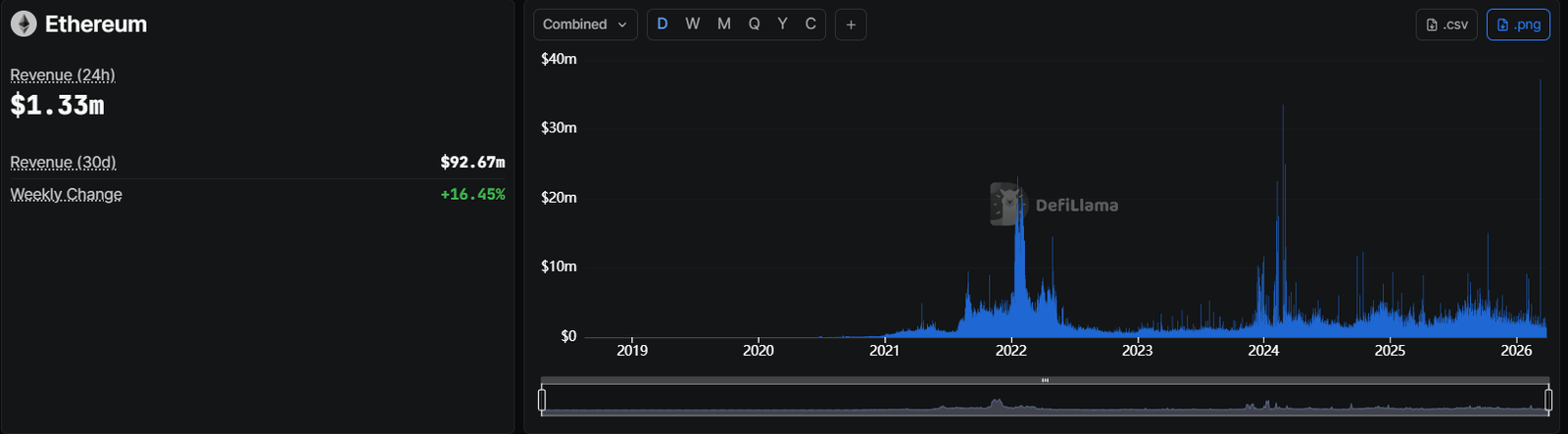
_Image Source: _DeFiLlama
Ethereum also changes the flow of money itself. Through EIP-1559, a portion of fees is burned. Higher demand can mean reduced net issuance, even deflationary conditions, which directly links economic security to user activity.
Bitcoin’s model depends more on whether fee growth catches up as subsidies fade. Ethereum’s model already shows how fee activity can influence supply dynamics.
Cultural factors may also steer capital. Galt claims Bitcoin’s ecosystem draws more macro narratives and institutional attention, with figures like Michael Saylor shaping public perception. He frames Bitcoin as increasingly positioned as a store-of-value asset.
Ethereum keeps a different emphasis. It still centers on programmability, decentralization, and iterative design choices rooted in its cypherpunk origins. Over time, that divergence could shape investors’ expectations for each chain as structural pressures intensify.
As Galt puts it, Bitcoin’s “problems” create both risk and a slower path to adaptation. As such, this gives Ethereum more room to gain share as the market starts pricing in longer-horizon security and coordination advantages.
Disclaimer: The information on this page may come from third parties and does not represent the views or opinions of Gate. The content displayed on this page is for reference only and does not constitute any financial, investment, or legal advice. Gate does not guarantee the accuracy or completeness of the information and shall not be liable for any losses arising from the use of this information. Virtual asset investments carry high risks and are subject to significant price volatility. You may lose all of your invested principal. Please fully understand the relevant risks and make prudent decisions based on your own financial situation and risk tolerance. For details, please refer to
Disclaimer.


