As the global electric vehicle market continues to expand, Tesla, as an industry leader, has remained under close watch from capital markets. With its brand strength, technological innovation, and first mover advantage, Tesla has established a strong competitive position in the EV industry, making TSLA one of the most closely watched growth stocks among investors.
However, strong growth potential often comes with elevated risk. As more automakers enter the new energy vehicle market, Tesla is facing growing competitive pressure. At the same time, its high valuation makes TSLA more sensitive to shifts in market expectations. For investors, understanding Tesla’s competitive landscape and the major risks it faces is essential to assessing TSLA’s investment value.
What Competition Does Tesla Face in the EV Market?
Although Tesla holds a leading position in the global new energy vehicle market, competition is becoming increasingly intense. As traditional automakers accelerate their transition to EVs and new electric vehicle brands rise quickly, the competitive environment Tesla faces is clearly different from the early stage of the market.
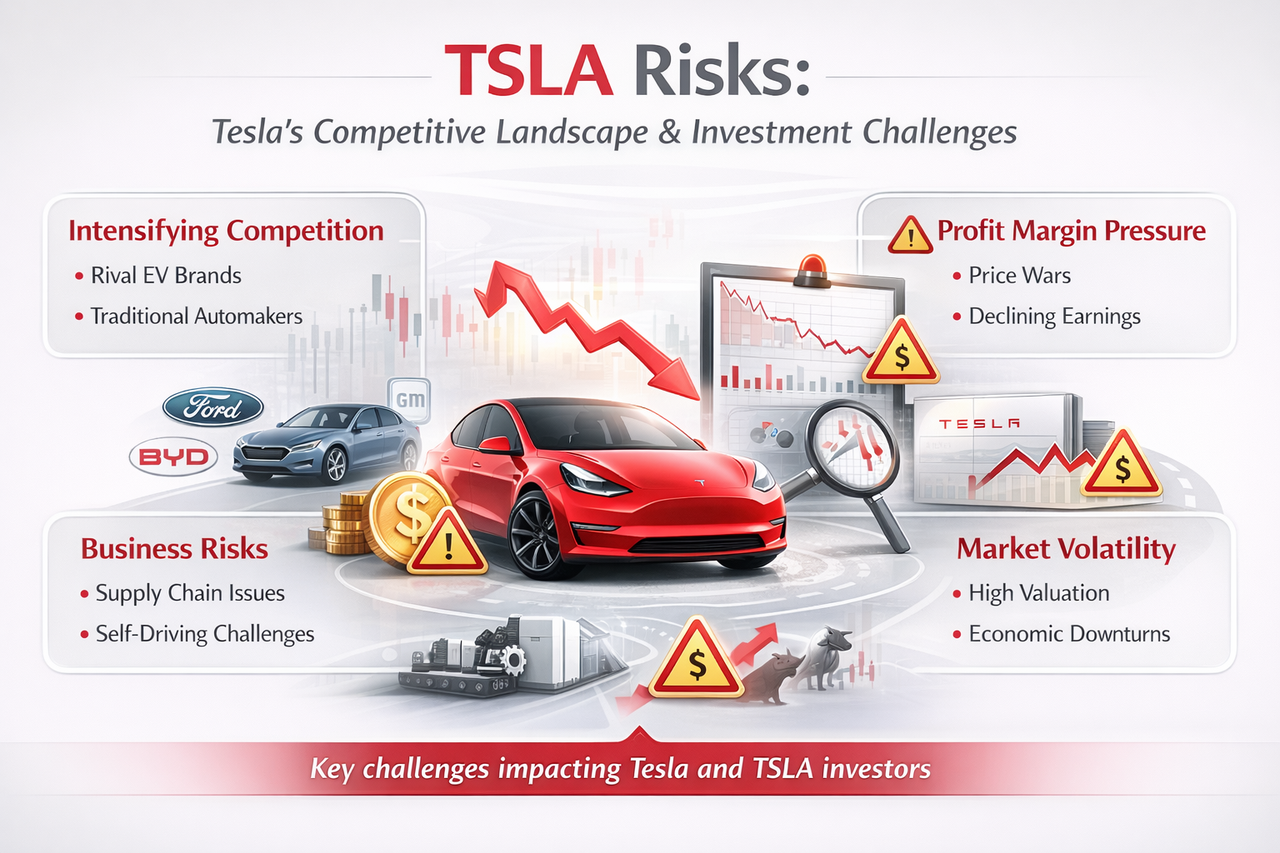
On one hand, traditional automakers have mature supply chains and global sales networks, and they are increasing investment in EV models. On the other hand, emerging EV companies are highly competitive in smart vehicle features and local market expansion. This landscape means Tesla must continue to maintain both its technological edge and cost advantage if it wants to preserve its current market position.
As the EV industry enters a more mature stage, competition has shifted from educating the market to fighting for market share, and this is one of Tesla’s most important current challenges.
Who Are Tesla’s Main Competitors?
Tesla’s main competitors currently come from two groups, traditional automakers and new energy vehicle companies. Among them, BYD is one of Tesla’s most important rivals in the global EV market, with clear strengths in sales volume and cost control.
In addition, traditional automakers such as Ford and General Motors are accelerating their EV strategies and using their brand recognition and distribution networks to compete for market share. At the same time, emerging brands such as NIO are creating pressure in the premium EV segment.
These competitors challenge Tesla across different markets and product categories, forcing the company to keep refining its products and pricing strategy while sustaining growth.
How Does Price Competition Affect Tesla’s Profitability?
Price competition is one of the key factors affecting Tesla’s profitability. To protect market share, Tesla has adopted price cuts in some markets to improve competitiveness and stimulate demand.
While lower prices can help drive sales volume, they also compress profit margins. For Tesla, aggressive pricing adjustments could reduce margins in its automotive business and weaken overall profitability. Because capital markets have high expectations for both Tesla’s growth and its margins, profit pressure caused by price competition often weighs on investor confidence.
As EV competition intensifies, Tesla needs to strike a balance between market share and profitability, making this one of the most important risks for investors to monitor.
What Business Risks Does Tesla Face?
Beyond competitive pressure, Tesla also faces a range of business risks. One is supply chain risk, including fluctuations in battery raw material prices and issues related to supply stability, both of which can affect production costs and delivery capacity.
Another is execution risk around technology. Tesla’s autonomous driving system is seen as an important growth engine, but its commercial rollout still depends on both technological maturity and regulatory policy. If progress falls short of expectations, the market may lower its long-term growth outlook for the company.
In addition, shifts in global demand can also affect Tesla’s operating performance. If growth in EV demand slows, Tesla’s revenue growth may come under pressure. These business risks can directly affect both profitability and market valuation.
What Market Risks Does TSLA Stock Face?
The main market risks facing TSLA come from valuation swings and changes in investor sentiment. Because Tesla is viewed as a growth stock, its valuation is typically higher than that of traditional automakers, which means the market has high expectations for its future growth.
If Tesla’s earnings growth falls short of expectations, or if macro conditions deteriorate and reduce investors’ appetite for risk, TSLA could experience sharp price volatility. This is especially true in a high interest rate environment, where growth stock valuations often come under pressure, directly affecting TSLA’s market performance.
In addition, shifts in market sentiment can amplify stock price swings. Even without a major change in company fundamentals, adjustments in investor expectations can trigger significant moves in the stock, making TSLA a highly volatile investment.
Does Tesla Still Have a Long Term Competitive Advantage?
Despite mounting competition, Tesla still retains certain long-term competitive advantages. First, it remains ahead in brand influence, with Tesla having become one of the defining names in the new energy vehicle industry. That gives its products strong market recognition.
Second, Tesla has an early mover advantage in autonomous driving, battery technology, and charging infrastructure. These accumulated strengths help support its competitive moat. In addition, its global manufacturing footprint and economies of scale also support cost control.
That said, whether these advantages can last will depend on Tesla’s ability to keep innovating and respond effectively to competitive pressure. So while its long-term edge still exists, it is not guaranteed.
Which Key Metrics Should Investors Watch When Investing in TSLA?
When evaluating TSLA, investors should focus on Tesla’s operating data and market performance in order to judge both its growth potential and risk level.
The key metrics to watch include:
-
Growth in vehicle deliveries
-
Changes in gross margin
-
Progress in autonomous driving
-
Changes in market share
-
Revenue growth and profit performance
These indicators reflect Tesla’s competitiveness and profitability, and they are also important benchmarks the market uses to assess TSLA’s investment value. If any of these key metrics weaken significantly, the stock could come under pressure.
Conclusion
Although TSLA has long-term growth potential, its investment risks should not be overlooked. Intensifying industry competition, price war pressure, execution risk, and valuation volatility can all affect Tesla’s profitability and share price performance.
For investors, understanding Tesla’s competitive landscape and the key risks it faces can lead to a more rational assessment of TSLA’s investment value. Only by fully understanding both the growth story and the potential downside can investors make more disciplined investment decisions.
FAQs
What are the main risks of TSLA?
The main risks include intensifying competition, margin pressure from price wars, business growth falling short of expectations, and valuation volatility.
Who is Tesla’s biggest competitor?
BYD is one of Tesla’s most important competitors today, alongside companies such as Ford, GM, and NIO.
What risk comes with Tesla’s high valuation?
A high valuation means the market has strong expectations for Tesla’s future growth. If results disappoint, the stock price could see significant volatility.
What data should investors watch when evaluating TSLA?
Investors should focus on key metrics such as vehicle deliveries, gross margin, market share, revenue growth, and progress in autonomous driving.