Ethereum-based decentralized finance (DeFi) lending protocol Fira said on Tuesday it was launching with about $450 million in deposits, highlighting demand for fixed-rate onchain credit.
Fira said the protocol’s fixed-rate credit market allows users to lock borrowing costs and lending returns for defined periods by organizing lending around maturities rather than floating utilization-based rates, according to an announcement shared with Cointelegraph.
The fixed-rate model differs from most DeFi lending protocols, where borrowers cannot lock funding costs, and lenders cannot predict returns, making long-term DeFi lending less predictable. Fira’s said its model organizes markets by maturity and determines interest rates by supply and demand mechanics, replacing utilization algorithms that fluctuate with borrowing activity.
Fira said the design is intended to create a more predictable onchain credit market by introducing yield curves and defined maturities, features that are standard in traditional fixed-income markets but rare in DeFi.
Fira is not the first DeFi lending protocol built around fixed-rate credit. Other protocols with similar structures include Notional Finance, IPOR and Term Finance.

Fira debuts fixed-rate onchain credit market. Source: Fira
Euler-linked liquidity migrated into Fira
Fira said it debuted with $450 million in deposits, which were “reallocated” from users of the modular lending platform Euler Finance during the pre-launch phase that started on Jan. 8, Pete Siegel, chief financial officer at Fira, told Cointelegraph.
“Fira was pre-launched in January. It opened with a first market called UZR, which enabled roughly a thousand users who were already on Euler, in a product available on Euler to migrate their assets at a fixed rate.”
Siegel said the deposits reflect user interest in fixed-rate lending products.
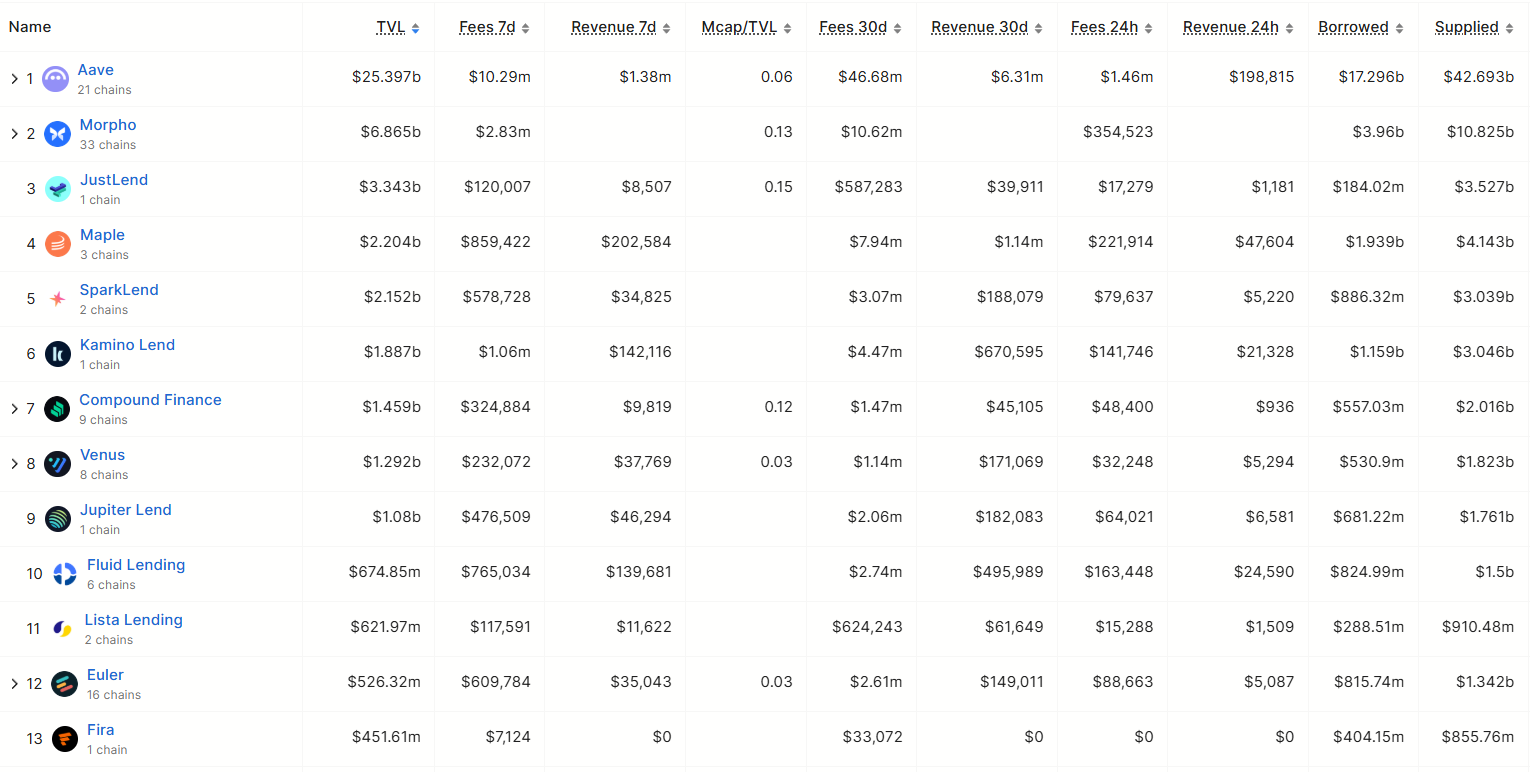
DeFi lending protocol rankings by TVL. Source: DeFiLlama
DefiLlama currently shows Fira with about $451.6 million in total value locked on Ethereum, compared with roughly $25.3 billion for Aave, the sector’s largest lending protocol.
**Related: **__Maestro launches mining-backed Bitcoin credit market for institutions
Fira said its smart contracts have undergone six independent security audits conducted by Sherlock, Spearbit via Cantina, Hexens and yAudit between November 2025 and early 2026.
Fira’s bug bounty program through Sherlock offers up to $500,000 in rewards for users finding critical vulnerabilities in the protocol’s open-source Ethereum-based smart contracts.
**Magazine: **__DeFi will rise again after memecoins die down: Sasha Ivanov
Cointelegraph is committed to independent, transparent journalism. This news article is produced in accordance with Cointelegraph’s Editorial Policy and aims to provide accurate and timely information. Readers are encouraged to verify information independently. Read our Editorial Policy https://cointelegraph.com/editorial-policy
- #Blockchain
- #Cryptocurrencies
- #Decentralization
- #Lending
- #Credits
- #DeFi
Disclaimer: The information on this page may come from third parties and does not represent the views or opinions of Gate. The content displayed on this page is for reference only and does not constitute any financial, investment, or legal advice. Gate does not guarantee the accuracy or completeness of the information and shall not be liable for any losses arising from the use of this information. Virtual asset investments carry high risks and are subject to significant price volatility. You may lose all of your invested principal. Please fully understand the relevant risks and make prudent decisions based on your own financial situation and risk tolerance. For details, please refer to
Disclaimer.
Gerelateerde artikelen
Lido EarnETH Vault Exposed to $21.6M rsETH Following Kelp Bridge Exploit, DAO Sets $3M Loss Protection
On April 18, a Kelp cross-chain bridge exploit led to the theft of $292 million in rsETH. Lido reported $21.6 million in exposure via its EarnETH vault, prompting Aave to freeze relevant markets. EarnETH has paused transactions and is deleveraging, while Lido's DAO treasury implemented a $3 million protection mechanism to cover potential losses. The core staking protocol remains unaffected.
GateNews30m geleden
Ripple Outlines Four-Phase Quantum-Safe Plan for XRP Ledger by 2028
Ripple has developed a four-phase roadmap to secure the XRP Ledger against quantum computing threats by 2028, addressing concerns over blockchain cryptography vulnerabilities. Key phases include researching quantum risks and implementing advanced security methods. XRP Ledger is currently better equipped than Bitcoin, with built-in key rotation enhancing safety.
GateNews5u geleden
Hong Kong Launches 24/7 Trading Framework for Tokenized Funds, AUM Reaches $1.37B
Hong Kong's Securities and Futures Commission (SFC) has established a regulatory framework for round-the-clock trading of tokenized products on licensed platforms. With 13 tokenized products and approximately HK$10.7 billion in assets, this initiative aims to integrate traditional finance with Web3 through regulated stablecoins and tokenized deposits, enhancing liquidity.
GateNews8u geleden
日本啟動 Canton 網路驗證專案、測試國債作為數位抵押品
JPX日本交易所集團旗下的JSCC與瑞穗、野村及Digital Asset合作,啟動基於Canton網路的概念驗證專案,測試日本國債作為數位抵押品的可行性,旨在提高金融市場流動性與管理效率,並確保不違背現行法規。此計畫也涵蓋跨境交易場景,預示著日本國債在數位資產領域的應用潛力。
ChainNewsAbmedia9u geleden
Vitalik Buterin Outlines Ethereum's 5-Year Roadmap Focused on Quantum Security and Scalability
Vitalik Buterin presented Ethereum's five-year roadmap, focusing on quantum security and scalability. Key goals include increasing gas limits, implementing Zero Knowledge Proofs, and enhancing transaction confirmation times by 2028, despite challenges with quantum-resistant signatures.
GateNews9u geleden
Nexchain Smart Actions Brings AI to Autonomous Web3
Nexchain introduced Smart Actions, a suite of intelligent modules designed to transform blockchain networks from manual, reactive systems into autonomous and self-optimizing environments, according to an announcement on April 18, 2026. The product reflects the company's commitment to building
CryptoFrontier11u geleden


