As the digital economy grows rapidly, cloud storage and cloud computing have become essential infrastructure for internet services. From data storage to application deployment, many enterprises rely on centralized cloud service providers to access resources and scale their operations. While this model improves efficiency, it also creates problems such as resource concentration, rising costs, and excessive centralization of data control.
Against this backdrop, decentralized physical infrastructure networks, or DePIN, have gradually become an important direction for Web3 infrastructure. By connecting globally distributed resources to a unified protocol network, DePIN aims to reshape how traditional infrastructure is supplied. Decentralized cloud networks are a key part of this shift.
What Is Impossible Cloud Network (ICNT)?
Impossible Cloud Network is a decentralized infrastructure protocol that provides cloud resource services through a distributed node network. Node operators can supply storage or computing resources to the network, while enterprises and developers can access those resources through the protocol, creating an open marketplace for cloud resources.
Unlike traditional cloud platforms, ICNT does not rely on a single service provider to manage resources in a centralized way. Instead, it coordinates supply and demand at the protocol layer. This design helps improve resource utilization and reduces cloud infrastructure’s dependence on any single platform.
At its core, ICNT turns the resource management, billing, and scheduling logic of traditional cloud services into protocol based processes, allowing cloud infrastructure to operate in a more open and distributed manner.
How Does Impossible Cloud Network Work?
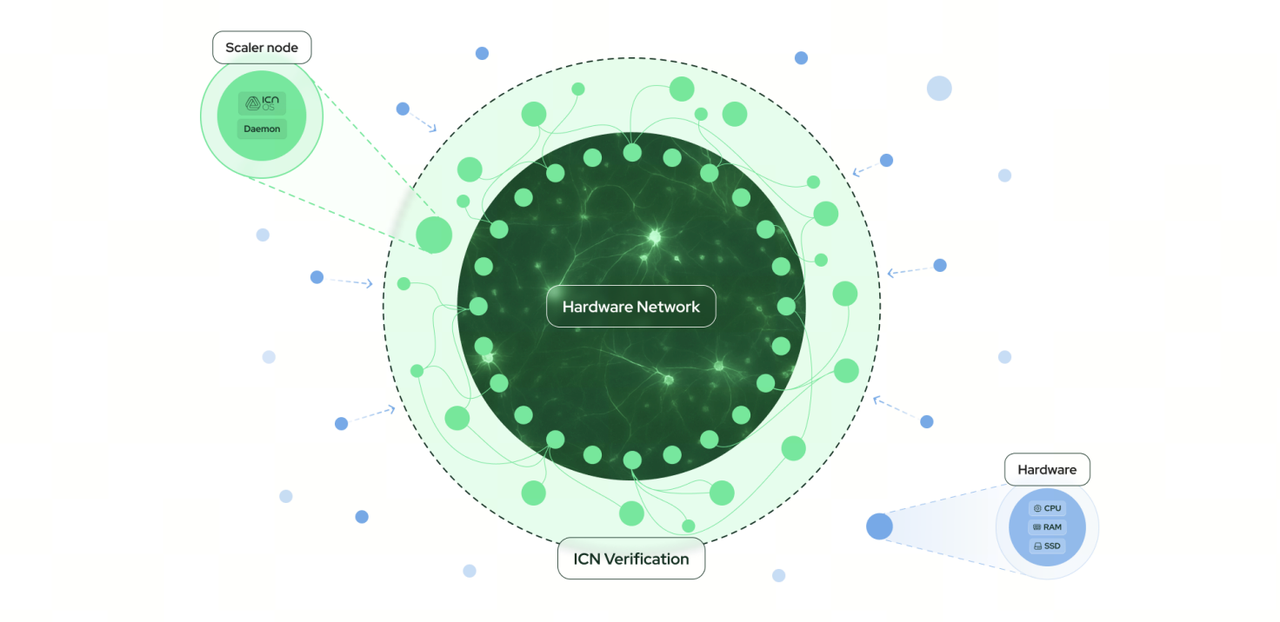
ICNT’s core operating logic is to connect distributed resource nodes to a unified protocol network so that resource supply and demand can be matched efficiently.
Node operators first connect their idle or dedicated storage, bandwidth, or computing resources to the network. The protocol then registers and schedules those resources based on resource type and service requirements. When a user submits a resource request, the protocol selects suitable nodes according to predefined rules and completes fee settlement after the service is delivered.
This model allows resource providers to earn incentives by contributing infrastructure, while resource users can access cloud service support through a protocol based process. Throughout the process, resource scheduling and fee distribution are coordinated by the protocol, improving transparency and flexibility across the resource marketplace.
Who Participates in the ICNT Network?
The ICNT network mainly consists of resource providers, resource users, and protocol governance participants.
Resource providers are usually node operators. They contribute storage or computing resources to the network and receive protocol incentives based on the services they provide. Resource users include developers, enterprise customers, and application service providers, who use the protocol to access network resources for data storage or computing needs.
In addition, governance participants use the token mechanism to take part in protocol parameter governance, such as resource pricing rules, reward distribution logic, and network upgrade decisions. Together, these roles form ICNT’s decentralized operating mechanism.
What Role Does the ICNT Token Play in the Network?
ICNT Token is an important part of how Impossible Cloud Network operates. It mainly serves three functions: payment, incentives, and governance.
For payments, users can use ICNT Token to pay for cloud resource usage. For incentives, node operators earn token rewards by providing resources. For governance, holders can participate in protocol governance and vote on key network parameters.
This mechanism makes ICNT Token an important medium connecting resource providers and resource users. At the same time, its incentive design helps expand the scale of network resources and supports stable service operations.
What Are the Use Cases of Impossible Cloud Network?
ICNT’s use cases are mainly focused on decentralized cloud storage, enterprise data services, and distributed computing infrastructure.
In cloud storage scenarios, the network can provide object storage services for enterprises. In data processing scenarios, it can support AI data infrastructure or large scale data access needs. In enterprise cloud service scenarios, it can serve as a complementary option alongside traditional cloud resources.
Because ICNT uses an open resource supply model, its use cases are not limited to on chain data support. They can also extend to enterprise grade infrastructure services, which is one of the key reasons it has growth potential within the DePIN sector.
How Is Impossible Cloud Network Different from Traditional Cloud Services?
The core difference between ICNT and traditional cloud services lies in how resources are organized and how the service architecture is structured.
Traditional cloud services rely on centralized platforms to provide resources, while ICNT integrates resource supply through a distributed node network. The former has advantages in service stability and centralized management, while the latter stands out for openness, resource cost efficiency, and resistance to single points of failure.
In addition, resource pricing and scheduling on traditional cloud platforms are controlled by the platform itself. ICNT, by contrast, uses protocol mechanisms to handle resource allocation and settlement. This makes the cloud resource market more transparent and gives resource providers a higher level of participation.
What Advantages and Challenges Does Impossible Cloud Network Face?
ICNT’s main advantages lie in its open resource supply mechanism, cost optimization potential, and decentralized resource allocation model. By connecting globally distributed resources to a protocol network, it may improve resource utilization and reduce infrastructure costs.
At the same time, decentralized cloud networks face challenges such as inconsistent node quality, more complex performance stability management, and difficulty in standardizing services. In enterprise level application scenarios in particular, finding the right balance between decentralization and service quality is a key issue that protocols of this kind must solve over the long term.
Conclusion
Impossible Cloud Network (ICNT) is a decentralized infrastructure protocol built for cloud storage and distributed cloud service scenarios. By integrating distributed node resources, it creates an open marketplace for cloud resources. Its core value lies in using the protocol to coordinate resource supply, payment settlement, and incentive distribution, giving enterprises and developers a more open cloud infrastructure option.
As DePIN becomes an important part of Web3 infrastructure, the decentralized cloud network model represented by ICNT is expanding the application boundaries of blockchain infrastructure. Whether in cloud storage, data processing, or enterprise grade infrastructure services, protocol based cloud resource networks are becoming an important direction for the development of decentralized infrastructure.
FAQs
Is ICNT a DePIN Project?
Yes. ICNT is a decentralized physical infrastructure network, or DePIN, project. Its goal is to provide cloud resource services through a distributed node network.
Does ICNT Provide Storage or Computing Resources?
ICNT can support both storage and computing resource services, including object storage, data processing, cloud infrastructure support, and related scenarios.
What Is the Main Role of ICNT Token?
ICNT Token is mainly used to pay for cloud resource fees, incentivize node operators, and participate in protocol governance.
What Is the Biggest Difference Between ICNT and Traditional Cloud Services?
The biggest difference lies in the resource supply model. Traditional cloud services rely on centralized platforms, while ICNT provides resources through a distributed node network.
What Are ICNT’s Use Cases?
Its use cases include decentralized cloud storage, AI data infrastructure, enterprise cloud services, and distributed computing support.