In cryptocurrency tokenomics, the burn mechanism is a critical tool for balancing supply and demand and controlling inflation. BNB, as a trailblazer in evolving from an Exchange Token to a public chain token, has transformed its burn process from early “manual operations” to today’s fully algorithm-driven model.
Grasping BNB’s burn logic is essential for understanding blockchain value capture. It not only affects token scarcity but also forms a direct feedback loop between BNB Chain ecosystem activity and Asset Value (USD). As competition among blockchains intensifies, this highly automated deflationary model has become a cornerstone of BNB’s competitive edge and market position.
Evolution of the BNB Burn Mechanism
BNB’s initial burn mechanism was based on quarterly buybacks and burns funded by exchange profits. To further decentralize and enhance predictability, the system introduced the Auto-Burn algorithm, separating the burn logic from centralized exchange decisions. This marked BNB’s entry into a new era of “objective deflation” driven by code and on-chain data.
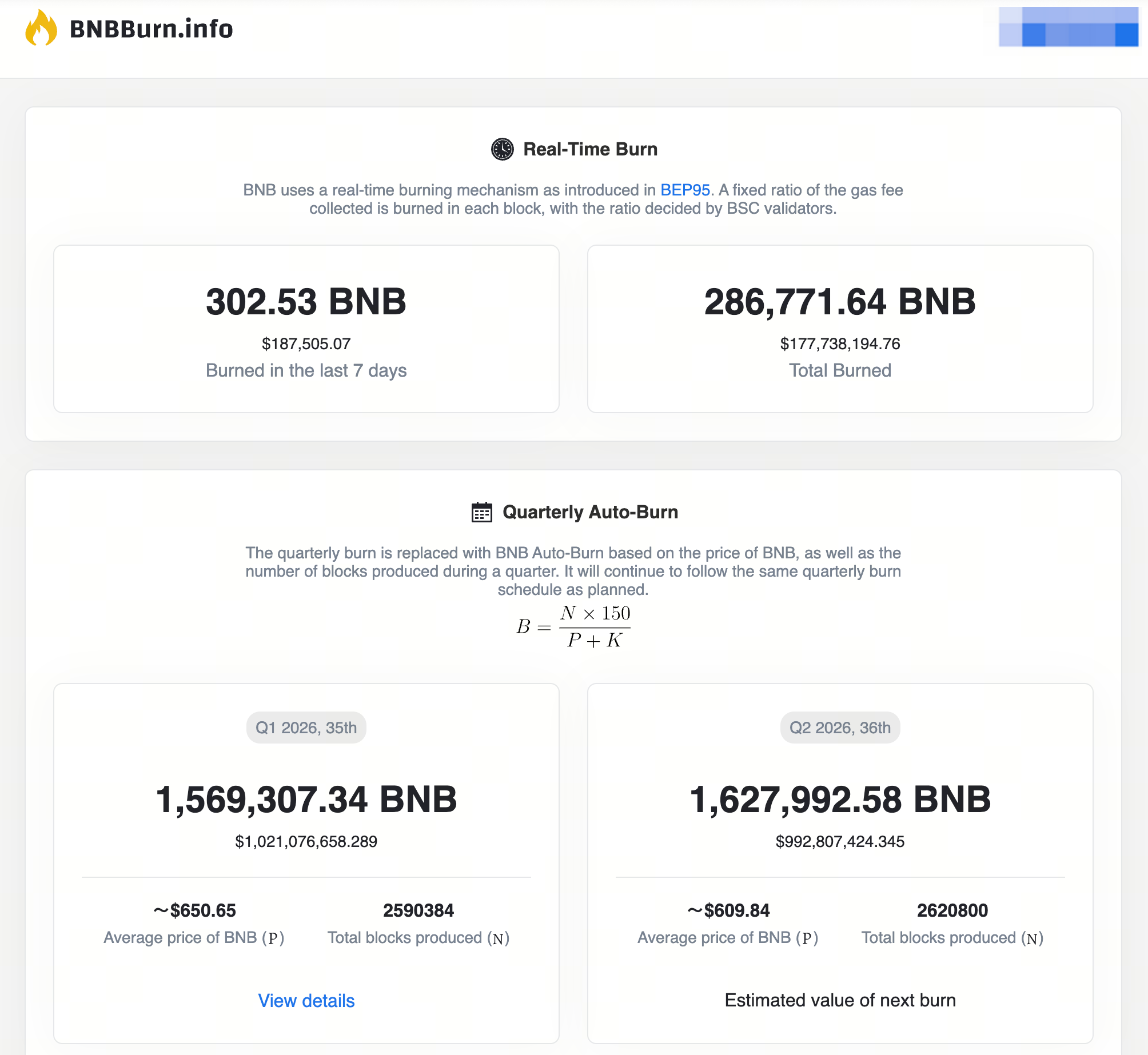 Image source: BNBBurn
Real-Time Burn Mechanism: BEP-95 Protocol Explained
Real-Time Burn, enabled by the BEP-95 proposal, operates similarly to Ethereum’s EIP-1559.
-
How it works: Every transaction on BNB Smart Chain generates Gas fees. BEP-95 requires that a fixed ratio—typically 10%—of these Gas fees is immediately sent to a black hole address, permanently removing them from circulation.
-
Core function: This mechanism directly ties BNB’s burn rate to network usage. The busier the network, the more is burned, providing real-time relief from inflationary pressure as the network grows.
How Is Quarterly Auto-Burn Calculated?
Unlike the original quarterly burn, Auto-Burn no longer references exchange profits, but instead uses a transparent mathematical formula.
-
Formula variables: The calculation primarily considers BNB’s average price and the number of blocks produced on BSC during the quarter.
-
Reverse adjustment mechanism: If BNB’s price falls, the burn volume increases automatically; if the price rises, the burn volume decreases accordingly. This design ensures the value burned stays within a reasonable range regardless of market volatility, ultimately targeting a total supply of 100 million tokens.
Key Differences Between the Two Burn Mechanisms
To clarify the differences between these two parallel mechanisms, see the comparison table below:
| Dimension |
Real-Time Burn (BEP-95) |
Quarterly Auto-Burn (Auto-Burn) |
| Trigger Frequency |
Every transaction |
Once per quarter |
| Driver |
On-chain transaction activity (Gas fees) |
Token price and block production |
| Transparency |
Real-time on-chain verification |
Algorithmic preset, on-chain execution |
| Main Purpose |
Offset network inflation |
Achieve long-term total supply deflation target |
Long-Term Impact of the Burn Mechanism on the BNB Ecosystem
By continuously removing tokens from circulation, BNB has established a “deflationary premium” expectation. This not only boosts confidence among token holders, but through BEP-95, directly links ecosystem growth returns to every token. By reducing circulating supply, this mechanism provides strong economic support for the asset’s long-term value and incentivizes Developers to build on a high-efficiency, low-cost deflationary network.
Summary
BNB’s burn mechanism, driven by the real-time adjustments of BEP-95 and the macro-level control of Auto-Burn, creates a sophisticated and decentralized deflationary system. This framework ensures BNB’s supply steadily decreases, tightly linking its scarcity to the underlying public chain’s activity, making it one of the most representative tokenomics models in the crypto market today.
FAQs
Can burned BNB ever be recovered?
No. The burn process sends tokens to a black hole address with an unrecoverable Private Key, permanently removing them from circulation.
Why is the total supply target set at 100 million?
This goal was established in BNB’s original economic white paper to ensure token scarcity and long-term value appreciation by reducing the supply by half.
Does the burn mechanism directly cause BNB’s price to rise?
The burn mechanism improves supply-demand dynamics by reducing supply, which is a positive factor for price. However, price is also influenced by overall market conditions, macroeconomic factors, and user demand.
Do users have to pay extra fees to participate in the burn?
No. Real-Time Burn is deducted from Gas fees already paid to the network and does not increase transaction costs for regular users.







