Recent on-chain data shows a clear shift in how demand is forming around Hyperliquid (HYPE). A “whale” deposited 4 million USDC, then purchased approximately 56,208 HYPE with a total value of around 2.1 million USD at a price of 38.21 USD.
Notably, the accumulation process did not stop at a single transaction. A TWAP (Time-Weighted Average Price) order has been continuously deployed, targeting 99,000 HYPE over a 10-hour period, reflecting a controlled and extended buying strategy. This approach helps absorb supply effectively while limiting negative impacts on price volatility.
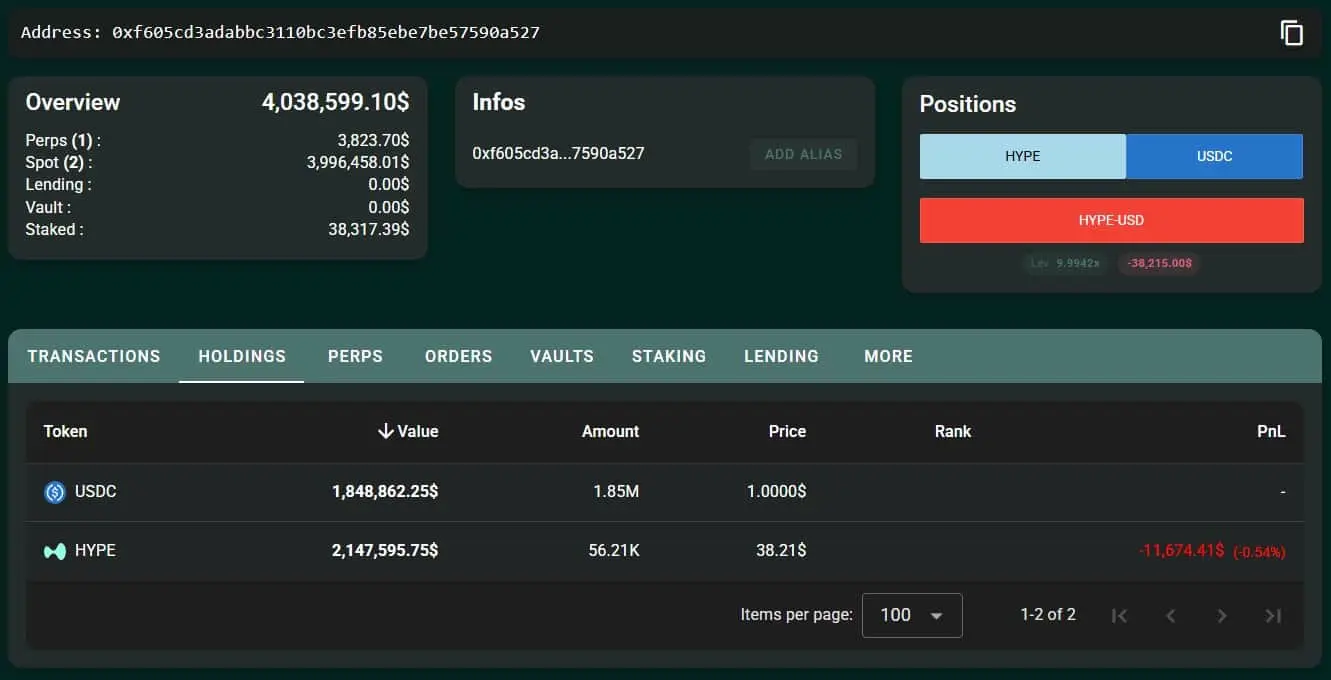 Source: The combination of these capital flows has contributed to tightening the circulating supply and reinforcing the support zone, especially as the price remains above the 40 USD mark despite previous selling pressure of up to 22 million USD. In this context, HYPE increasingly demonstrates characteristics of a revenue-generating asset, driven by actual usage levels rather than just market “narratives.”
HYPE supply is deflationary, but floating exchange rates remain a determining factor
The current demand structure is shifting focus toward how the actual supply operates in the market. Hyperliquid has removed approximately 37.5 million HYPE through a burning mechanism, while daily buyback programs continue to absorb circulating tokens.
At the time of writing, the circulating supply stands at about 238.4 million out of a total of 962 million HYPE, indicating that a large portion remains locked or has not entered circulation. This is particularly important, as price volatility is directly influenced by the amount of supply available for trading, rather than nominal supply reduction metrics.
As buyback activities move tokens into system addresses and long-term holding wallets, the circulating token supply continues to shrink, thereby increasing price sensitivity to new demand. However, supply pressure could still return through the distribution of approximately 1.2 million HYPE each month, along with profit-taking activities from whales during upward movements.
This trend indicates that the deflationary mechanism plays a role in supporting price stability, but a sustainable upward trend can only be established if circulation continues to contract while demand remains stable.
Is HYPE demand sustainable or just a result of cash flow?
Current price dynamics raise a core question: is the current demand sustainable enough or is it merely short-term? The recent support zone reflects structured cash inflows, yet the market is testing the sustainability of this demand amid a lack of clear catalysts.
The reason lies in the fact that the protocol’s buyback activity is directly dependent on trading volume. When liquidity remains high, this mechanism helps fortify prices; conversely, any reduction in volume could quickly weaken the support foundation.
Additionally, while the controlled accumulation process shows clear intent from investors, it is still not enough to assert a long-term holding trend—especially if the primary goal is to optimize short-term positions. In a broader market context where demand does not keep pace, these cash flows often prove to be temporary.
Thus, HYPE finds itself in a fragile equilibrium: if demand continues to be maintained, the upward trend will be reinforced; conversely, as activity weakens, prices may quickly face corrective pressure as the short-term support layer gradually disappears.
Disclaimer: The information on this page may come from third parties and does not represent the views or opinions of Gate. The content displayed on this page is for reference only and does not constitute any financial, investment, or legal advice. Gate does not guarantee the accuracy or completeness of the information and shall not be liable for any losses arising from the use of this information. Virtual asset investments carry high risks and are subject to significant price volatility. You may lose all of your invested principal. Please fully understand the relevant risks and make prudent decisions based on your own financial situation and risk tolerance. For details, please refer to
Disclaimer.


