What Is Dash (DASH)?
Dash (symbol: DASH) is a payment-focused cryptocurrency designed to function as “digital cash” for everyday transactions and online transfers. Operating on a decentralized blockchain network—meaning no single entity controls its transaction validation or ledger maintenance—Dash leverages blockchain’s distributed ledger to record transactions in chronological order.
Key features of Dash include rapid transaction confirmations, low fees, optional privacy, and community-driven governance. In addition to miners, the network utilizes a “masternode” system that enables instant confirmations and governance voting, offering a payment experience similar to using a card or mobile app.
Current Price, Market Cap, and Supply of Dash (DASH)
As of 2026-01-20, Dash is priced at $74.18, with a circulating market capitalization of approximately $931.52 million and a 24-hour trading volume around $6.46 million. The current circulating supply is 12,557,189.526285 DASH, with a total supply of 12,557,595.115829 DASH and a maximum supply cap of 18,920,000 DASH—meaning Dash is not subject to unlimited inflation. The fully diluted market cap is approximately $931.52 million, calculated based on the current price and the maximum possible supply.
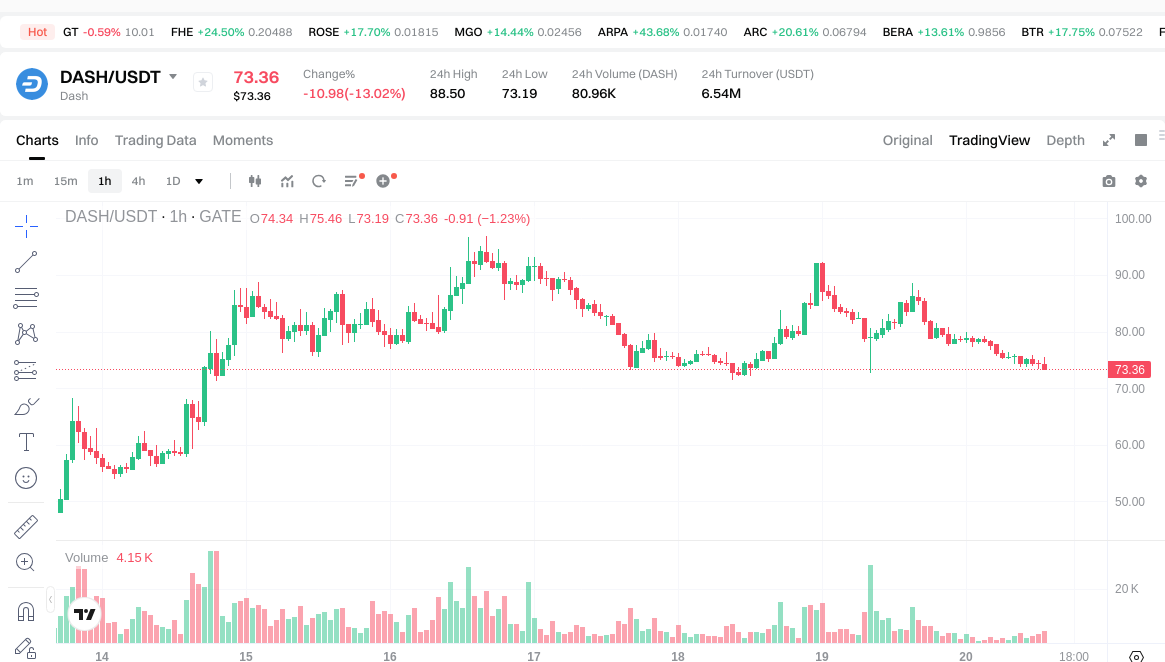
Click to view DASH USDT Price
Short-term price changes: 1 hour: -0.62%, 24 hours: -10.19%, 7 days: +62.89%, 30 days: +89.059%.
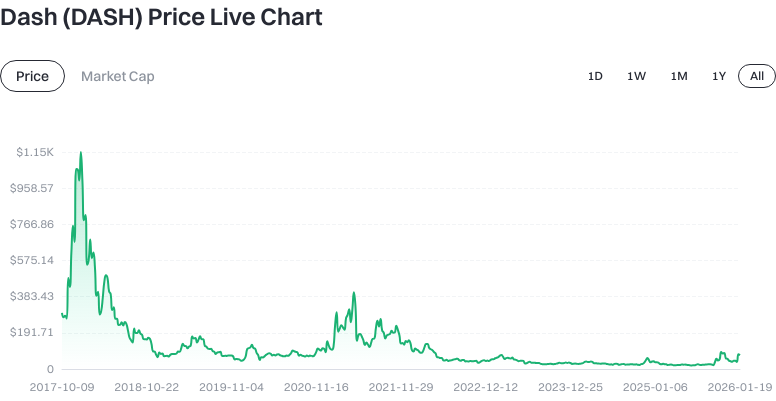
Click to view latest DASH price action
“Market capitalization” is calculated as price multiplied by circulating supply. “Fully diluted market cap” estimates the total value if all tokens are issued at current prices.
Data source: This page’s reference data, updated as of 2026-01-20.
Who Created Dash (DASH) and When?
Dash launched on 2014-01-17, originally named XCoin, later rebranded as Darkcoin before settling on Dash (“Digital Cash”). Evan Duffield was an early driving force behind the project. Through community-driven development, Dash established its masternode system along with on-chain governance and a treasury mechanism.
This history explains Dash’s “payments-first” technical approach and feature set, with multiple iterations enhancing instant confirmation and resistance to network attacks.
Source: Dash project public materials and community documentation as of 2024-10.
How Does Dash (DASH) Work?
Dash utilizes Proof of Work (PoW) consensus—meaning miners compete using computational power to secure the network by packaging blocks. It employs the X11 algorithm, which emphasizes energy efficiency and multi-hash security.
In addition to miners, “masternodes” are nodes with stable uptime, sufficient bandwidth, and a collateral requirement (historically 1000 DASH). Masternodes provide:
- InstantSend: Masternodes lock transaction inputs for rapid confirmation—typically within seconds—giving users high confidence in settlement.
- PrivateSend: An optional privacy feature that mixes multiple transactions and splits funds to obscure on-chain traceability.
- ChainLocks: Masternodes rapidly lock blocks to reduce reorganization risks and prevent 51% attacks.
- Governance & Treasury: Masternodes vote on proposals; the treasury issues monthly budgets to fund ecosystem initiatives and development.
Block rewards are distributed proportionally among miners, masternodes, and the treasury to ensure ongoing network security and ecosystem growth.
Source: Dash technical documentation and community resources as of 2024-10.
What Can You Do With Dash (DASH)?
- Merchant Payments & Online Purchases: Users can pay via mobile wallet QR codes with low fees and fast confirmation, making Dash suitable for cafés, e-commerce stores, and more.
- Cross-Border Remittance: For international transfers, Dash helps avoid correspondent banking delays and high fees; recipients receive funds quickly for local conversion.
- Micropayments & Tips: Small-value transfers benefit from Dash’s low cost and fast settlement.
- Governance Participation: Token holders who operate masternodes can vote on proposals that shape product development and community growth.
Dash (DASH) Wallets and Ecosystem Extensions
Popular wallets include the desktop Dash Core and the mobile Dash Wallet, both supporting sending, receiving, and privacy configurations. Some hardware wallets (such as Ledger and Trezor) provide offline private key storage for added security. On the merchant side, POS apps and e-commerce plugins (like WooCommerce community extensions) enable fast integration.
Always download from official or trusted sources and verify signature checksums and update logs before use.
Source: Official and community public resources as of 2024-10.
Key Risks and Regulatory Considerations for Dash (DASH)
- Price Volatility: Cryptocurrency prices are subject to significant fluctuations driven by market sentiment and liquidity; prudent fund management is advised.
- Privacy Feature Regulation: Privacy functions like PrivateSend may face stricter scrutiny in some jurisdictions, potentially impacting compliance or exchange listings.
- Masternode Concentration & Governance: Collateral requirements may introduce centralization risk; proposal voting and budget allocation can be contentious.
- Network & Wallet Security: Malware, phishing links, or incorrect addresses can result in asset loss; strict security practices are essential.
- Account & Exchange Risks: Platform risk controls, withdrawal limits, or account security incidents may impact user experience—always enable security features and maintain backups.
- Taxation & Compliance: Crypto asset reporting and tax treatment varies by jurisdiction; follow local regulations accordingly.
How to Buy and Securely Store Dash (DASH) on Gate
Step 1: Register and Complete Identity Verification. Visit the Gate website to create an account and complete KYC procedures to enable deposits and trading.
Step 2: Prepare Funds. Purchase USDT via fiat gateways on Gate or deposit USDT from your own wallet, ensuring you have enough funds plus extra for fees.
Step 3: Select Trading Pair and Place Order. Search for “DASH” on Gate to access the DASH/USDT spot trading pair. Choose between market or limit orders as needed; watch out for slippage and fees—splitting trades can help manage volatility.
Step 4: Withdraw to Self-Custody Wallet. For long-term holding or spending, go to Gate’s withdrawal page, select the Dash mainnet, and paste your Dash address. Test with a small amount before full withdrawal; confirm network selection, address format, and miner fee settings.
Step 5: Enhance Security. Enable two-factor authentication (2FA) and set up a withdrawal whitelist; backup your wallet’s recovery phrase offline—never store it in photos or cloud drives.
Step 6: Ongoing Maintenance. Stay informed about Dash network upgrades and wallet updates; regularly verify backup usability and practice address/signature recovery when necessary.
How Does Dash (DASH) Differ from Litecoin?
- Technical Algorithm: Dash uses X11 PoW; Litecoin uses Scrypt PoW—both use Proof of Work but different algorithms.
- Confirmation Mechanism: Dash offers InstantSend and ChainLocks via masternodes for faster, high-confidence confirmations; Litecoin accelerates speed with ~2.5-minute block times but lacks an instant-locking masternode layer.
- Privacy Features: Dash provides optional coin-mixing privacy features; Litecoin’s main chain does not natively support privacy mixing.
- Governance & Treasury: Dash supports on-chain governance with a treasury budget; Litecoin relies mainly on off-chain community/foundation governance.
- Supply Cap: Dash has a max supply of ~18,920,000 coins; Litecoin’s cap is ~84,000,000 coins.
Both are payment-friendly cryptocurrencies—users can choose based on preferences for confirmation speed, privacy options, or governance structures.
Source: Public project materials and technical documentation as of 2024-10.
Summary of Dash (DASH)
Positioned as “digital cash,” Dash combines Proof of Work with a masternode second layer to achieve fast transactions, low fees, optional privacy, on-chain governance, and capped supply. Its price and market cap are notably volatile; users should prioritize account/wallet security, compliance requirements, and privacy-related regulatory risks when using Dash. When purchasing through Gate, conduct small test transactions first, trade in batches, verify network/address details, enable 2FA/withdrawal whitelists, and securely back up recovery phrases. Monitoring ecosystem adoption, governance proposals, and technical updates can help assess long-term utility and risk-reward profiles.
FAQ
What Is Dash?
Dash is a cryptocurrency focused on privacy and payments. It enables anonymous transactions through its PrivateSend feature while combining Bitcoin’s decentralization with faster transaction speeds. Designed for everyday payments, Dash operates a masternode network that rewards ecosystem participants.
How Does Dash Differ from Bitcoin?
Both are cryptocurrencies, but Dash places greater emphasis on privacy protection and usability. Dash offers much faster transactions (with near-instant confirmations) and an optional PrivateSend privacy feature; Bitcoin transactions are fully transparent but settle more slowly. Furthermore, Dash uses a masternode governance model while Bitcoin relies solely on mining.
How Do I Trade Dash on Gate?
You can buy and trade Dash directly on the Gate platform. Register an account with completed verification; search for DASH trading pairs (such as DASH/USDT) in spot markets; choose buy or sell options; enter your quantity/price and confirm your order. Beginners are encouraged to start small while learning platform operations.
How Does Dash’s PrivateSend Feature Work?
PrivateSend is Dash’s privacy mechanism using coin-mixing technology to hide transaction histories and fund flows. When enabled by users seeking anonymity, multiple transactions are mixed together so external observers cannot trace the source of funds—ideal for those prioritizing transaction privacy.
Is Dash Suitable for Long-Term Holding?
As a utility-focused cryptocurrency with an active community and ongoing technical development, Dash offers privacy features and payment capabilities suited for specific scenarios. However, crypto investments carry inherent risks—decide based on your risk tolerance. This is not investment advice; always check latest prices/news on Gate or other platforms before participating.
Quick Reference Glossary for Dash (DASH)
- Privacy Transaction: A feature that hides sender/recipient details and amounts using coin-mixing technology.
- Masternode: A node running specialized software that maintains the network and earns rewards; requires a set DASH collateral.
- Instant Payments: Rapid transaction confirmation via the masternode network—settling within seconds.
- Coin Mixing: A privacy technique that blends multiple transactions together to obfuscate blockchain tracking.
- Proof of Work: A consensus mechanism where miners solve computational puzzles to validate transactions and earn rewards.
- Governance Voting: A democratic process where masternode operators vote on network upgrades and funding allocations.
Further Reading & References for Dash (DASH)
-
Official Website / Whitepaper:
-
Development / Documentation:
-
Authoritative Media / Research: