As the blockchain ecosystem rapidly evolves, various public chains have developed their own independent asset networks—such as BTC on the Bitcoin network, ETH on the Ethereum network, and native assets on other public blockchains. While each of these assets holds intrinsic value, they lack direct interoperability. As a result, users typically rely on centralized exchanges or Bridges to facilitate asset swaps.
This approach introduces both efficiency and security concerns. Centralized platforms increase custodial risk, while Bridges—due to their technical complexity—are frequent targets for security breaches. The market, therefore, urgently needs a decentralized cross-chain liquidity solution that enables direct native asset swaps. THORChain was designed precisely in response to this demand.
What Is THORChain?
THORChain is a decentralized cross-chain liquidity protocol focused on enabling direct swaps of native assets across different blockchains. Leveraging an Automated Market Maker (AMM) mechanism and liquidity pool architecture, THORChain allows users to perform Cross-Chain Transactions between assets like BTC and ETH without intermediaries.
Unlike traditional Bridges, THORChain doesn’t rely on wrapped assets. Instead, it uses RUNE as a settlement intermediary for Trades. For instance, when a user swaps BTC for ETH, the protocol first exchanges BTC for RUNE, then RUNE for ETH—completing the Cross Chain Swap. This model not only reduces liquidity fragmentation but also increases the efficiency of Cross-Chain Transactions.
What Is the Utility of the RUNE Token?
RUNE is the core token of the THORChain network, playing a critical role in liquidity settlement, node security, and incentive distribution throughout the protocol. Since all liquidity pools are paired with RUNE, every Cross Chain Swap requires RUNE as an intermediary, so protocol trading volume growth directly increases demand for RUNE.
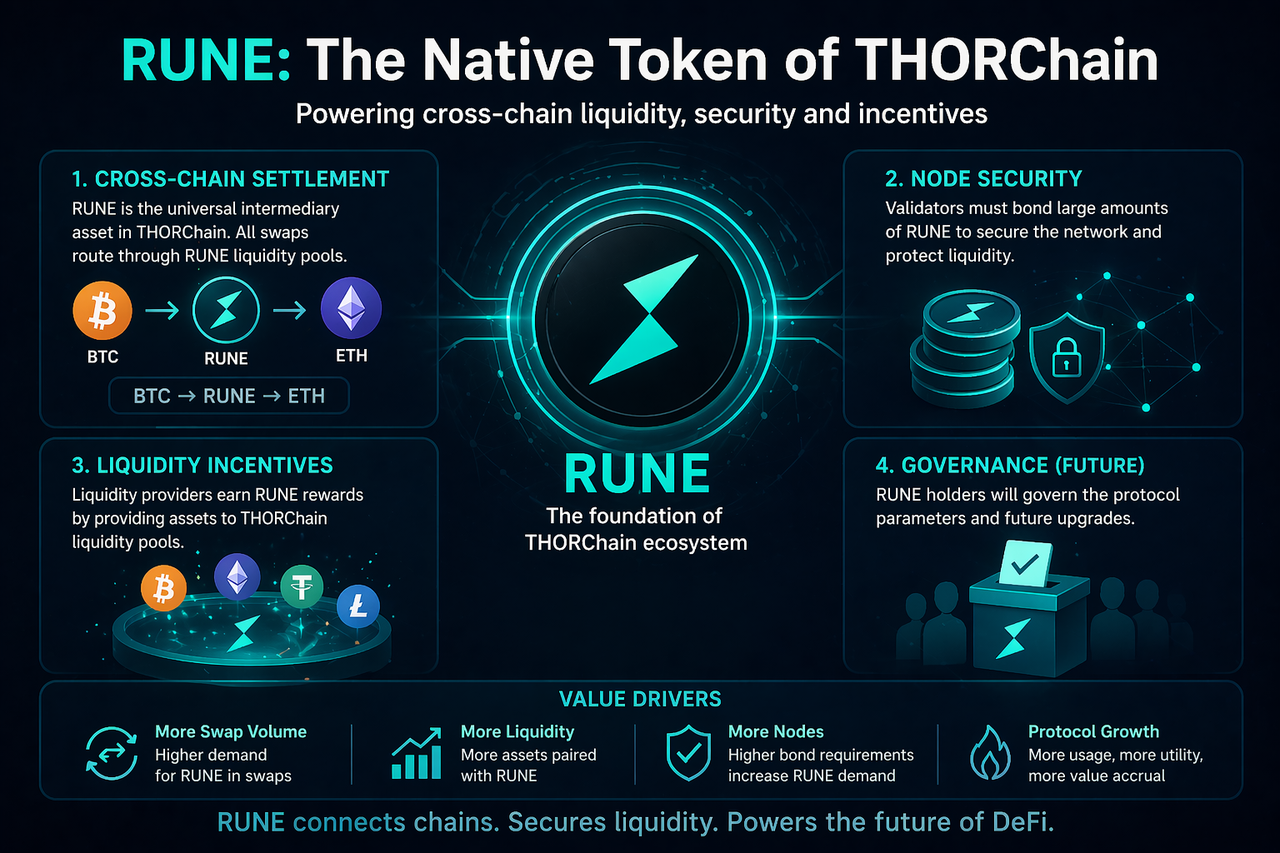
Beyond settlement, RUNE is also used for node staking. Validator nodes must Stake a specified amount of RUNE to participate in network operations, raising the cost of malicious behavior and securing Cross-Chain Transactions. Additionally, Liquidity Providers earn RUNE rewards for supplying Assets, making RUNE a key component of the ecosystem’s incentive structure.
How Does THORChain Enable Cross-Chain Transactions?
THORChain’s Cross-Chain Transactions are powered by the coordinated operation of liquidity pools and a node network. When a user submits a Cross Chain Swap request, the protocol first exchanges the input Asset for RUNE, then swaps RUNE for the target Asset from the destination chain’s liquidity pool. This dual-swap model eliminates the need to create a dedicated trading pool for every possible asset pair.
To support this process, THORChain’s architecture includes liquidity pools, validator nodes, and fund custody modules. Nodes monitor on-chain Trades across multiple blockchains and validate Asset statuses, while the funds pool ensures liquidity for Asset swaps. This structure enables decentralized cross-chain Asset exchange.
THORChain’s Technical Architecture
THORChain’s foundation consists of a consensus mechanism, fund management system, and cross-chain communication module. The protocol employs the Tendermint consensus mechanism to coordinate node activity and uses the Vault system to manage funds across different chains.
Additionally, the Bifröst module connects THORChain to external blockchain networks, enabling on-chain Trade monitoring and Asset transfer verification. The synergy among these technical modules allows THORChain to deliver native asset cross-chain liquidity without relying on centralized custodians.
What Are the Advantages of THORChain?
THORChain’s primary advantage is its ability to facilitate decentralized native asset cross-chain swaps. Users don’t need to convert BTC to wrapped assets or trust centralized platforms for custody—they can directly swap Assets across chains, significantly lowering the barrier to cross-chain usage.
Its liquidity pool model also enhances swap efficiency and centralizes liquidity management in a multi-chain environment. This design not only improves user experience but also lays the foundation for future cross-chain DeFi applications, making THORChain a leading example of cross-chain liquidity infrastructure.
THORChain vs. Traditional Bridges: Native Cross-Chain Swap Comparison
THORChain and traditional Bridges differ fundamentally in asset handling, security models, and use cases. Traditional Bridges primarily transfer Assets, while THORChain focuses on decentralized native asset swaps, offering a superior cross-chain liquidity experience.
| Comparison Dimension |
THORChain |
Traditional Bridge |
| Core Function |
Native asset cross-chain swap |
Cross-chain asset transfer |
| Asset Type |
Native asset |
Wrapped asset |
| Swap Method |
Via RUNE liquidity pool |
Mint mapped asset after locking |
| Need for Wrapped Asset |
Not required |
Required |
| Liquidity Source |
Decentralized liquidity pool |
Bridged asset reserves |
| Security Mechanism |
Node staking + liquidity pool |
Lock contract + verification mechanism |
| Main Risk |
Node and protocol risk |
Bridge contract attack risk |
| Application Scenario |
Cross-chain asset swap |
Cross-chain asset migration |
| User Experience |
Direct native asset swap |
Bridge first, then trade |
| Degree of Decentralization |
High |
Varies by bridge type |
In summary, THORChain enables true native asset cross-chain swaps, eliminating the extra complexity of wrapped assets and reducing reliance on bridged reserves. For cross-chain swaps, THORChain is better positioned as liquidity infrastructure compared to traditional Bridges.
Risks and Limitations of THORChain
Despite its advantages, THORChain faces certain risks. Cross-chain protocols are inherently complex, and any code vulnerabilities can have security implications. Low liquidity depth may also result in higher Slippage for large Trades, affecting the trading experience.
As competition among cross-chain infrastructure intensifies, THORChain must also address market pressure from other protocols. The long-term value of RUNE depends not only on its technical strengths but also on sustained protocol adoption and ecosystem growth.
Summary
THORChain delivers native asset cross-chain swaps through decentralized liquidity pools, providing essential liquidity infrastructure for multi-chain ecosystems. RUNE is central to the protocol, supporting liquidity settlement, node security, and incentive distribution.
As cross-chain demand continues to rise, THORChain’s strategic value in the DeFi ecosystem is increasing. For those focused on cross-chain infrastructure, THORChain is a project to watch, and the long-term value of RUNE is closely tied to the protocol’s future development.
FAQs
What does THORChain do?
THORChain is a decentralized liquidity protocol that enables native asset cross-chain swaps, allowing users to exchange assets directly across different blockchains.
What is RUNE used for?
RUNE is used for cross-chain transaction settlement, node staking, and liquidity incentives. It is the core token powering THORChain protocol operations.
Does THORChain require wrapped assets?
No. THORChain supports direct swaps between native assets—there’s no need to wrap assets into other forms.
Does RUNE have long-term value?
RUNE’s long-term value is driven by cross-chain transaction growth, node staking demand, and protocol liquidity expansion.







