In the traditional financial system, lending rates are usually set by banks or financial institutions based on market conditions and risk assessments. This model relies on centralized institutions to manage the cost of capital and manually adjust the price of borrowing and lending. In decentralized lending protocols, however, there is no intermediary responsible for setting interest rates, so an automated mechanism is needed to price capital.
One of the core goals of DeFi lending protocols is to let the market determine the price of capital in an open and transparent way. Compound achieves this through an algorithmic interest rate model, allowing borrowing and lending rates to adjust in real time as capital supply and demand change. This helps maintain liquidity and lending balance in the pool without manual intervention.
Why Is Compound’s Interest Rate Model Important?
In Compound’s lending system, the interest rate model directly affects two key market behaviors: the borrowing cost for borrowers and the yield earned by depositors. If rates are too low, large amounts of capital may be borrowed while deposits become insufficient; if rates are too high, borrowing demand may be suppressed, reducing market activity.
For this reason, Compound’s interest rate model not only determines the price of capital in the lending market, but also plays an important role in balancing market supply and demand. By adjusting rates automatically, Compound encourages capital to flow between lenders and borrowers, helping the protocol operate steadily across different market conditions. This mechanism is one of the reasons Compound has become an important piece of on-chain money market infrastructure.
What Is Compound’s Interest Rate Model?
Compound’s interest rate model is an algorithmic mechanism that automatically calculates borrowing and lending rates based on fund utilization. The protocol determines the borrowing rate according to the share of a given asset that has been borrowed from the liquidity pool, then uses that rate to calculate the deposit rate.
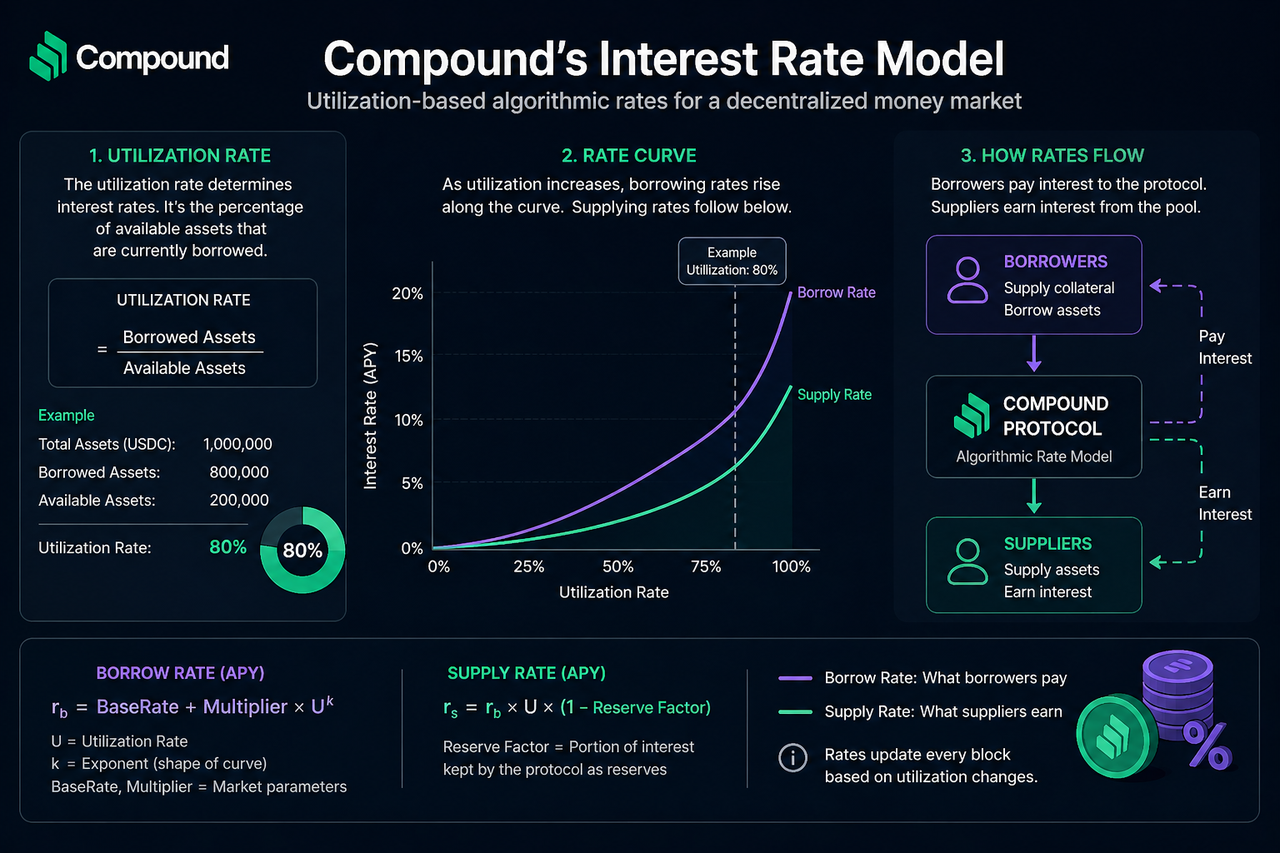
The core logic of this model is straightforward: when borrowing demand increases, the protocol raises borrowing rates to restrain demand while increasing deposit yields to attract more capital into the market; when borrowing demand declines, it lowers rates to encourage lending activity. Through this dynamic adjustment mechanism, Compound enables automatic capital pricing in a decentralized lending market.
What Is the Utilization Rate?
The Utilization Rate is the core parameter in Compound’s interest rate model. It shows the proportion of funds already borrowed from a specific asset pool. It is calculated as follows:
Utilization Rate = Total Borrowed Assets ÷ (Total Assets in the Pool - Reserves)
For example, if an asset pool contains 1,000 USDC in total and 800 USDC has been borrowed, the Utilization Rate is 80%.
The higher the Utilization Rate, the less available liquidity remains in the pool, so the borrowing rate rises. Conversely, when the Utilization Rate is low, the borrowing rate is lower. This indicator determines the direction of interest rate changes in Compound and serves as an important basis for the protocol’s dynamic market adjustment.
How Is the Borrowing Rate Calculated?
Compound’s borrowing rate is determined by a preset interest rate curve, while the Utilization Rate determines the rate range users fall into at any given time. In general, as utilization rises, the borrowing rate gradually increases as well.
This interest rate curve is designed to keep borrowing costs low when market liquidity is sufficient, while raising borrowing costs quickly when liquidity becomes tight. That helps reduce the risk of excessive borrowing. In this way, Compound can automatically raise the price of capital when market demand increases, helping protect liquidity in the pool.
How Is the Deposit Rate Calculated?
The deposit rate is not set independently. Instead, it is calculated based on the borrowing rate and the Utilization Rate. The basic logic is that part of the interest paid by borrowers is distributed to depositors, becoming the source of deposit yield.
In simplified terms:
Deposit Rate ≈ Borrowing Rate × Utilization Rate
This means that even if the borrowing rate is high, the deposit rate may not be very high when utilization is low. When borrowing demand is strong and utilization is high, however, the deposit rate rises noticeably. This mechanism keeps depositor returns linked to market borrowing demand.
Why Do Interest Rates Fluctuate with Market Changes?
Interest rate changes in Compound are fundamentally driven by market supply and demand. When borrowing demand increases, the amount of available capital in the pool decreases, utilization rises, and the protocol automatically raises borrowing rates to reduce borrowing demand and attract more deposits.
Conversely, when deposits increase or borrowing decreases, utilization falls, and the protocol lowers rates to stimulate lending activity. This automatic adjustment mechanism allows Compound to balance the market without manual intervention.
This is also one of the main differences between Compound’s interest rate model and traditional fixed-rate lending: the price of capital can change in real time according to market conditions, improving capital allocation efficiency.
Why Can Compound’s Interest Rate Model Improve Capital Efficiency?
In traditional lending markets, interest rate adjustments usually rely on manual decisions, which can be slow to respond. Compound’s algorithmic interest rate model, by contrast, can adjust borrowing and lending prices immediately based on the Utilization Rate, allowing the market to respond quickly to changes in capital supply and demand.
This mechanism improves capital efficiency because the price of capital remains aligned with market demand. When borrowing demand is high, higher rates help prevent liquidity shortages. When demand is low, lower rates help encourage lending activity. Through its dynamic rate mechanism, Compound has built an automated capital adjustment system for on-chain lending markets.
Conclusion
Compound’s interest rate model automatically calculates borrowing rates and deposit rates based on the Utilization Rate, making it a core part of the protocol’s lending mechanism. The higher the borrowing demand, the higher the Utilization Rate. Borrowing rates and deposit rates then rise accordingly, attracting more liquidity into the market.
This dynamic interest rate mechanism allows Compound to balance market supply and demand without manual intervention while improving capital allocation efficiency. As an important piece of decentralized lending market infrastructure, Compound’s algorithmic interest rate model provides an automated capital pricing model for DeFi lending protocols.
FAQs
Are Compound’s Borrowing and Lending Rates Fixed?
No. Compound’s borrowing and lending rates adjust dynamically according to changes in the Utilization Rate. They are not fixed rates.
What Is the Utilization Rate?
The Utilization Rate refers to the proportion of funds already borrowed from a liquidity pool relative to the total available funds. It is the core parameter in Compound’s interest rate model.
Why Does the Borrowing Rate Rise?
When borrowing demand increases and the Utilization Rate rises, the protocol automatically raises the borrowing rate to balance capital supply and demand.
What Is the Relationship Between Deposit Rates and Borrowing Rates?
Deposit rates come from the interest paid by borrowers, so they are usually determined jointly by the borrowing rate and the Utilization Rate.
What Does Compound’s Interest Rate Model Do?
It balances market supply and demand by dynamically adjusting borrowing and lending rates, improves capital efficiency, and helps protect liquidity in the pool.







