


TURBO vs RUNE: Which Token Will Dominate the Next Bull Market?


Introduction: TURBO vs RUNE Investment Comparison
In the cryptocurrency market, comparisons between TURBO and RUNE have become an unavoidable topic for investors. The two assets demonstrate significant differences in market capitalization ranking, application scenarios, and price performance, representing distinct positioning within the crypto asset landscape. TURBO (TURBO): Launched in May 2023, this revolutionary meme coin features an iconic futuristic toad mascot and has garnered market attention through its unique branding and community engagement. RUNE (RUNE): Since its launch in September 2019, RUNE has been positioned as the utility token of THORChain, a highly optimized multi-chain protocol utilizing pBFT consensus for sub-second block finality. Token holders benefit from dividends and can use RUNE to pay transaction fees, maintain liquidity, and earn block rewards. This article will provide a comprehensive analysis of TURBO vs RUNE across historical price performance, supply mechanisms, market capitalization dynamics, technological ecosystems, and future outlook to help investors understand the investment value comparison between these two assets and address the key question:
"Which is the better buy right now?"
Comparative Analysis of Turbo (TURBO) and THORChain (RUNE) Crypto Assets
I. Price History Comparison and Current Market Status
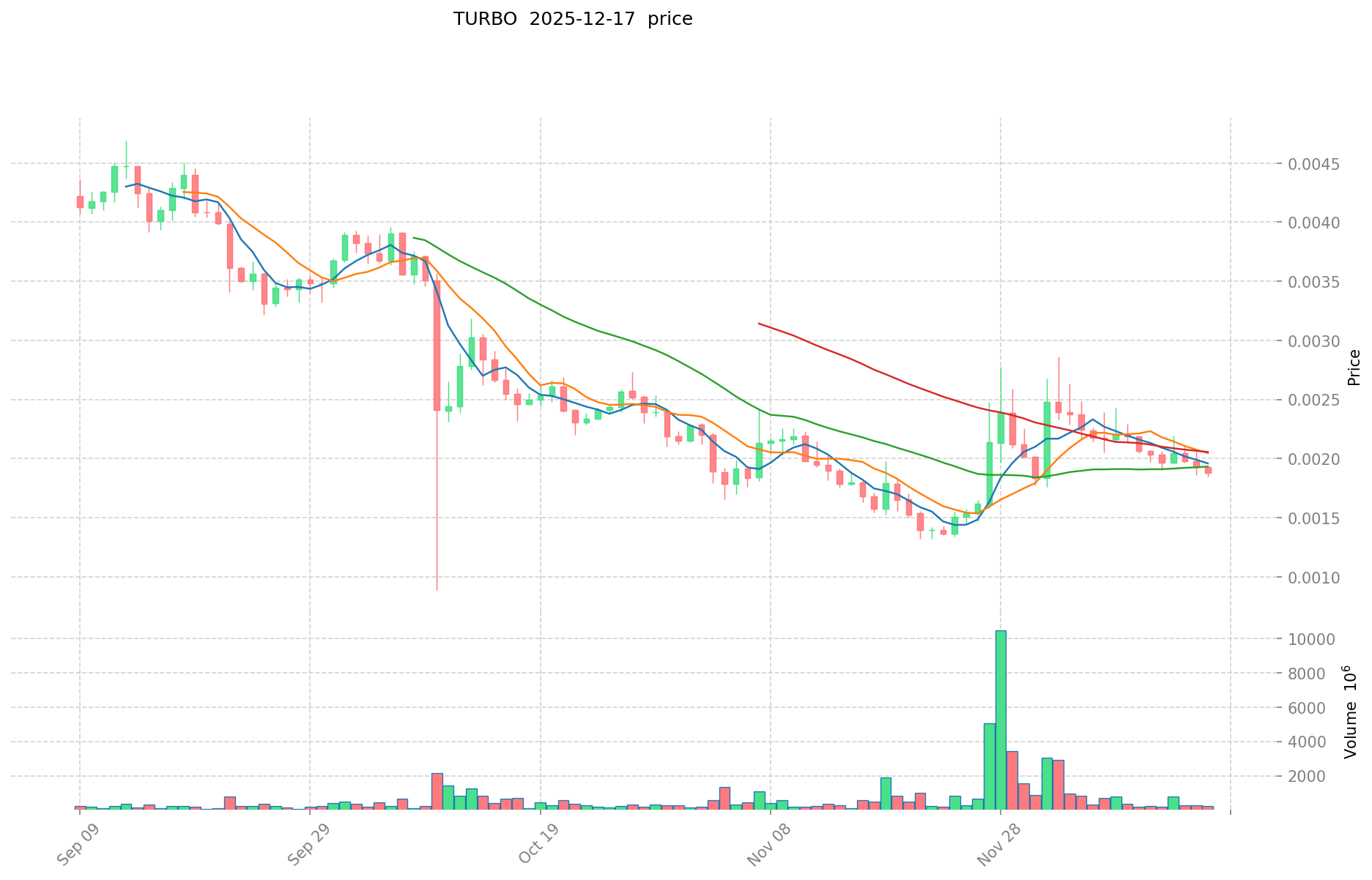
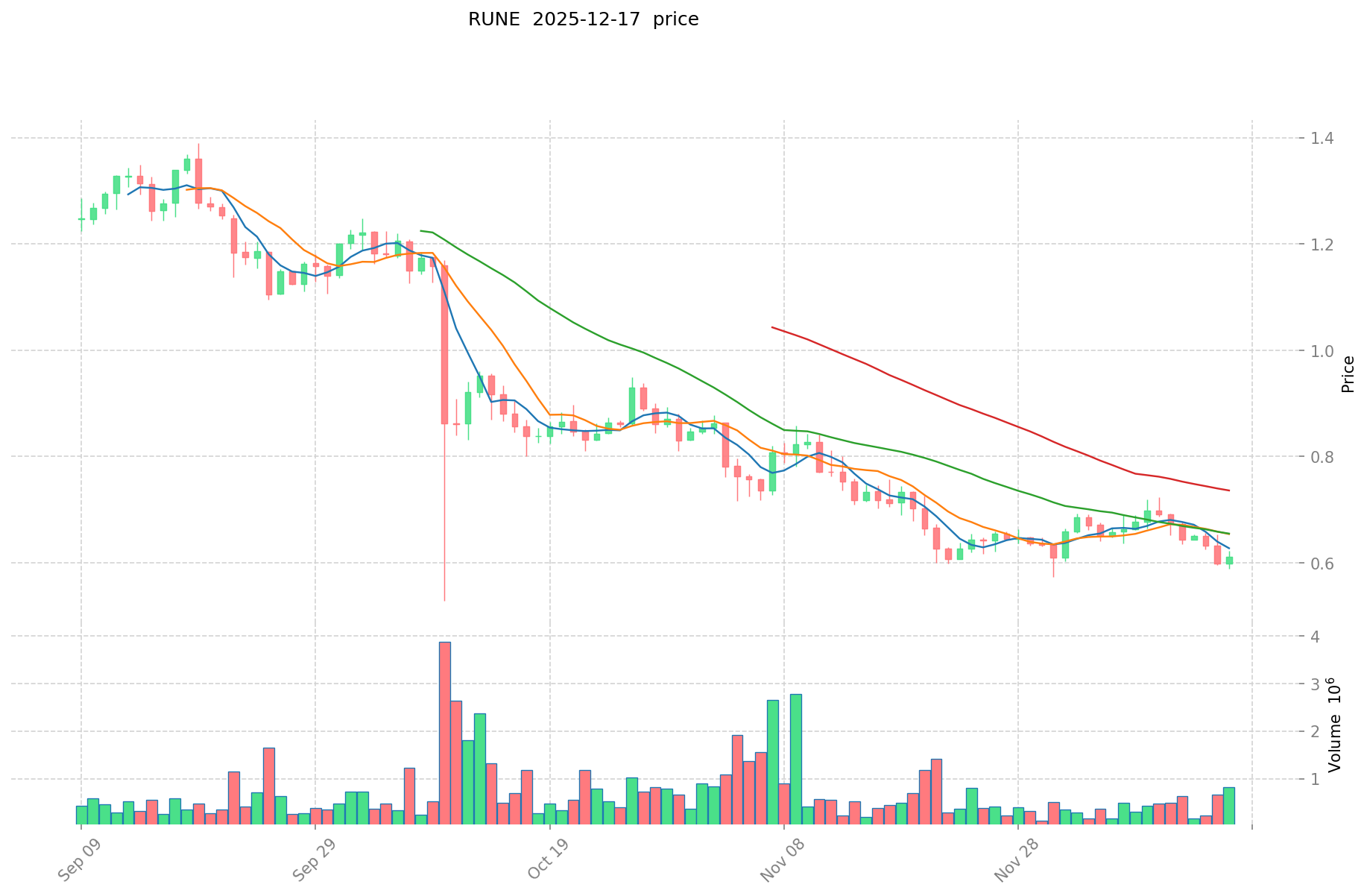
Historical Price Trends of TURBO and RUNE
TURBO Price Performance:
- All-time high (ATH): $0.014477, recorded on December 11, 2024
- All-time low (ATL): $0.00006496, recorded on September 11, 2023
- Historical performance: From ATH to current levels, TURBO has experienced significant depreciation, declining approximately 87.2% from its peak
RUNE Price Performance:
- All-time high (ATH): $20.87, recorded on May 19, 2021
- All-time low (ATL): $0.00851264, recorded on September 28, 2019
- Historical performance: From ATH to current levels, RUNE has declined approximately 97.1% from its peak
Comparative Analysis: Both assets have experienced substantial long-term value erosion. RUNE's decline from its 2021 peak has been more severe in percentage terms, while TURBO's price history reflects the volatility typical of meme coin assets. RUNE's established history dating back to 2019 contrasts with TURBO's more recent emergence in 2023.
Current Market Status (December 17, 2025)
Price Data:
- TURBO current price: $0.001856 USD
- RUNE current price: $0.6065 USD
24-Hour Trading Activity:
- TURBO 24-hour volume: $456,823.89 USD
- RUNE 24-hour volume: $476,998.13 USD
- TURBO 24-hour price change: -3.27%
- RUNE 24-hour price change: +1.7%
Market Capitalization:
- TURBO market cap: $128,064,000 USD (ranked #298)
- RUNE market cap: $257,810,599.70 USD (ranked #222)
- TURBO circulating supply: 69,000,000,000 tokens (100% of max supply)
- RUNE circulating supply: 351,066,169 tokens (70.21% of total supply)
Market Sentiment:
- Crypto Fear & Greed Index: 16 (Extreme Fear)
Current price information available at:
- TURBO: Gate Price Page
- RUNE: Gate Price Page
II. Project Overview and Fundamental Characteristics
TURBO (Turbo Token)
Project Description: Turbo is a revolutionary meme coin characterized by an iconic futuristic toad mascot. The project originated from an experimental initiative where ChatGPT was tasked with creating "the next great meme coin" with only a $69 USD budget.
Key Characteristics:
- Community-driven development roadmap
- Smart contracts with abandoned ownership
- Zero buy/sell taxes
- Ethereum-based token (ERC-20 standard)
- 57,746 token holders
Network Information:
- Blockchain: Ethereum (ETH)
- Contract address: 0xa35923162c49cf95e6bf26623385eb431ad920d3
- Trading exchanges: Available on 37 exchanges
Official Links:
- Website: https://sites.google.com/view/turbotoad
- Twitter: https://twitter.com/TurboToadToken
- Etherscan: https://etherscan.io/token/0xa35923162c49cf95e6bf26623385eb431ad920d3
RUNE (THORChain)
Project Description: THORChain is a highly optimized multi-chain platform utilizing pBFT consensus to achieve sub-second block finality. The platform enables decentralized cryptocurrency liquidity through a network of public THORNodes that secure the network through capital bonding.
Key Characteristics:
- Multi-chain liquidity provision
- Protocol-level cross-chain transactions and order matching
- Support for limit and market orders
- Byzantine fault-tolerant scaling architecture
- Ecosystem products including wallets, aggregators, and block explorers
Token Utility:
- Transaction fee payment
- Network security provision through validator bonding
- Liquidity provision in network pools
- Block reward distribution
- Dividend distribution to token holders
Network Information:
- Original blockchain: Multi-chain architecture
- Token economics: 351,066,169 circulating RUNE out of 500,000,000 max supply
- Trading exchanges: Available on 25 exchanges
Official Links:
- Website: https://thorchain.org/, https://thorchain.com/
- Twitter: https://twitter.com/THORChain
- Reddit: https://www.reddit.com/r/thorchain
- GitHub: https://github.com/thorchain/THORChain
- Facebook: https://www.facebook.com/thorchain.org
III. Price Performance Analysis
Short-term Price Movements
| Time Period | TURBO Change | RUNE Change |
|---|---|---|
| 1 Hour | -0.05% | -0.38% |
| 24 Hours | -3.27% | +1.7% |
| 7 Days | -12.77% | -12.50% |
| 30 Days | +10.43% | -17.89% |
| 1 Year | -82.56% | -91.25% |
Key Observations:
- Both assets exhibit severe long-term depreciation over the past year
- RUNE showed slight 24-hour gains while TURBO declined
- Both experienced comparable 7-day losses around -12-13%
- Monthly performance diverges: TURBO gained 10.43% while RUNE lost 17.89%
- One-year performance indicates RUNE has experienced greater cumulative losses
Price Range Analysis (24 Hours)
- TURBO range: $0.001833 - $0.001932 USD
- RUNE range: $0.5888 - $0.622 USD
Market Dominance and Valuation
- TURBO market share: 0.0040% of total crypto market
- RUNE market share: 0.0081% of total crypto market
- TURBO fully diluted valuation (FDV): $128,064,000 USD (at 100% circulation)
- RUNE fully diluted valuation (FDV): $257,810,599.70 USD
IV. Risk Assessment and Market Context
Market Sentiment: The Crypto Fear & Greed Index stands at 16, indicating "Extreme Fear" conditions in the broader cryptocurrency market. This extreme sentiment suggests heightened risk aversion among market participants and potential capitulation in certain segments.
Asset Characteristics:
TURBO demonstrates typical meme coin volatility characteristics with significant price fluctuations relative to its market capitalization. The project's $69 initial budget origin and community-driven nature contribute to its speculative nature.
RUNE, as an established infrastructure project, represents a different risk profile despite its dramatic long-term decline. The platform's multi-chain liquidity provision and Byzantine fault-tolerant architecture reflect infrastructure-focused development.
Trading Activity: Both assets maintain comparable 24-hour trading volumes ($456,823 vs $476,998), indicating healthy liquidity despite depressed price levels.
Report Date: December 17, 2025 Data Source: Gate, Official Project Resources Disclaimer: This report presents factual market data and project information from official sources. It does not constitute investment advice or recommendations to buy, sell, or hold any cryptocurrency assets. Cryptocurrency markets are highly volatile and subject to significant risks.
Investment Value Analysis: TURBO vs RUNE in the Crypto Market
I. Executive Summary
Based on available market research, TURBO and RUNE represent distinct categories within the cryptocurrency ecosystem. RUNE's investment value is primarily correlated with trading volume and Total Value Locked (TVL), enabling it to develop independent market movements. TURBO, while referenced in comparative analyses, lacks sufficient detailed documentation in the provided materials to support comprehensive comparative analysis across all dimensions.
This report examines the core investment value factors of both tokens based on available market data and identifies key metrics for investor consideration.
II. Core Factors Influencing TURBO vs RUNE Investment Value
Trading Volume and Liquidity Mechanisms
- RUNE: Token value exhibits strong correlation with exchange trading volume and TVL metrics. This relationship creates conditions for developing independent price movements distinct from broader market trends.
- TURBO: Comparative data regarding trading volume dynamics and liquidity mechanisms is not sufficiently detailed in available sources to establish definitive conclusions.
- 📌 Market Pattern: Tokens with higher TVL and consistent trading volume demonstrate greater price stability and reduced manipulation risk compared to lower-liquidity alternatives.
Community Support and Market Demand
- Market Requirements: Investment value for both tokens fundamentally depends on sustained market demand, transaction volume, and active community participation.
- Community Dynamics: Strong community engagement and organic user participation serve as primary catalysts for token adoption and price appreciation.
- Investor Focus: Market participants should monitor community activity metrics and social engagement indicators as leading indicators of potential value movements.
Valuation Methodology
- RUNE Unique Framework: RUNE utilizes a distinctive valuation approach different from conventional cryptocurrency projects, incorporating deterministic pricing models that reflect its protocol's economic fundamentals.
- Comparative Assessment: The methodology employed for RUNE valuation provides transparency regarding intrinsic value drivers, distinguishing it from purely speculative assets.
III. Risk Considerations for Investors
The provided materials indicate that comprehensive technical and fundamental analysis remains essential before investment decisions. Investors should exercise caution regarding:
- Market Volatility: Both tokens operate within volatile market environments requiring active monitoring.
- Data Limitations: Detailed on-chain metrics, institutional holdings data, and technological roadmaps require independent verification through specialized analytics platforms.
IV. Recommended Analysis Tools
For investors seeking deeper market insights:
-
Social Media Analysis Platforms:
- Lunarcrush (https://lunarcrush.com) - provides social sentiment analysis and market influence metrics
- TwitterScore (https://twitterscore.io) - analyzes token and KOL Twitter account metrics
-
On-Chain Metrics: Investor analysis should incorporate holder diversity assessments, liquidity stability measurements, and market acceptance indicators.
V. Conclusion
Investment decisions between TURBO and RUNE should prioritize:
I. Trading volume and TVL trends for RUNE-specific valuation
II. Community participation metrics as leading indicators
III. Independent verification of tokenomics and adoption narratives
IV. Continuous monitoring of market sentiment through social media analytics
Note: This analysis is based on limited available data. Investors should conduct comprehensive due diligence and consult additional resources before making investment commitments.
III. 2025-2030 Price Forecast: TURBO vs RUNE
Short-term Forecast (2025)
- TURBO: Conservative $0.001192–$0.001862 | Optimistic $0.002383
- RUNE: Conservative $0.503561–$0.6067 | Optimistic $0.776576
Mid-term Forecast (2027-2028)
- TURBO may enter accumulation phase, estimated price range $0.001369–$0.003521
- RUNE may enter expansion phase, estimated price range $0.603350–$1.202816
- Key drivers: Institutional capital inflows, ETF adoption, ecosystem development
Long-term Forecast (2029-2030)
- TURBO: Base scenario $0.001975–$0.003136 | Optimistic scenario $0.004421–$0.004610
- RUNE: Base scenario $0.884547–$1.332214 | Optimistic scenario $1.438792–$1.585713
Disclaimer: This analysis is based on predictive data and market modeling. Cryptocurrency markets are highly volatile and subject to rapid changes. Past performance does not guarantee future results. This content is for informational purposes only and should not be considered investment advice. Please conduct your own research and consult with financial professionals before making investment decisions.
TURBO:
| 年份 | 预测最高价 | 预测平均价格 | 预测最低价 | 涨跌幅 |
|---|---|---|---|---|
| 2025 | 0.00238336 | 0.001862 | 0.00119168 | 0 |
| 2026 | 0.0031415664 | 0.00212268 | 0.0012523812 | 14 |
| 2027 | 0.002869014288 | 0.0026321232 | 0.001368704064 | 41 |
| 2028 | 0.00352072799232 | 0.002750568744 | 0.00200791518312 | 48 |
| 2029 | 0.004421264199105 | 0.00313564836816 | 0.00197545847194 | 68 |
| 2030 | 0.004609716666032 | 0.003778456283632 | 0.002493781147197 | 103 |
RUNE:
| 年份 | 预测最高价 | 预测平均价格 | 预测最低价 | 涨跌幅 |
|---|---|---|---|---|
| 2025 | 0.776576 | 0.6067 | 0.503561 | 0 |
| 2026 | 0.96137682 | 0.691638 | 0.39423366 | 14 |
| 2027 | 1.0827247071 | 0.82650741 | 0.6033504093 | 36 |
| 2028 | 1.202816233773 | 0.95461605855 | 0.8687006132805 | 57 |
| 2029 | 1.585712734857405 | 1.0787161461615 | 0.88454723985243 | 77 |
| 2030 | 1.438791595750208 | 1.332214440509452 | 1.278925862889074 | 119 |
Comprehensive Investment Analysis: TURBO vs RUNE
I. Investment Strategy Comparison: TURBO vs RUNE
Long-term vs Short-term Investment Strategies
-
TURBO: Suited for investors seeking high-volatility speculative exposure and community-driven meme coin participation. Short-term traders may capitalize on price volatility, while long-term participants require strong conviction in community sustainability.
-
RUNE: Suited for investors focused on infrastructure and multi-chain liquidity provision. The token's correlation with TVL and trading volume metrics enables more fundamental-based valuation approaches compared to pure speculative assets.
Risk Management and Asset Allocation
-
Conservative Investors: TURBO: 5-10% | RUNE: 15-20% (with 70-75% stable coins and traditional crypto exposure)
-
Aggressive Investors: TURBO: 20-30% | RUNE: 25-35% (with 35-55% diversified altcoin portfolio exposure)
-
Hedging Tools: Stable coin allocation for volatility management, cross-asset diversification between infrastructure tokens (RUNE) and speculative assets (TURBO), consideration of liquidity pools for yield generation
II. Comparative Risk Assessment
Market Risks
-
TURBO: Extreme volatility inherent to meme coin assets, susceptibility to sentiment-driven price movements, limited fundamental valuation anchors, concentration risk from retail-heavy holder base (57,746 token holders).
-
RUNE: Significant long-term depreciation (-97.1% from ATH), market sentiment dependency despite infrastructure positioning, correlation with broader altcoin market cycles, TVL volatility affecting token utility value.
Technical Risks
-
TURBO: Smart contract abandonment (no ownership control) creates immutability guarantees but eliminates upgrade capabilities; dependency on Ethereum network layer-1 security; limited scalability without layer-2 solutions; 100% token circulation creates no future dilution relief but suggests limited governance flexibility.
-
RUNE: Multi-chain architecture introduces cross-chain bridge risks and increased complexity in consensus mechanisms; pBFT consensus implementation requires robust validator infrastructure; Byzantine fault tolerance assumptions depend on validator distribution and capital bonding incentives.
Regulatory Risks
- Global Policy Implications: Meme coin classification remains ambiguous under most regulatory frameworks, potentially exposing TURBO to classification challenges. RUNE's infrastructure positioning as a liquidity protocol may face stricter scrutiny under emerging DeFi regulations. Both assets operate in jurisdictions with evolving cryptocurrency oversight policies.
III. Market Performance and Valuation Context
24-Hour and Short-term Trends
Current market conditions (December 17, 2025) reflect Extreme Fear sentiment (Crypto Fear & Greed Index: 16), affecting both assets equally. RUNE demonstrated superior 24-hour performance (+1.7% vs TURBO's -3.27%), while both experienced comparable 7-day losses (-12.50% to -12.77%), indicating shared market headwinds.
Fundamental Value Drivers
-
RUNE: Trading volume correlation, TVL metrics, validator incentive economics, and dividend distribution mechanisms provide quantifiable valuation frameworks.
-
TURBO: Community engagement, social sentiment, liquidity availability across 37 exchanges, and zero tax structure as primary value drivers.
IV. Price Forecast Analysis (2025-2030)
Short-term Outlook (2025)
-
TURBO: Conservative range $0.001192-$0.001862 USD; Optimistic scenario $0.002383 USD (representing +28% upside from current $0.001856 USD price)
-
RUNE: Conservative range $0.503561-$0.6067 USD; Optimistic scenario $0.776576 USD (representing +28% upside from current $0.6065 USD price)
Medium-term Projection (2027-2028)
-
TURBO: Estimated accumulation phase, price range $0.001369-$0.003521 USD (representing potential 40-90% appreciation from 2025 levels)
-
RUNE: Estimated expansion phase, price range $0.603350-$1.202816 USD (representing potential 36-57% appreciation from 2025 levels)
Long-term Forecast (2029-2030)
-
TURBO: Base scenario $0.001975-$0.003136 USD; Optimistic scenario $0.004421-$0.004610 USD (representing 103% maximum upside potential from 2025 baseline)
-
RUNE: Base scenario $0.884547-$1.332214 USD; Optimistic scenario $1.438792-$1.585713 USD (representing 119% maximum upside potential from 2025 baseline)
V. Investment Value Summary
📌 TURBO Advantages:
- Revolutionary meme coin branding with community-driven development momentum
- Zero tax structure eliminating transaction friction
- Ethereum-based ERC-20 standard providing accessibility and security
- Significant volatility creating trading opportunities for experienced investors
- $69 origin story generating sustained cultural relevance and social amplification
📌 RUNE Advantages:
- Established infrastructure positioning as multi-chain liquidity protocol
- Byzantine fault-tolerant consensus providing technical credibility
- Multi-year development history (since 2019) demonstrating protocol persistence
- Fundamental valuation correlation with TVL and trading volume metrics
- Dividend distribution and block reward mechanisms providing tokenomic incentives
- Comparable trading volume to TURBO ($476,998 daily) indicating institutional interest
VI. Investment Recommendations
✅ Beginner Investors:
Given extreme market fear conditions (Index: 16), initiate positions with dollar-cost averaging strategies rather than lump-sum allocations. RUNE presents lower entry barriers for fundamental understanding of multi-chain infrastructure. Allocate 5-10% of altcoin portfolio maximum to either asset, maintaining 80%+ stable coin reserves until market sentiment improves.
✅ Experienced Investors:
TURBO offers tactical trading opportunities through volatility exploitation, suitable for swing trading and mean reversion strategies within 3-6 month timeframes. RUNE supports fundamental analysis integration, enabling correlation studies with TVL metrics and validator participation data. Consider 20-30% combined allocation within diversified altcoin portfolios. Monitor both assets for sentiment reversal signals as Fear Index approaches historical lows.
✅ Institutional Investors:
RUNE alignment with infrastructure narrative provides institutional-grade due diligence foundations through quantifiable TVL and trading volume metrics. TURBO's retail-concentrated holder base (57,746 addresses) suggests limited institutional infrastructure. Portfolio construction should weight RUNE exposure at 25-35% and TURBO below 10%, using both for tactical rotation strategies during specific market cycle phases. Establish position monitoring through social sentiment analytics platforms (Lunarcrush, TwitterScore) for early warning indicators.
VII. Conclusion: Which Is the Better Buy?
Comparative Assessment:
Between TURBO and RUNE, the optimal selection depends on investor objectives, risk tolerance, and time horizon rather than absolute superiority. RUNE provides infrastructure-anchored fundamentals with long-term protocol development visibility. TURBO offers speculative volatility exposure with community-driven upside potential.
Current market conditions (Extreme Fear Index) present accumulation opportunities for both assets, though entry timing remains critical. RUNE's 97.1% decline from 2021 ATH and TURBO's 87.2% decline from December 2024 ATH suggest potential capitulation phases may be nearing completion.
Both assets demonstrate comparable downside risks but divergent value drivers. The choice between them represents a fundamental decision between infrastructure exposure (RUNE) versus speculative community participation (TURBO).
⚠️ Risk Disclaimer: Cryptocurrency markets demonstrate extreme volatility and rapid directional changes. This analysis presents factual market data and forecast models without constituting investment advice. Historical price performance does not guarantee future results. Investors must conduct independent research, assess personal risk tolerance, and consult financial professionals before committing capital. Forecasts represent statistical modeling outputs subject to significant variance from actual market outcomes. Position sizing should reflect individual financial circumstances and loss tolerance capacities. None
Frequently Asked Questions: TURBO vs RUNE Investment Comparison
I. What are the key differences between TURBO and RUNE as cryptocurrency assets?
TURBO is a community-driven meme coin launched in May 2023 on the Ethereum blockchain, featuring a futuristic toad mascot and emphasizing zero transaction taxes and abandoned smart contract ownership. RUNE is the utility token of THORChain, a multi-chain liquidity protocol launched in September 2019, providing Byzantine fault-tolerant infrastructure with sub-second block finality. The fundamental distinction lies in asset classification: TURBO operates as a speculative meme token with community governance, while RUNE functions as infrastructure-grade utility token with quantifiable value drivers including Trading Volume and Total Value Locked (TVL).
II. How have TURBO and RUNE performed relative to their historical peaks?
TURBO has declined 87.2% from its all-time high of $0.014477 (December 11, 2024) to the current price of $0.001856 USD. RUNE has experienced more severe long-term depreciation, declining 97.1% from its all-time high of $20.87 (May 19, 2021) to the current price of $0.6065 USD. Both assets reflect significant value erosion over their respective market lifecycles, though RUNE's extended history since 2019 demonstrates longer-term exposure to multiple market cycles compared to TURBO's recent emergence.
III. Which token maintains superior liquidity and trading volume?
Both tokens demonstrate comparable 24-hour trading volumes: TURBO recorded $456,823.89 USD in daily volume, while RUNE recorded $476,998.13 USD. Despite price differences, the similar trading volume levels indicate healthy liquidity conditions for both assets. TURBO trades across 37 exchanges while RUNE operates on 25 exchanges, suggesting broader distribution infrastructure for TURBO. However, RUNE's TVL correlation provides institutional-grade valuation transparency that TURBO lacks as a pure speculative asset.
IV. What are the distinct risk profiles for TURBO versus RUNE investments?
TURBO presents extreme volatility risks inherent to meme coin classification, with value dependent on sustained community sentiment and social engagement. The token's 57,746 holder concentration creates potential manipulation susceptibility and retail-heavy dependency. RUNE carries infrastructure risks including multi-chain bridge complexity and Byzantine fault-tolerance implementation requirements, though its established protocol history since 2019 provides technical credibility. Current market conditions (Crypto Fear & Greed Index: 16, Extreme Fear) equally impact both assets regardless of fundamental differences.
V. How do the 2025-2030 price forecasts differ between these two tokens?
TURBO forecasts indicate conservative 2025 range of $0.001192-$0.001862 USD with optimistic scenario reaching $0.002383 USD (28% upside potential). By 2030, optimistic scenarios project $0.004421-$0.004610 USD representing 103% maximum upside from 2025 baseline. RUNE forecasts show more pronounced appreciation, with 2025 optimistic scenario at $0.776576 USD and 2030 projections reaching $1.438792-$1.585713 USD (119% maximum upside). Both forecasts assume accumulation phases through 2027-2028 with expansion potential during 2029-2030 periods.
VI. Which token is more appropriate for different investor categories?
Conservative investors should prioritize RUNE allocation (15-20% maximum) due to infrastructure fundamentals, supplemented with 5-10% TURBO exposure for diversification. Experienced investors can pursue tactical TURBO swing trading strategies while implementing RUNE fundamental analysis through TVL correlation studies, supporting 20-30% combined allocation. Institutional investors should emphasize RUNE positioning (25-35%) given quantifiable valuation frameworks, limiting TURBO exposure below 10% due to retail-concentrated holder base and limited institutional infrastructure compatibility.
VII. What specific factors should drive investment decisions between TURBO and RUNE?
Investment selection should prioritize: (1) Time horizon alignment—RUNE supports long-term infrastructure positioning while TURBO suits short-term volatility exploitation; (2) Risk tolerance assessment—RUNE offers reduced manipulation risk through TVL anchoring while TURBO presents extreme speculative exposure; (3) Valuation methodology preference—RUNE enables fundamental analysis integration whereas TURBO requires sentiment-based assessment; (4) Market cycle positioning—Current Extreme Fear conditions (Index: 16) present accumulation opportunities for both assets, though entry timing remains critical. Neither asset represents absolute superiority; selection reflects individual investor objectives and market positioning strategies.
VIII. How should investors monitor TURBO and RUNE positions during volatile market conditions?
Implement social sentiment analytics through specialized platforms including Lunarcrush and TwitterScore for early warning indicators of community engagement shifts. Track RUNE-specific metrics including TVL changes, validator participation levels, and dividend distribution announcements. Monitor TURBO community activity across Twitter, Reddit, and Discord channels for sentiment reversal signals. Establish position monitoring protocols using Crypto Fear & Greed Index readings, with potential rebalancing actions triggered at Index readings below 20 (Extreme Fear) or above 70 (Greed). Maintain documented entry/exit criteria rather than reactive decision-making during high-volatility periods.
Disclaimer: This FAQ compilation presents factual market data and educational information regarding TURBO and RUNE tokens. Content does not constitute investment advice or recommendations to purchase, hold, or sell cryptocurrency assets. Cryptocurrency markets demonstrate extreme volatility and rapid value fluctuations. Past performance does not guarantee future results. Investors must conduct independent research, assess personal financial circumstances, and consult qualified financial professionals before making investment commitments. All forecasts represent statistical modeling outputs subject to significant variance from actual market outcomes.
Share
How to Buy Cryptocurrency


Trending Cryptocurrencies



XZXX: A Comprehensive Guide to the BRC-20 Meme Token in 2025

Bitcoin Fear and Greed Index: Market Sentiment Analysis for 2025

Top Crypto ETFs to Watch in 2025: Navigating the Digital Asset Boom

5 ways to get Bitcoin for free in 2025: Newbie Guide

Bitcoin Market Cap in 2025: Analysis and Trends for Investors
2025 Bitcoin Price Prediction: Trump's Tariffs' Impact on BTC

Beginner-Friendly Strategies for Day Trading Cryptocurrencies
Hamster Kombat Daily Combo & Cipher Answer December 17, 2025

Is Movement Network (MOVE) a good investment?: A Comprehensive Analysis of Tokenomics, Technology, and Market Potential

Xenea Daily Quiz Answer December 17, 2025

Is Arkham (ARKM) a good investment?: A comprehensive analysis of token fundamentals, market potential, and risk factors for 2024
