Is Tezos (XTZ) a good investment?: A Comprehensive Analysis of Features, Performance, and Future Potential

Introduction: Tezos (XTZ) Investment Position and Market Outlook
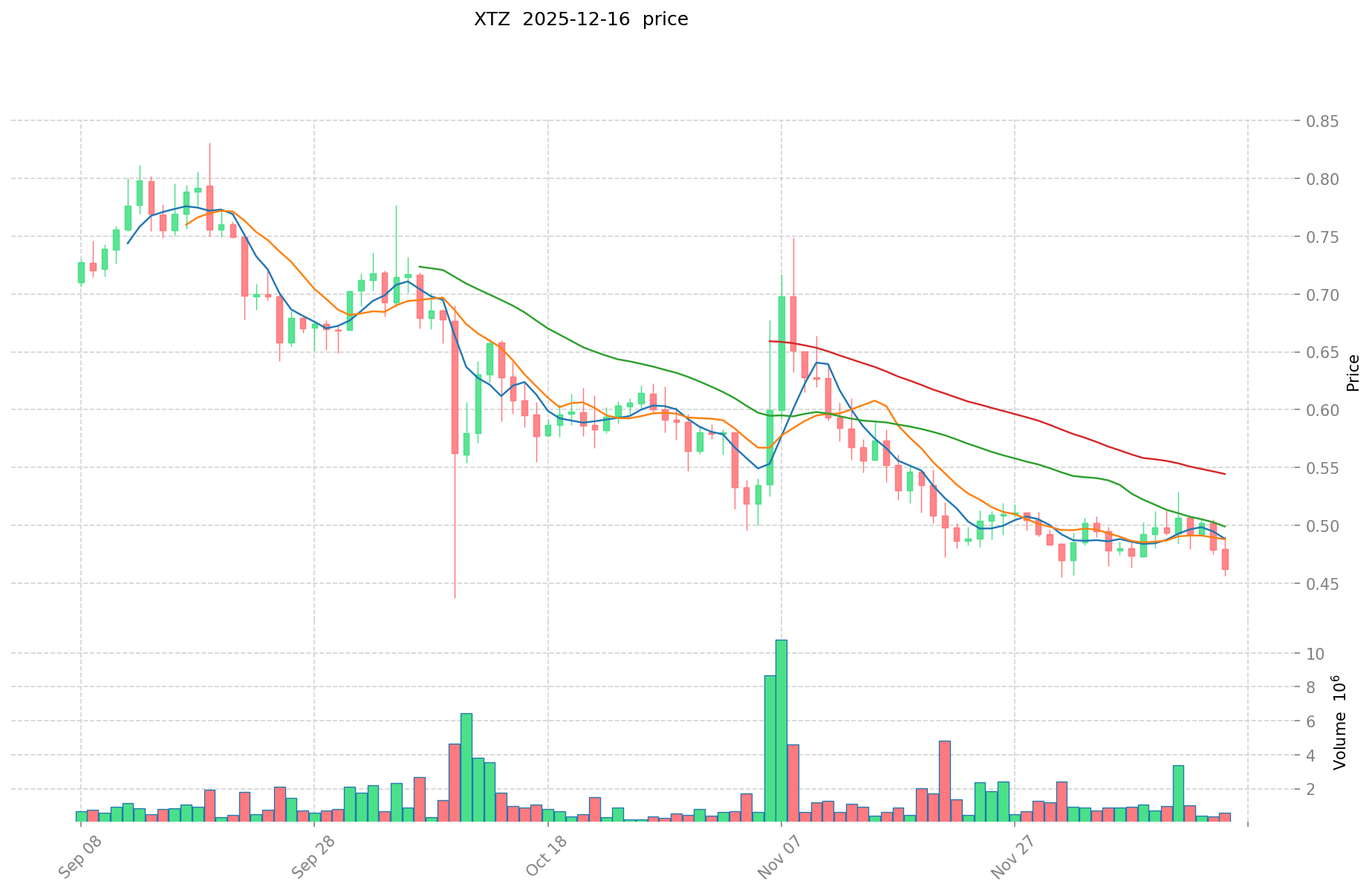
XTZ is an important asset in the cryptocurrency field. Since its launch in 2018, Tezos has established itself as a self-evolving decentralized blockchain platform. As of December 2025, Tezos maintains a market capitalization of approximately $494.6 million, with a circulating supply of around 1.069 billion XTZ tokens. The current price stands at $0.4542, reflecting significant volatility from its all-time high of $9.12 achieved in October 2021.
Tezos distinguishes itself through its innovative approach to formal verification and smart contract security. By establishing a real digital federation for self-governance, the platform simplifies formal verification while mathematically guaranteeing transaction code accuracy. This focus on security and self-amendment has positioned Tezos as a noteworthy contender in the blockchain ecosystem.
With 20,481 token holders and availability on 46 major exchanges, Tezos has cultivated a meaningful community presence. However, the token has experienced substantial price depreciation, declining approximately 69.83% over the past year, signaling the challenging market conditions affecting the broader cryptocurrency sector.
This article provides a comprehensive analysis of Tezos's investment value, historical price performance, future price forecasts, and associated investment risks. By examining the platform's technological foundations, market positioning, and current market dynamics, this analysis aims to offer investors a balanced perspective on XTZ's potential role within a diversified cryptocurrency portfolio.
Tezos (XTZ) Market Analysis Report
I. Tezos (XTZ) Price History Review and Current Investment Status
XTZ Historical Price Performance and Investment Returns
- 2021: Tezos reached its all-time high (ATH) of $9.12 USD on October 4, 2021 → Significant appreciation from initial price levels
- 2018-2021: Market expansion phase → Price grew from historical low of $0.350476 (December 7, 2018) to peak levels
- 2021-2025: Market correction cycle → Declined from ATH of $9.12 to current price of $0.4542 USD, representing approximately 95% decline from peak
Current Tezos Investment Market Status (December 16, 2025)
- XTZ Current Price: $0.4542 USD
- Market Sentiment: Neutral (Score: 1 on scale)
- 24-Hour Trading Volume: $290,522.08 USD
- Current Market Capitalization: $485,461,008.28 USD
- Market Rank: #124 globally
- Circulating Supply: 1,068,826,526 XTZ tokens (98.16% of total supply)
Current real-time XTZ market price available at: https://www.gate.com/price/tezos-xtz
II. Recent Price Performance Trends
| Time Period | Price Change | Change Amount |
|---|---|---|
| 1 Hour | -0.66% | -$0.003017636 |
| 24 Hours | -6.28% | -$0.030435083 |
| 7 Days | -6.95% | -$0.033924664 |
| 30 Days | -19.81% | -$0.112204789 |
| 1 Year | -69.83% | -$1.051269009 |
III. Tezos (XTZ) Ecosystem Overview
Project Foundation
Tezos is a decentralized blockchain that manages itself through establishing a genuine digital federation to simplify formal verification. This technology mathematically guarantees the accuracy of transaction code and enhances smart contract security. As a universal and self-evolving encrypted digital ledger, Tezos' primary advantage lies in its capacity to absorb beneficial aspects from any blockchain-based ledger architecture.
Technical Architecture
- Network Structure: Operations on conventional blockchains are implemented as simple functional modules
- Network Shell: Processes network layer tasks through a modular network shell interface
- Compatibility: Bitcoin, Ethereum, Cryptonote and similar protocols can be implemented and represented through Tezos' network layer interface
IV. Market Liquidity and Exchange Availability
- Trading Pairs Available: 46 exchanges
- Total Holders: 20,481 addresses
- Circulating Supply Ratio: 98.16% of total supply in circulation
- Fully Diluted Valuation: $494,572,255.36 USD
- Market Dominance: 0.015% of total cryptocurrency market
V. Community and Development Resources
- Official Website: https://www.tezos.com/
- Foundation Site: https://tezos.foundation/
- Block Explorers: https://tzkt.io/, https://explorer.etherlink.com
- GitHub Repository: https://github.com/tezos/tezos
- Whitepaper: https://tezos.com/whitepaper.pdf
- Community Forum: https://forum.tezosagora.org/
- Social Channels: https://twitter.com/tezos, https://www.reddit.com/r/tezos
- Wallet Interface: https://wallet.kukai.app/
VI. Key Market Observations
Price Volatility Assessment
XTZ has experienced significant volatility, declining approximately 95% from its 2021 peak. The current price represents a severe correction from previous highs, though the token maintains active market participation across 46 trading venues.
Circulating Supply Dynamics
With 98.16% of the total supply already in circulation, the token exhibits relatively low inflation pressure from the remaining locked supply. This represents a mature supply distribution phase.
Trading Activity
The 24-hour trading volume of $290,522 reflects moderate market liquidity, supporting active trading but indicating lower speculative interest compared to major cryptocurrency assets.
Report Date: December 16, 2025
Data Source: Gate Cryptocurrency Market Data
Disclaimer: This report presents factual market data only and does not constitute investment advice.
Tezos (XTZ) Investment Analysis Report
Report Date: December 16, 2025
I. Executive Summary
Tezos (XTZ) is a decentralized blockchain designed for self-evolution and formal verification of smart contracts. As of the report date, XTZ trades at $0.4542 with a market capitalization of approximately $485.46 million, ranking 124th by market cap. The asset has experienced significant downward pressure, declining 69.83% over the past year and 19.81% over the past month. This report examines key investment factors based on available data and recent technical developments.
II. Core Factors Influencing Whether Tezos (XTZ) Is a Good Investment
A. Supply Mechanism and Scarcity
Circulating Supply Dynamics:
- Circulating supply: 1,068,826,526.38 XTZ (98.16% of total supply)
- Total supply: 1,088,886,515.55 XTZ
- Maximum supply: Unlimited (∞)
Investment Implications: The unlimited maximum supply structure differs from fixed-supply models such as Bitcoin. This characteristic may impact long-term scarcity dynamics and price appreciation potential. The high circulation ratio (98.16%) indicates most tokens are already in active circulation, limiting future supply-side price support mechanisms.
B. Price Performance and Volatility
Recent Price Trends:
- Current price: $0.4542
- 24-hour change: -6.28% (-$0.0304)
- 7-day change: -6.95% (-$0.0339)
- 30-day change: -19.81% (-$0.1122)
- 1-year change: -69.83% (-$1.0513)
Historical Price Extremes:
- All-time high: $9.12 (October 4, 2021)
- All-time low: $0.350476 (December 7, 2018)
- Current distance from ATH: 95.03% below peak
Market Metrics:
- 24-hour trading volume: $290,522.08
- Market share: 0.015%
- Fully diluted valuation to market cap ratio: 98.16%
The substantial decline from historical highs combined with consistent downward momentum across all measured timeframes indicates significant bearish pressure.
C. Technology and Ecosystem Development
Recent Protocol Upgrades:
The 18th Tezos protocol upgrade introduced meaningful technical enhancements:
- Implementation of 1-day network cycles enabling more flexible staking mechanisms
- Allocation of 10% of participation rewards to the Data Availability Layer to support Layer 2 scalability solutions
- Strengthened network resilience through stricter baker inactivity thresholds
The 17th protocol upgrade delivered:
- Reduction in block time to 8 seconds and finality to 16 seconds
- Improved staking mechanisms
- Enhanced network economics through refinement of the Adaptive Issuance mechanism
Core Technical Advantages:
- Mathematical formal verification of transaction code accuracy
- Improved smart contract security through formal methods
- Self-evolving protocol design enabling adaptation without hard forks
- Network shell architecture supporting modular blockchain implementations
Ecosystem Composition:
- Active holders: 20,481
- Listed on 46 cryptocurrency exchanges
- Developed infrastructure including multiple blockchain explorers and wallet solutions
D. Network Utility and Use Case Development
Potential Growth Drivers:
- Interoperability with payment rails and ongoing CBDC (Central Bank Digital Currency) experiments may support demand if integrations mature
- Developer ecosystem expansion and strategic partnerships could strengthen network utility and defensibility
- Layer 2 scalability infrastructure development through the Data Availability Layer allocation
Adoption Challenges:
- Limited mainstream commercial adoption compared to established platforms
- Relatively low trading volume concentration across exchange ecosystem
- Modest market share (0.015%) indicates limited market dominance
E. Regulatory and Macroeconomic Environment
Policy Harmonization Potential:
- Consumer protection frameworks may broaden institutional and retail access
- Policy evolution could improve overall liquidity conditions
External Risk Factors:
- Cryptocurrency markets remain susceptible to sentiment shocks and liquidity vacuums
- Geopolitical uncertainty and evolving regulatory frameworks create volatility
- Macro interest rate environment affects risk asset valuations
III. Market Positioning
Comparative Context:
- Market ranking: 124th by market capitalization
- Dominance: 0.015% of total cryptocurrency market cap
- Price discovery liquidity: Moderate fragmentation across 46 exchanges
IV. Key Observations
I. Technical Foundation: Tezos possesses differentiated technical architecture emphasizing formal verification and protocol self-evolution, distinguishing it from many competing platforms.
II. Development Activity: Ongoing protocol upgrades and ecosystem refinements demonstrate sustained technical development, particularly in scalability and staking mechanisms.
III. Price Headwinds: Pronounced year-over-year decline and consistent monthly losses reflect significant valuation pressure requiring fundamental catalysts for reversal.
IV. Liquidity Constraints: Low trading volume relative to market cap and fragmented exchange listing may limit efficient price discovery.
V. Long-term Positioning: Platform emphasis on developer experience and smart contract safety addresses real market needs, though competitive dynamics remain intense.
V. Conclusion
Tezos represents a technically differentiated blockchain platform with ongoing development and protocol improvements. However, current valuation pressures, unlimited supply mechanics, and modest market adoption present material headwinds. Investment decisions should incorporate personal risk tolerance, time horizon, and diversification considerations. The platform's long-term viability depends on successful ecosystem expansion, developer adoption acceleration, and execution of strategic integrations including CBDC interoperability initiatives.
III. XTZ Future Investment Predictions and Price Outlook (Is Tezos(XTZ) worth investing in 2025-2030)
Short-term Investment Forecast (2025, short-term XTZ investment outlook)
- Conservative Forecast: $0.38 - $0.48
- Neutral Forecast: $0.48 - $0.66
- Optimistic Forecast: $0.66 - $0.75
Mid-term Investment Outlook (2026-2028, mid-term Tezos(XTZ) investment forecast)
-
Market Phase Expectations: Tezos is entering a consolidation and development phase, with ecosystem expansion through DeFi and NFT applications driving moderate growth amid broader cryptocurrency market cycles.
-
Investment Return Predictions:
- 2026: $0.43 - $0.72 (average: $0.56)
- 2027: $0.49 - $0.94 (average: $0.64)
- 2028: $0.59 - $1.17 (average: $0.79)
-
Key Catalysts: Liquid Proof-of-Stake (LPoS) consensus mechanism refinements, expanded smart contract applications, ecosystem developer growth, institutional adoption acceleration, and regulatory clarity improvements.
Long-term Investment Outlook (Is Tezos a good long-term investment?)
-
Base Case Scenario: $0.66 - $1.57 (2030) - Assumes steady ecosystem adoption, moderate market sentiment improvement, and gradual institutional participation within stable regulatory frameworks.
-
Optimistic Scenario: $1.00 - $2.00+ (2030) - Assumes significant DeFi and NFT ecosystem expansion, breakthrough partnerships with major enterprises, positive regulatory environment, and sustained cryptocurrency market growth.
-
Risk Scenario: $0.40 - $0.80 (2030) - Assumes prolonged market consolidation, slower-than-expected developer adoption, increased regulatory headwinds, or competitive pressure from alternative platforms.
For more on XTZ long-term investment and price forecasts, see: Price Prediction
2025-2030 Long-term Outlook
-
Base Case: $0.66 - $1.25 USD (corresponding to steady progress and mainstream application incremental expansion)
-
Optimistic Scenario: $1.26 - $1.57 USD (corresponding to widespread adoption and favorable market conditions)
-
Transformative Scenario: $2.00+ USD (contingent on breakthrough ecosystem developments and mainstream adoption acceleration)
-
December 31, 2030 Predicted Peak: $1.57 USD (based on optimistic development assumptions)
Disclaimer: This analysis is for informational purposes only and does not constitute investment advice. Cryptocurrency markets are highly volatile and subject to regulatory, technological, and macroeconomic risks. Past price performance does not guarantee future results. Investors should conduct independent research and consult financial professionals before making investment decisions.
| 年份 | 预测最高价 | 预测平均价格 | 预测最低价 | 涨跌幅 |
|---|---|---|---|---|
| 2025 | 0.664738 | 0.4553 | 0.377899 | 0 |
| 2026 | 0.71682432 | 0.560019 | 0.43121463 | 23 |
| 2027 | 0.9384798402 | 0.63842166 | 0.4915846782 | 40 |
| 2028 | 1.166907110148 | 0.7884507501 | 0.591338062575 | 73 |
| 2029 | 1.25142903055872 | 0.977678930124 | 0.9287949836178 | 115 |
| 2030 | 1.571521112281317 | 1.11455398034136 | 0.657586848401402 | 145 |
Tezos (XTZ) Research Report
I. Project Overview
Basic Information
Project Name: Tezos
Token Symbol: XTZ
Market Ranking: 124
Current Price: $0.4542 (as of December 16, 2025)
Market Capitalization: $485,461,008.28
Circulating Supply: 1,068,826,526.384195 XTZ
Total Supply: 1,088,886,515.551456 XTZ
Max Supply: Unlimited
24-hour Trading Volume: $290,522.08
Project Description
Tezos is a decentralized blockchain platform that manages itself by establishing a real digital federation to simplify formal verification. The technology mathematically ensures the accuracy of transaction code and enhances smart contract security. Tezos functions as a universal and self-evolving encrypted digital ledger with the distinctive capability to absorb best practices from various blockchain-based ledgers.
The platform implements conventional blockchain operations as simple functional modules, utilizing a network shell architecture to handle network layer tasks. This design enables Bitcoin, Ethereum, Cryptonote, and other blockchain protocols to be implemented through Tezos' network layer interface and represented within the ecosystem.
II. Market Performance Analysis
Price Performance
| Time Period | Price Change | Change Amount |
|---|---|---|
| 1 Hour | -0.66% | -$0.003018 |
| 24 Hours | -6.28% | -$0.030435 |
| 7 Days | -6.95% | -$0.033925 |
| 30 Days | -19.81% | -$0.112205 |
| 1 Year | -69.83% | -$1.051269 |
Historical Price Milestones
- All-Time High: $9.12 (October 4, 2021)
- All-Time Low: $0.350476 (December 7, 2018)
- 24-hour High: $0.4907
- 24-hour Low: $0.4536
Market Statistics
- Market Dominance: 0.015%
- Circulating Supply Ratio: 98.16%
- Active Holders: 20,481
- Exchange Listings: 46
III. Technical & Ecosystem Characteristics
Core Technological Features
-
Self-Evolving Architecture: Tezos enables protocol upgrades through on-chain governance, allowing the network to adapt without hard forks.
-
Formal Verification: The platform prioritizes mathematical verification of transaction code accuracy, reducing smart contract vulnerabilities.
-
Modular Design: Blockchain operations are implemented as functional modules, facilitating interoperability with other protocols.
-
Network Shell Structure: A layered architecture that separates network operations from consensus mechanisms.
Ecosystem Resources
- Official Website: https://www.tezos.com/
- Foundation: https://tezos.foundation/
- Block Explorer: https://tzkt.io/
- Community Forum: https://forum.tezosagora.org/
- GitHub Repository: https://github.com/tezos/tezos
- Wallet: https://wallet.kukai.app/
- Social Media: https://twitter.com/tezos, https://www.reddit.com/r/tezos
IV. Investment Strategy and Risk Management
Investment Methodology
Long-Term Holding (HODL XTZ): Suitable for conservative investors who believe in the platform's long-term governance innovation and technical differentiation. This strategy accommodates the significant price volatility observed over the past year.
Active Trading: Dependent on technical analysis and swing trading strategies. Given the 24-hour volume of approximately $290,522 and liquidity across 46 exchanges, intraday trading opportunities exist but require careful position management.
Risk Management
Asset Allocation Recommendations:
- Conservative Investors: 1-3% of cryptocurrency portfolio allocation
- Aggressive Investors: 3-7% of cryptocurrency portfolio allocation
- Professional Investors: Strategic allocation based on risk-adjusted returns and portfolio correlation analysis
Risk Mitigation Strategies:
- Multi-asset portfolio diversification across different blockchain platforms
- Hedging through stablecoins or inverse derivatives
- Dollar-cost averaging to reduce timing risk
Security Storage:
- Hot Wallets: Kukai (official Tezos wallet) for active trading
- Cold Storage: Hardware wallets for long-term holdings
- Best Practice: Maintain majority of holdings in non-custodial cold storage solutions
V. Investment Risks and Challenges
Market Risks
- High Volatility: XTZ has experienced a -69.83% decline over the past 12 months, demonstrating significant price instability.
- Liquidity Constraints: While listed on 46 exchanges, daily volume of ~$290,522 may limit large position entry/exit without market impact.
- Dependence on Market Sentiment: As a mid-cap cryptocurrency, XTZ is susceptible to broader market cycles and sentiment shifts.
Regulatory Risks
- Policy Uncertainty: Different jurisdictions apply varying regulatory frameworks to cryptocurrency tokens, potentially affecting adoption and trading access.
- Classification Ambiguity: Regulatory classification of XTZ could evolve, impacting its legal status in different regions.
Technical Risks
- Protocol Upgrade Execution: While on-chain governance is a differentiator, failed or contentious upgrades could fragment the network.
- Smart Contract Security: Enhanced formal verification does not eliminate all potential vulnerabilities in deployed applications.
- Competitive Pressure: The blockchain ecosystem remains highly competitive, with platforms like Ethereum, Cardano, and others actively developing comparable features.
VI. Conclusion: Is Tezos a Good Investment?
Investment Value Summary
Tezos presents a differentiated value proposition through its on-chain governance mechanism and formal verification approach. However, the token's performance over the past year (-69.83% YTD decline) reflects market challenges and competition within the smart contract platform category. The platform's technical innovation does not guarantee near-term price appreciation, and significant market volatility persists.
Investor Recommendations
✅ Beginners: Consider dollar-cost averaging with small position sizes (1-2% of cryptocurrency allocation). Prioritize storage in Kukai wallet or reputable hardware wallets. Start with research and community engagement before deploying capital.
✅ Experienced Investors: Swing trading strategies may capitalize on volatility cycles. Combine XTZ with complementary layer-1 and layer-2 protocol holdings for portfolio diversification. Monitor governance proposal participation and protocol updates.
✅ Institutional Investors: Strategic allocation as part of blockchain infrastructure diversification strategies. Evaluate Tezos' competitive positioning against Ethereum, Cardano, and Polkadot. Consider long-term governance participation and ecosystem partnership opportunities.
⚠️ Important Disclaimer: Cryptocurrency investments carry substantial risk, including potential total loss of capital. This report is provided for informational purposes only and does not constitute investment advice. Conduct independent research and consult financial advisors before making investment decisions. Past performance does not guarantee future results.
Tezos (XTZ) Frequently Asked Questions (FAQ)
I. What is Tezos (XTZ) and what are its main technological innovations?
Answer: Tezos is a decentralized blockchain platform that distinguishes itself through formal verification and self-evolving protocol design. The platform mathematically guarantees the accuracy of transaction code and enhances smart contract security. Unlike traditional blockchains requiring hard forks for upgrades, Tezos enables on-chain governance allowing the network to adapt without consensus fragmentation. Its modular architecture supports implementation of Bitcoin, Ethereum, and Cryptonote protocols through a unified network shell interface, creating a flexible multi-protocol ecosystem.
II. What is Tezos's current market position and price performance?
Answer: As of December 16, 2025, Tezos trades at $0.4542 with a market capitalization of $485.46 million, ranking 124th globally. The token has experienced significant downward pressure: declining 69.83% over the past year, 19.81% over the past month, and 6.28% over the past 24 hours. XTZ peaked at $9.12 in October 2021, representing a 95% decline from all-time highs. The circulating supply comprises 1.069 billion tokens (98.16% of total supply) across 46 major exchanges, with daily trading volume around $290,522.
III. What are the key supply mechanics and scarcity characteristics of XTZ?
Answer: Tezos has an unlimited maximum supply, distinguishing it from fixed-supply assets like Bitcoin. With 98.16% of total supply already circulating (1.069 billion of 1.089 billion tokens), the token exhibits low inflation pressure from remaining locked supply and represents a mature distribution phase. This unlimited supply structure may impact long-term scarcity dynamics and price appreciation potential compared to deflationary token models. However, the high circulation ratio indicates most tokens are already actively participating in the ecosystem.
IV. What are Tezos's main investment risks and challenges?
Answer: Significant investment risks include: (1) High volatility with 69.83% year-over-year decline, (2) Moderate liquidity with $290,522 daily volume potentially limiting large position execution, (3) Regulatory uncertainty across jurisdictions, (4) Competitive pressure from established platforms like Ethereum and Cardano, (5) Protocol execution risks from on-chain governance decisions, (6) Market sentiment dependence as a mid-cap cryptocurrency. Additionally, enhanced formal verification does not eliminate all smart contract vulnerabilities, and broader cryptocurrency market cycles substantially influence XTZ performance.
V. What are the price forecasts for Tezos through 2030?
Answer: Short-term (2025): Conservative $0.38-$0.48, Neutral $0.48-$0.66, Optimistic $0.66-$0.75. Mid-term forecasts project: 2026 average $0.56 ($0.43-$0.72), 2027 average $0.64 ($0.49-$0.94), 2028 average $0.79 ($0.59-$1.17). Long-term base case (2030): $0.66-$1.25; Optimistic scenario: $1.26-$1.57; Transformative scenario: $2.00+. These forecasts assume ecosystem adoption expansion, developer growth, and improved regulatory clarity. Key catalysts include DeFi/NFT ecosystem development, Liquid Proof-of-Stake refinements, and institutional adoption acceleration.
VI. What portfolio allocation recommendations exist for different investor types?
Answer: Conservative investors should allocate 1-3% of their cryptocurrency portfolio to XTZ; Aggressive investors 3-7%; Professional investors should base allocation on risk-adjusted returns and portfolio correlation analysis. Risk mitigation strategies include multi-asset diversification across blockchain platforms, dollar-cost averaging to reduce timing risk, and maintaining majority holdings in non-custodial cold storage. For security, use Kukai wallet for active trading and hardware wallets for long-term holdings. Beginners should start with small positions (1-2%), experienced investors may employ swing trading strategies, and institutional investors should evaluate XTZ's competitive positioning against Ethereum and Cardano.
VII. What recent protocol upgrades has Tezos implemented and how do they impact the platform?
Answer: The 18th protocol upgrade introduced 1-day network cycles enabling more flexible staking mechanisms, allocated 10% of participation rewards to the Data Availability Layer supporting Layer 2 scalability, and strengthened network resilience through stricter baker inactivity thresholds. The 17th upgrade reduced block time to 8 seconds and finality to 16 seconds, improved staking mechanisms, and refined the Adaptive Issuance mechanism enhancing network economics. These upgrades demonstrate sustained technical development addressing scalability, developer experience, and smart contract safety—critical market needs despite intense competitive dynamics.
VIII. Is Tezos a worthwhile investment for different investor profiles?
Answer: Tezos presents differentiated value through on-chain governance and formal verification technology, but requires careful consideration. Beginners should use dollar-cost averaging with small positions prioritizing hardware wallet storage. Experienced investors may capitalize on volatility through swing trading while combining XTZ with complementary layer-1/layer-2 holdings. Institutional investors should evaluate strategic allocation within blockchain infrastructure diversification, monitoring governance participation and competitive positioning against platforms like Ethereum and Cardano. The 69.83% year-over-year decline reflects substantial market challenges. Critical disclaimer: Cryptocurrency investments carry total capital loss risk. This analysis provides information only, not investment advice. Conduct independent research and consult financial professionals before investing.
Share
How to Buy Cryptocurrency


Trending Cryptocurrencies



XZXX: A Comprehensive Guide to the BRC-20 Meme Token in 2025

Bitcoin Fear and Greed Index: Market Sentiment Analysis for 2025

Top Crypto ETFs to Watch in 2025: Navigating the Digital Asset Boom
5 ways to get Bitcoin for free in 2025: Newbie Guide

Bitcoin Market Cap in 2025: Analysis and Trends for Investors
2025 Bitcoin Price Prediction: Trump's Tariffs' Impact on BTC

Complete Guide: How to Navigate Arbitrum Bridging for Web3 Enthusiasts

Is Ronin Network (RON) a good investment?: A Comprehensive Analysis of Performance, Risks, and Future Potential in the Gaming Blockchain Ecosystem

Is KUB Coin (KUB) a good investment?: A Comprehensive Analysis of Price Performance, Market Potential, and Risk Factors in 2024

Is Akash Network (AKT) a good investment?: A Comprehensive Analysis of the Decentralized Cloud Computing Platform's Potential and Risk Factors
Is MAG7.ssi (MAG7SSI) a good investment?: A Comprehensive Analysis of Performance, Risks, and Future Prospects