Is Frax (FRAX) a good investment?: A Comprehensive Analysis of the Fractional-Algorithmic Stablecoin and Its Market Potential
Introduction: Frax (FRAX) Investment Position and Market Prospects
FRAX is an important asset in the cryptocurrency domain, serving as the native gas token for Fraxtal, a modular Layer 2 rollup blockchain. Fraxtal utilizes the OP Stack as its smart contract platform and execution environment, offering deployment speeds, security, and costs comparable to leading Ethereum rollups such as Optimism and Base.
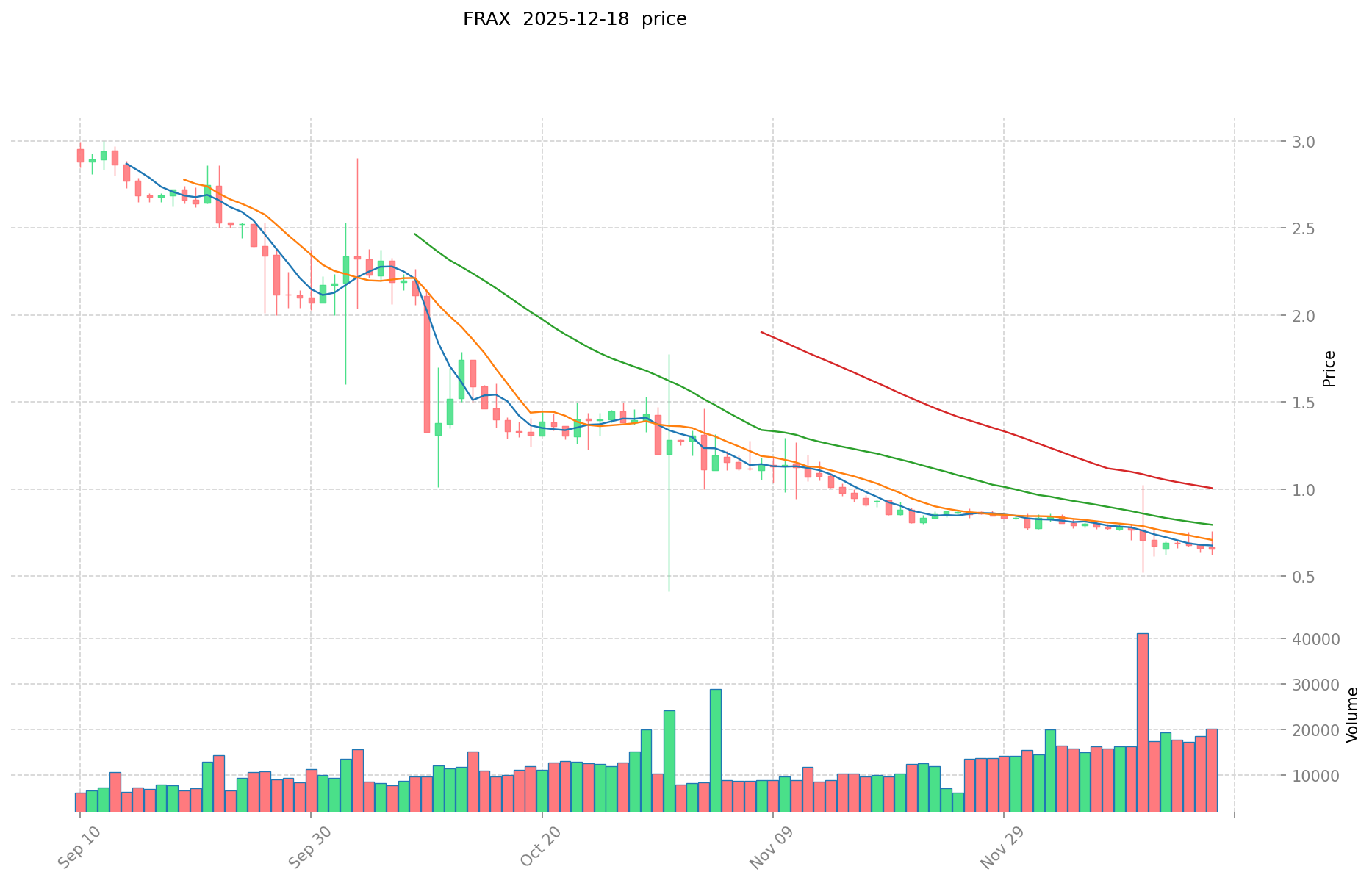
As of December 18, 2025, FRAX maintains a market capitalization of approximately $93.33 million with a fully diluted valuation consistent with current market cap, reflecting a circulating supply of approximately 90.89 million tokens out of a total supply of 141.91 million. The token is currently trading at $0.6577, representing a 24-hour decline of 2.71% and a notable year-to-date decline of 79.75% from its all-time high of $1.14 recorded in February 2021.
Fraxtal introduces innovative blockspace incentive mechanisms known as Flox, which reward users and developers for network participation. Users spending gas and developers deploying contracts earn FXTL points convertible into tokens, creating a unique economic model where participants can earn rewards exceeding their actual gas expenditure. This distinctive positioning has generated significant discussion among investors evaluating FRAX as a potential investment opportunity.
This article provides a comprehensive analysis of FRAX's investment merit, historical price performance, future price projections, and associated investment risks to support informed decision-making by market participants.
Frax (FRAX) Investment Analysis Report
I. Price History Review and Current Investment Status
Historical Price Performance of FRAX
Based on available data, FRAX has experienced significant volatility:
- All-Time High (ATH): $1.14 reached on February 7, 2021
- All-Time Low (ATL): $0.874536 reached on March 11, 2023
- 1-Year Performance: -79.75% decline
- 30-Day Performance: -30.56% decline
- 7-Day Performance: -15.89% decline
The asset has demonstrated substantial downward pressure over the extended period, with particularly steep declines observed in the past year.
Current Market Status (December 18, 2025)
- Current Price: $0.6577 USD
- 24-Hour Change: -2.71%
- 24-Hour Trading Volume: $13,288.39
- Market Capitalization: $59,779,829.54 (circulating supply basis)
- Fully Diluted Valuation (FDV): $93,333,666.37
- Market Capitalization to FDV Ratio: 64.05%
- Circulating Supply: 90,892,245 FRAX
- Total Supply: 141,909,178 FRAX
- Market Dominance: 0.0030%
- Holder Count: 3,249
24-Hour Price Range: $0.6249 - $0.7602
View real-time FRAX market prices on Gate
II. Project Overview and Technical Architecture
Core Network Specifications
Fraxtal is a modular Layer 2 (L2) rollup blockchain built on Ethereum with a "fractal scaling" roadmap. The network incorporates the following key features:
I. EVM Equivalence and Compatibility
Fraxtal is an EVM-equivalent rollup utilizing the OP Stack as its smart contract platform and execution environment. Application deployment speed, security, and costs are comparable to leading Ethereum rollups such as Optimism and Base.
II. Modular Architecture
Fraxtal functions as a modular rollup containing multiple components and middleware designed for use by other chains and networks. The network supports deployment of Layer 3 (L3) networks and enables building on top of existing infrastructure. Currently, Fraxtal implements a proprietary data availability module developed by the Frax Core Team.
III. Blockspace Incentive Mechanism (Flox)
Fraxtal introduces a novel incentive structure that rewards both users and developers:
- Users earn rewards for gas consumption and smart contract interactions on the network
- Developers earn rewards when their deployed contracts consume gas
- Both users and developers accumulate FXTL points each epoch, convertible to tokens
- Unique feature: Users may earn rewards exceeding their actual gas expenditure, and developers can generate revenue beyond their applications' gas consumption
IV. Native Gas Token
FRAX serves as the native gas token issued by Frax Finance.
III. Market Metrics and On-Chain Indicators
| Metric | Value |
|---|---|
| Market Rank | #456 |
| 1-Hour Change | -1.58% |
| Market Share | 0.0030% |
| Circulating Supply Percentage | 64.05% |
The asset maintains a relatively modest market position with low market dominance relative to the broader cryptocurrency ecosystem.
Data as of: December 18, 2025, 08:24:02 UTC
Frax (FRAX) Investment Analysis Report
Report Date: December 18, 2025
Data Update Time: 2025-12-18 08:24:02
I. Executive Summary
Frax (FRAX) is the native gas token of Fraxtal, a modular Layer 2 (L2) rollup blockchain built on the Ethereum ecosystem. As of the report date, FRAX is trading at $0.6577, representing a 24-hour decline of 2.71% and a one-year decline of 79.75%. The token maintains a market capitalization of approximately $59.78 million with a circulating supply of 90,892,245 tokens out of a total supply of 141,909,178 tokens.
II. Core Factors Influencing FRAX as an Investment
Supply Mechanism and Scarcity
The total supply of FRAX is capped at 141,909,178 tokens, with current circulation representing 64.05% of the maximum supply. This fixed supply cap creates a defined scarcity model. The circulating supply of 90,892,245 tokens indicates that approximately 51 million tokens remain in non-circulating status, which could impact price dynamics as these tokens enter circulation over time.
The supply mechanism directly influences price sustainability. With a maximum supply constraint in place, any increase in adoption and network activity could theoretically create upward pressure on token valuation, assuming demand increases alongside network usage.
Technological Innovation and Ecosystem Development
Fraxtal introduces several distinguishing technical features that support long-term value proposition:
EVM Equivalence and OP Stack Architecture: Fraxtal operates as an EVM-equivalent rollup utilizing the OP Stack, providing performance characteristics comparable to leading Ethereum rollups such as Optimism and Base. This technical parity enables developers to deploy applications with similar speed, security, and cost efficiency as other major L2 solutions.
Modular Rollup Design: Fraxtal's modular architecture allows other chains and networks to utilize its components and middleware, deploy Layer 3 (L3) networks, and build on its infrastructure. The network currently employs a proprietary data availability module developed by the Frax Core Team, distinguishing it from solutions relying on external DA providers.
Flox Blockspace Incentive Mechanism: Fraxtal implements a novel reward system called Flox, which incentivizes both users and developers through FXTL points. Users who spend gas on the network and developers who deploy contracts earning gas fees receive points convertible to tokens. Notably, this mechanism allows users to earn rewards exceeding their actual gas expenditure, and developers can receive returns surpassing their dApps' gas consumption.
Market Performance and Price History
Price Trajectory:
- All-Time High (ATH): $1.14 (February 7, 2021)
- All-Time Low (ATL): $0.874536 (March 11, 2023)
- Current Price: $0.6577
- 24-Hour Range: $0.6249 - $0.7602
Performance Metrics:
- 1-Hour Change: -1.58%
- 24-Hour Change: -2.71%
- 7-Day Change: -15.89%
- 30-Day Change: -30.56%
- 1-Year Change: -79.75%
The significant one-year decline indicates substantial downward price pressure over the extended period. Current trading levels are below both historical highs and recent support levels, suggesting a period of consolidation or potential weakness in investor sentiment.
Market Liquidity and Trading Activity
24-hour trading volume stands at approximately $13,288.39, indicating moderate liquidity conditions. The token is listed on one major exchange, which may present both concentration risk and potential liquidity constraints during periods of high volatility or significant trading demand.
The holder count of 3,249 addresses suggests a concentrated distribution pattern, which could amplify price volatility if large holders execute significant trades.
III. Network Fundamentals
Gas Token Utility: FRAX serves as the native gas token for Fraxtal, providing essential utility for transaction execution and smart contract interaction on the L2 network. This fundamental utility creates baseline demand tied to network activity levels.
Developer and User Adoption: The Flox incentive mechanism aims to bootstrap network adoption by rewarding participation. Initial success in attracting developers and users to deploy and interact with smart contracts will be critical for establishing network effects and sustainable demand for FRAX tokens.
IV. Risk Considerations
Price Volatility: Historical price performance demonstrates substantial volatility, with the token trading 42.36% below its all-time high and having declined 79.75% over the past year. This volatility reflects broader market sentiment challenges or ecosystem-specific concerns.
Supply Expansion Risk: Approximately 36% of the maximum token supply remains non-circulating. Future token releases could exert downward pressure on prices if market demand does not simultaneously increase.
Market Position: FRAX ranks 456th by market capitalization, positioning it outside the top tier of cryptocurrency assets. This ranking reflects limited mainstream adoption and smaller capital base compared to established L2 solutions.
Liquidity Concentration: Limited exchange listings and concentrated holder distribution may constrain liquidity during periods of increased trading demand.
V. Key Information Resources
- Official Website: https://frax.com/
- Block Explorer: https://fraxscan.com
- Social Media: https://x.com/fraxfinance
VI. Conclusion
Frax (FRAX) functions as the native gas token for Fraxtal, a modular L2 rollup with innovative technical features including the Flox blockspace incentive mechanism. The protocol's architecture and utility mechanisms provide a foundation for long-term value creation contingent on successful developer and user adoption.
However, the token faces significant headwinds reflected in substantial year-to-date losses and a market position outside the top tier of cryptocurrency assets. Investment decisions should be evaluated in the context of individual risk tolerance, investment horizon, and the broader competitive landscape of L2 solutions.
III. FRAX Future Investment Forecast and Price Outlook (Is Frax(FRAX) worth investing in 2025-2030)
Short-term Investment Forecast (2025, short-term FRAX investment outlook)
- Conservative Forecast: $0.40 - $0.58
- Neutral Forecast: $0.58 - $0.75
- Optimistic Forecast: $0.75 - $0.83
Mid-term Investment Outlook (2026-2028, mid-term Frax(FRAX) investment forecast)
-
Market Stage Expectation: Fraxtal L2 ecosystem maturation phase with potential for increased developer adoption and user engagement through the Flox incentive mechanism.
-
Investment Return Forecast:
- 2026: $0.38 - $1.08
- 2027: $0.79 - $1.36
- 2028: $0.74 - $1.51
-
Key Catalysts: Fraxtal L2 network expansion, Flox blockspace incentive program adoption, ecosystem developer growth, FRAX stablecoin utility enhancement
Long-term Investment Outlook (Is Frax a good long-term investment?)
- Base Case Scenario: $1.46 - $2.08 (2030) under conditions of steady ecosystem growth and mainstream Rollup adoption comparable to Optimism and Base
- Optimistic Scenario: $1.71 - $2.08+ (2029-2030) contingent upon rapid Fraxtal adoption, successful L3 deployment, and increased institutional interest in modular L2 solutions
- Risk Scenario: $0.74 - $1.02 (potential downside under adverse market conditions or reduced adoption)
Click to view FRAX long-term investment and price forecast: Price Prediction
2025-12-18 to 2030 Long-term Outlook
- Base Case Scenario: $1.46 - $1.72 USD (corresponding to steady ecosystem development and incremental mainstream adoption)
- Optimistic Scenario: $1.71 - $2.08 USD (corresponding to large-scale Fraxtal adoption and favorable market environment)
- Transformative Scenario: $2.08+ USD (contingent upon breakthrough ecosystem progress and mainstream L2 proliferation)
- 2030-12-31 Predicted Peak: $2.08 USD (based on optimistic development assumptions)
Disclaimer: This analysis is based on historical data and market forecasts. Past performance does not guarantee future results. Cryptocurrency investments carry significant risk. Investors should conduct independent research and consult with qualified financial advisors before making investment decisions.
| 年份 | 预测最高价 | 预测平均价格 | 预测最低价 | 涨跌幅 |
|---|---|---|---|---|
| 2025 | 0.833082 | 0.6458 | 0.400396 | -1 |
| 2026 | 1.07958386 | 0.739441 | 0.38450932 | 12 |
| 2027 | 1.3551735207 | 0.90951243 | 0.7912758141 | 38 |
| 2028 | 1.5060161572155 | 1.13234297535 | 0.7360229339775 | 72 |
| 2029 | 1.714933436167575 | 1.31917956628275 | 1.015768266037717 | 100 |
| 2030 | 2.078367406678472 | 1.517056501225162 | 1.456374241176156 | 130 |
Frax (FRAX) Investment Analysis Report
I. Executive Summary
Frax (FRAX) is the native gas token of Fraxtal, a modular Layer 2 (L2) rollup blockchain built on the Ethereum ecosystem. As of December 18, 2025, FRAX trades at $0.6577 with a 24-hour decline of -2.71%. The token maintains a market capitalization of approximately $59.78 million with a fully diluted valuation of $93.33 million, representing 0.0030% of the total cryptocurrency market.
II. Project Overview: Fraxtal Ecosystem
A. Technical Architecture
Fraxtal is a modular rollup blockchain with the following core technical features:
1. EVM Equivalence & OP Stack Integration
- Fraxtal utilizes the OP Stack as its smart contract platform and execution environment
- Provides deployment speed, security, and cost efficiency comparable to leading Ethereum rollups (Optimism, Base)
- Maintains full EVM compatibility for seamless application migration
2. Modular Design
- Functions as a modular rollup supporting multiple components and middleware
- Enables other chains and networks to integrate, connect, and deploy Layer 3 (L3) solutions
- Implements a proprietary data availability module developed by the Frax Core Team
3. Blockspace Incentive Mechanism (Flox)
- Introduces a novel incentive system rewarding both users and developers
- Users earn FXTL points by spending gas and interacting with smart contracts
- Developers earn FXTL points when their deployed contracts consume gas
- FXTL points are convertible to tokens in future periods
- Users can earn rewards exceeding actual gas expenditure, while developers can generate returns surpassing their dApps' gas consumption
4. Native Gas Token
- FRAX serves as the network's native gas token
- Issued and governed by Frax Finance
B. "Fractal Scaling" Roadmap
Fraxtal implements a fractal scaling strategy enabling recursive L3 deployment and unlimited horizontal scalability within its modular framework.
III. Market Performance & Tokenomics Analysis
A. Price Performance Metrics
| Metric | Value |
|---|---|
| Current Price | $0.6577 |
| 24-Hour Change | -2.71% |
| 7-Day Change | -15.89% |
| 30-Day Change | -30.56% |
| Year-to-Date Change | -79.75% |
| 24-Hour High/Low | $0.7602 / $0.6249 |
| All-Time High | $1.14 (February 7, 2021) |
| All-Time Low | $0.8745 (March 11, 2023) |
B. Tokenomic Distribution
| Parameter | Value |
|---|---|
| Circulating Supply | 90,892,245 FRAX |
| Total Supply | 141,909,178 FRAX |
| Max Supply | 141,909,178 FRAX |
| Circulation Ratio | 64.05% |
| Market Cap (Circulating) | $59,779,829.54 |
| Fully Diluted Valuation | $93,333,666.37 |
| 24-Hour Volume | $13,288.39 |
| Market Dominance | 0.0030% |
C. Token Holder Distribution
- Active Token Holders: 3,249
- Primary Exchange: Gate (1 exchange recorded)
D. Market Sentiment
The token exhibits bearish sentiment with sustained negative performance across multiple timeframes. The year-to-date decline of -79.75% indicates significant depreciation since token inception.
IV. Investment Strategy & Risk Management
Investment Methodology
Long-Term Holding (HODL FRAX): Suitable for investors focused on Fraxtal's ecosystem expansion and the Flox incentive mechanism maturation. Long-term holders benefit from potential network growth as L3 deployment increases and developer adoption expands.
Active Trading: Dependent on technical analysis of resistance/support levels ($0.75, $0.62) and volatility-driven swing trading opportunities. The 24-hour volume of $13,288 indicates limited liquidity for large position execution.
Risk Management Framework
Asset Allocation Recommendations
- Conservative Investors: 0-2% portfolio allocation to FRAX given market cap and volatility profile
- Aggressive Investors: 2-5% allocation with active position scaling
- Professional Investors: Strategic allocation based on Fraxtal ecosystem development milestones and developer adoption metrics
Risk Hedging Strategies
- Multi-asset Portfolio Diversification: Balance FRAX exposure with established L2 tokens (OP, ARB) and blue-chip cryptocurrencies
- Avoid Concentration Risk: Do not exceed recommended portfolio allocation percentages
- Use Stablecoins: Maintain USDC/USDT reserves during high volatility periods
Secure Storage Solutions
- Cold Wallets: Hardware wallets (Ledger, Trezor) recommended for medium to long-term holdings
- Hot Wallets: Web3 wallets (MetaMask) for active interaction with Fraxtal dApps
- Custody Solutions: Institutional investors consider regulated custody providers
V. Investment Risks & Challenges
Market Risk
- High Volatility: FRAX exhibits extreme price fluctuation (-79.75% annually), characteristic of emerging L2 tokens
- Low Liquidity: Daily volume of $13,288 creates slippage risk for institutional position building
- Market Concentration: Limited exchange listings (currently 1 recorded) constrains price discovery and trading accessibility
Regulatory Risk
- Jurisdiction Uncertainty: L2 blockchain regulatory frameworks remain under development across major jurisdictions
- Stablecoin Classification: Potential regulatory designation changes affecting FRAX's role in the ecosystem
- Protocol Governance: Changes in Frax Finance governance may impact FRAX tokenomics and utility
Technology Risk
- Smart Contract Vulnerabilities: OP Stack-based architecture inherits execution layer risks; audits critical for security validation
- Upgrade Implementation: Network upgrades and L3 deployment failures could impact ecosystem stability
- Data Availability Dependency: Proprietary data availability module represents centralized failure point requiring continuous monitoring
Adoption Risk
- Developer Adoption Uncertainty: Fraxtal's success depends on developer migration from established L2s (Optimism, Arbitrum)
- Flox Incentive Sustainability: Long-term viability of the blockspace incentive mechanism depends on protocol treasury sustainability
- Competition: Intense competition from established L2 platforms with superior liquidity and developer networks
VI. Conclusion: Is FRAX a Good Investment?
Investment Value Summary
Fraxtal presents a differentiated L2 value proposition through its modular architecture and novel Flox incentive mechanism. The project addresses legitimate scaling challenges and offers potential upside for early adopters. However, FRAX exhibits significant short-term price volatility and limited market liquidity, with sustained negative price trends (-79.75% year-to-date) indicating market skepticism regarding near-term adoption dynamics.
The token's viability hinges on demonstrable developer adoption, sustainable L3 deployment growth, and Flox mechanism effectiveness in driving network activity. The current market sentiment reflects uncertainty regarding these factors.
Investor Recommendations
✅ New Investors: Dollar-cost averaging (DCA) strategy with 3-6 month accumulation periods; prioritize security through hardware wallet storage; maintain position sizing below 2% of total portfolio.
✅ Experienced Traders: Implement swing trading strategies around identified support ($0.62) and resistance ($0.75) levels; scale positions based on ecosystem development announcements; utilize technical analysis for entry/exit optimization.
✅ Institutional Investors: Strategic long-term allocation conditioned on reaching specific milestones: L3 deployment >10 active chains, monthly active developer count >100, 24-hour volume >$1M. Utilize regulated custody and execute through regulated trading venues.
⚠️ Disclaimer
Cryptocurrency investments carry substantial risk including potential total capital loss. This analysis is provided for informational purposes only and does not constitute investment advice, financial advice, or recommendations to buy or sell FRAX or any cryptocurrency. Conduct independent research and consult licensed financial advisors before making investment decisions. Past performance does not guarantee future results. Regulatory environment changes may materially impact token valuation and utility.
Report Generated: December 18, 2025
Data Source: GateData
Last Updated: 08:24:02 UTC
Frequently Asked Questions (FAQ) - Frax (FRAX) Investment Guide
I. What is Frax (FRAX) and what is its primary utility?
Frax (FRAX) is the native gas token of Fraxtal, a modular Layer 2 (L2) rollup blockchain built on the Ethereum ecosystem. FRAX serves as the network's primary utility token, used for transaction execution, smart contract interactions, and gas fee payment on the Fraxtal network. Additionally, FRAX holders can earn rewards through the Flox blockspace incentive mechanism by participating in network activities or deploying smart contracts.
II. What makes Fraxtal's Flox incentive mechanism unique compared to other L2 solutions?
Fraxtal's Flox mechanism differentiates itself by rewarding both users and developers with FXTL points convertible to tokens, with a distinctive feature: users can earn rewards exceeding their actual gas expenditure, and developers can generate returns surpassing their dApps' gas consumption. This creates a novel economic model incentivizing network participation beyond traditional transaction fees. Most competing L2 platforms (Optimism, Arbitrum) utilize standard fee-based models without comparable reward structures for early-stage adoption.
III. What is the current price of FRAX and what has been its historical performance?
As of December 18, 2025, FRAX trades at $0.6577 with a 24-hour decline of -2.71%. The token's historical performance shows: All-Time High of $1.14 (February 7, 2021), All-Time Low of $0.8745 (March 11, 2023), and a year-to-date decline of -79.75%. The 24-hour trading volume stands at approximately $13,288.39, indicating moderate liquidity conditions. The token maintains a market capitalization of $59.78 million with a ranking of 456th among all cryptocurrencies.
IV. What are the tokenomic characteristics and supply mechanics of FRAX?
FRAX has a fixed maximum supply of 141,909,178 tokens with a current circulating supply of 90,892,245 tokens (64.05% circulation ratio). This means approximately 51 million tokens remain non-circulating and could enter circulation over time, potentially creating downward price pressure. The fixed supply cap creates a defined scarcity model where increased network adoption could theoretically generate upward price pressure, assuming demand increases alongside network usage and activity.
V. What are the primary investment risks associated with FRAX?
Key investment risks include: (1) High Volatility - the token has declined 79.75% year-to-date; (2) Low Liquidity - limited exchange listings and modest daily volume ($13,288) create slippage risks; (3) Adoption Uncertainty - success depends on developer migration from established L2 platforms; (4) Supply Expansion Risk - 36% of maximum supply remains non-circulating; (5) Regulatory Risk - evolving L2 blockchain regulatory frameworks; (6) Technology Risk - potential smart contract vulnerabilities or upgrade failures; (7) Flox Sustainability Risk - the incentive mechanism's long-term viability depends on protocol treasury adequacy.
VI. What price targets and investment forecasts are provided for FRAX through 2030?
According to the investment analysis, FRAX price forecasts include: Short-term (2025): $0.40-$0.83; Mid-term 2026: $0.38-$1.08; 2027: $0.79-$1.36; 2028: $0.74-$1.51; Long-term 2030: Base Case $1.46-$1.72, Optimistic Case $1.71-$2.08, Transformative Case $2.08+. These forecasts are contingent upon successful ecosystem development, increased developer adoption, and mainstream L2 proliferation. Past performance does not guarantee future results.
VII. What investment strategies are recommended for different investor types?
Conservative Investors should maintain 0-2% portfolio allocation with dollar-cost averaging strategies and hardware wallet storage; Experienced Traders can employ swing trading around support ($0.62) and resistance ($0.75) levels with technical analysis optimization; Institutional Investors should utilize strategic long-term allocation conditioned on ecosystem milestones: L3 deployment >10 active chains, monthly active developers >100, and 24-hour volume >$1M. All investor types should prioritize portfolio diversification and avoid concentration risk.
VIII. Where can investors access reliable information about FRAX and Fraxtal?
Official project resources include the main website at https://frax.com/, the Fraxtal block explorer at https://fraxscan.com, and official social media presence on X (formerly Twitter) at https://x.com/fraxfinance. Real-time market pricing and trading data are available through major exchanges such as Gate. Investors should consult multiple authoritative sources and conduct independent research before making investment decisions. Licensed financial advisors should be consulted for personalized investment guidance.
⚠️ Disclaimer: This FAQ provides informational content only and does not constitute investment advice, financial recommendations, or guidance to buy or sell FRAX. Cryptocurrency investments carry substantial risk including potential total capital loss. Conduct independent research and consult qualified financial professionals before making investment decisions.
Share
How to Buy Cryptocurrency


Trending Cryptocurrencies



XZXX: A Comprehensive Guide to the BRC-20 Meme Token in 2025

Bitcoin Fear and Greed Index: Market Sentiment Analysis for 2025
Top Crypto ETFs to Watch in 2025: Navigating the Digital Asset Boom

5 ways to get Bitcoin for free in 2025: Newbie Guide

Bitcoin Market Cap in 2025: Analysis and Trends for Investors

2025 Bitcoin Price Prediction: Trump's Tariffs' Impact on BTC
What is ORBS: A Comprehensive Guide to Decentralized Blockchain Infrastructure and Its Real-World Applications
What is NEIRO: A Comprehensive Guide to Understanding This Revolutionary Cryptocurrency and Its Impact on the Digital Economy

Understanding Cosmos: The Key to Blockchain Interoperability

Notcoin Price Prediction: Future Prospects and Investment Potential

Understanding Node Transactions in Blockchain: A Comprehensive Guide